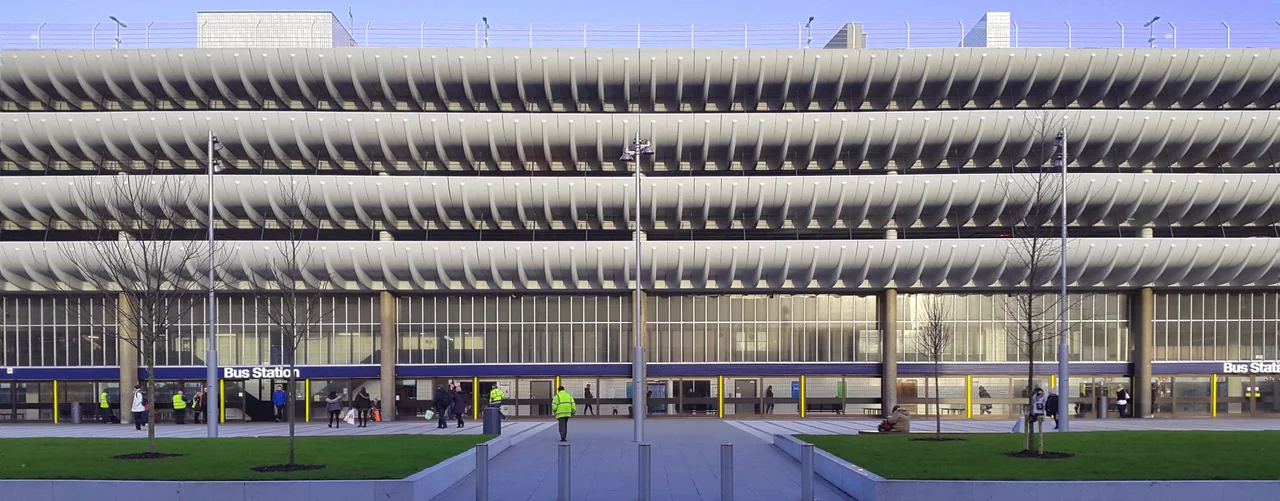

Preston Bus Station
Few buildings have been so loved and so threatened. Preston Bus Station opened in October 1969 with bays for eighty double-decker buses and a five-storey car park curving above them like the deck of an ocean liner. The Twentieth Century Society called it one of the most significant Brutalist buildings in the UK. Preston City Council called it expensive and obsolete. For more than a decade the two sides argued over whether to bulldoze it. Twice English Heritage refused to list it. Twice Preston voted in surveys to keep it. In 2013 it finally got Grade II status; in 2018 it reopened after a refurbishment that cost more than the city had earlier said demolition would save. The concrete won.
Concrete and the British Leyland Chairman
It was designed between 1968 and 1969 by Keith Ingham and Charles Wilson of Building Design Partnership, working with the structural engineers Ove Arup & Partners and built by John Laing. The eighty bus bays — forty along each long side — made it, by some claims, the second largest bus station in Western Europe. A five-storey car park for 1,100 cars stacked on top. Three subways linked the bays to the city centre and to the adjacent Guild Hall. The chairman of British Leyland opened it on 22 October 1969, a moment that perfectly captured what the building was for: moving thousands of people from a Lancashire town to factories that still made buses and cars in numbers Britain has not seen since.
The Curve
What everyone remembers is the curve. Each storey of the car park ends in a long, scooped concrete balcony, repeating around the entire building like the prow of a ship multiplied. Ove Arup's engineers designed it that way because finishing a vertical concrete wall to an acceptable standard had proved too expensive. The curve was cheap, organic, sculptural, and turned out to protect car bumpers from scraping a wall they would otherwise have hit. The balustrade also kept rain off the buses that pulled in beneath. The decision was driven by budget. The result is now considered one of the defining gestures of British Brutalism.
The Demolition Fight
By the 2000s the council wanted the site for a Tithebarn shopping redevelopment. The bus station got in the way. English Heritage rejected listing applications in 2000 and again in 2010. A council-commissioned report argued the station had low passenger numbers and poor pedestrian links. A Lancashire Evening Post survey in May 2010 found Preston Bus Station was the favourite building of the people of Preston. In 2012 the World Monuments Fund put it on its list of sites at risk. That December the council voted to demolish. The Twentieth Century Society fought back, pointing out that a fraction of the £23 million refurbishment cost would maintain the building while alternatives were developed. In September 2013, after a third application, English Heritage finally granted Grade II listed status. The bulldozers were turned away.
The Refurbishment That Cost What Demolition Would Have Saved
Lancashire County Council took over and committed £23 million to renovation, the same figure that had been cited as the reason to knock it down. An international design competition was held under the Royal Institute of British Architects. John Puttick Associates won; Preston-based Cassidy + Ashton finished four points behind and were brought on as partners. The western bus stands were closed and replaced by a public square. The eastern bays were renumbered one to forty. The station reopened in July 2018 and won three regional RIBA awards in 2019, including the overall Conservation Award. It was long-listed for the Stirling Prize, though it did not make the shortlist.
The Building Now
It is still working as a bus station. Three historic Ribble buses paraded through the new public square in October 2019 to mark fifty years almost to the day since opening. The Harris Museum hosted a Beautiful and Brutal exhibition. Ip Man 4: The Finale used it as a filming location. Jonathan Meades put it in his 2014 Brutalism series. Five floors of curved concrete car park still rise over the bays, the typeface on the original signs has been lovingly restored, and a city that twice tried to demolish its favourite building now has the building back and the demolition bill safely unspent.
From the Air
Preston Bus Station is in central Preston at 53.761N, 2.696W, on Tithebarn Street one block north of the Harris Museum. From the air the building is unmistakable: a long rectangular block roughly 170 m by 60 m with a distinctive curved-balcony car park stacked on top. Nearest airports: Warton (EGNO) 7 nm west, Blackpool (EGNH) 14 nm west, Manchester (EGCC) 27 nm south-southeast. M6 runs along the eastern edge of the city; the River Ribble curves to the south. Best viewing altitude 2,000-4,000 ft.
Nearby Stories
- Winwick rail crash 1.4 km away
- Hoylake Lifeboat Station 4.4 km away
- Murder of Lindsay Rimer 7 km away
- Mellor Mill 7 km away
- Embsay and Bolton Abbey Steam Railway 7.8 km away
- Piel Castle 11 km away
- Ashton Memorial 13 km away
- Hoylake 35 km away