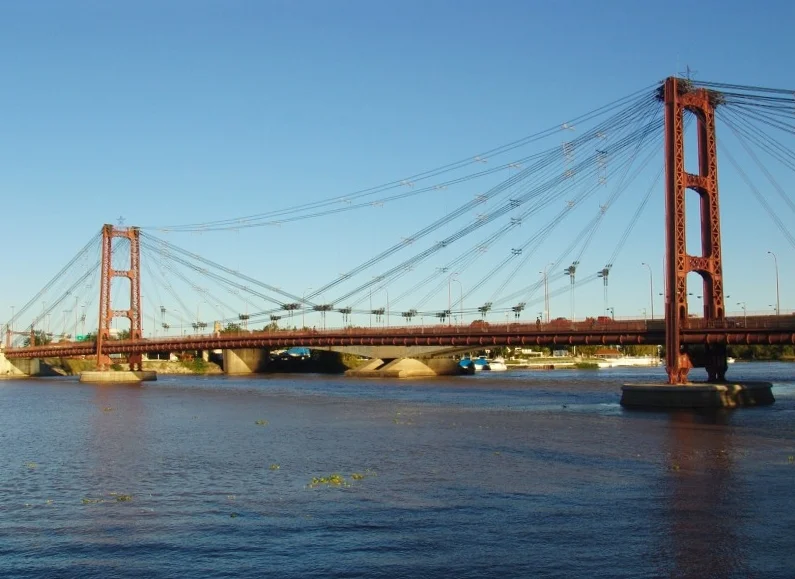

Puente Colgante de Santa Fe
At 4:35 in the afternoon on September 28, 1983, the east tower of the Puente Colgante leaned, sagged, and slid into the Setúbal lagoon while neighbors stood on the shore filming it. Months of relentless flooding had undermined the foundations of a bridge that had stood for fifty-five years, and now half of it was gone. The next morning the Santa Fe newspaper El Litoral ran a headline that read like a personal loss: "A goodbye that wants to be a see-you-later." The people of Santa Fe were not mourning a piece of infrastructure. They were mourning a member of the family.
An Engineer's Wager Over Water
Construction began in mid-1924 and the bridge opened on June 8, 1928, an audacious lattice of steel cable thrown across the Setúbal lagoon on the eastern edge of the city. It carried the formal name of the engineer who championed it, Rafael Marcial Candioti, but nobody called it that. To everyone it was simply el Puente Colgante, the hanging bridge. Its first job was practical: ferry drinking water from the Colastiné neighborhood and stitch the city to the El Pozo district and the campus of the Universidad Nacional del Litoral across the water. A suspension span was an ambitious choice for a provincial city on the flat Argentine littoral, where the land barely rises and the rivers do most of the talking. The bridge became the thing the eye reached for on the horizon.
The Slow Fall
The 1983 collapse was not a sudden snap but an agonizing slump that played out in front of cameras. The Paraná system had been flooding for months, the water clawing at land that builders had encroached on, the dredging mismanaged. Neighbors and journalists gathered on the shore as the structure sagged, recording the slow descent in photographs and film that the city still keeps. When the east tower finally gave way, it kept only half the structure standing and dropped the rest into the lagoon. What followed soured the loss into a scandal. The recovered steel was hauled to the city port and placed under the custody of the provincial government, then quietly sold off for scrap. The administration of governor José María Vernet became fused, in public memory, with the image of the broken bridge, a symbol of human shortsightedness as much as of high water. The fault, in other words, was not the river's alone.
Twenty Years of Absence
For two decades the lagoon held an empty space where the silhouette used to be. Recovery of the sunken sections began in 1984, but reconstruction did not start in earnest until April 2000, when crews set out to rebuild the span while honoring the lines of the original 1920s design. By 2002 the bridge was carrying people again. A whole generation of santafesinos had grown up with only photographs of the thing their parents described, and then, improbably, it returned. Cities rarely get their landmarks back once they fall. Santa Fe insisted, and paid in patience.
A Meeting Place, Not a Monument
Restored, the Puente Colgante earns its keep less as a roadway than as a gathering point. Couples meet at its towers, festivals spill across its deck, and photographers chase the way late light turns the cables to filament. It has worked its way into the city's poems, its documentaries, its sense of itself. There is something fitting in that. A bridge is, by definition, the thing that refuses to let two separated places stay apart, and the people who rebuilt this one decided that a gap in the skyline was simply not acceptable. The structure spanning the Setúbal today is a copy of one that fell, and somehow that makes it mean more, not less.
From the Air
The Puente Colgante crosses the Laguna Setúbal on the eastern edge of Santa Fe at roughly 31.64°S, 60.68°W. From the air it reads as a slender pale line laid across a broad sheet of water on the city's lagoon side, distinct from the wider braided channels of the Paraná to the east. Best appreciated at low to medium altitude (1,500-3,000 ft AGL) in the clear, calm air of an Argentine winter morning, before the summer thunderstorms of the littoral build. The nearest airport is Sauce Viejo (ICAO SAAV, local SFN), about 15 km south of the city; the larger Paraná airport (ICAO SAAP) lies across the river to the east. Watch for haze and convective buildups in the humid summer months.
Nearby Stories
- Sa Pereira Rail Disaster 20 km away
- Rafaela 30 km away
- Predelta National Park 37 km away
- Cayastá 47 km away
- San José Palace 165 km away
- El Palmar National Park 173 km away
- Federación 212 km away
- Villa General Belgrano 321 km away