.jpg)
Puente de la Mujer
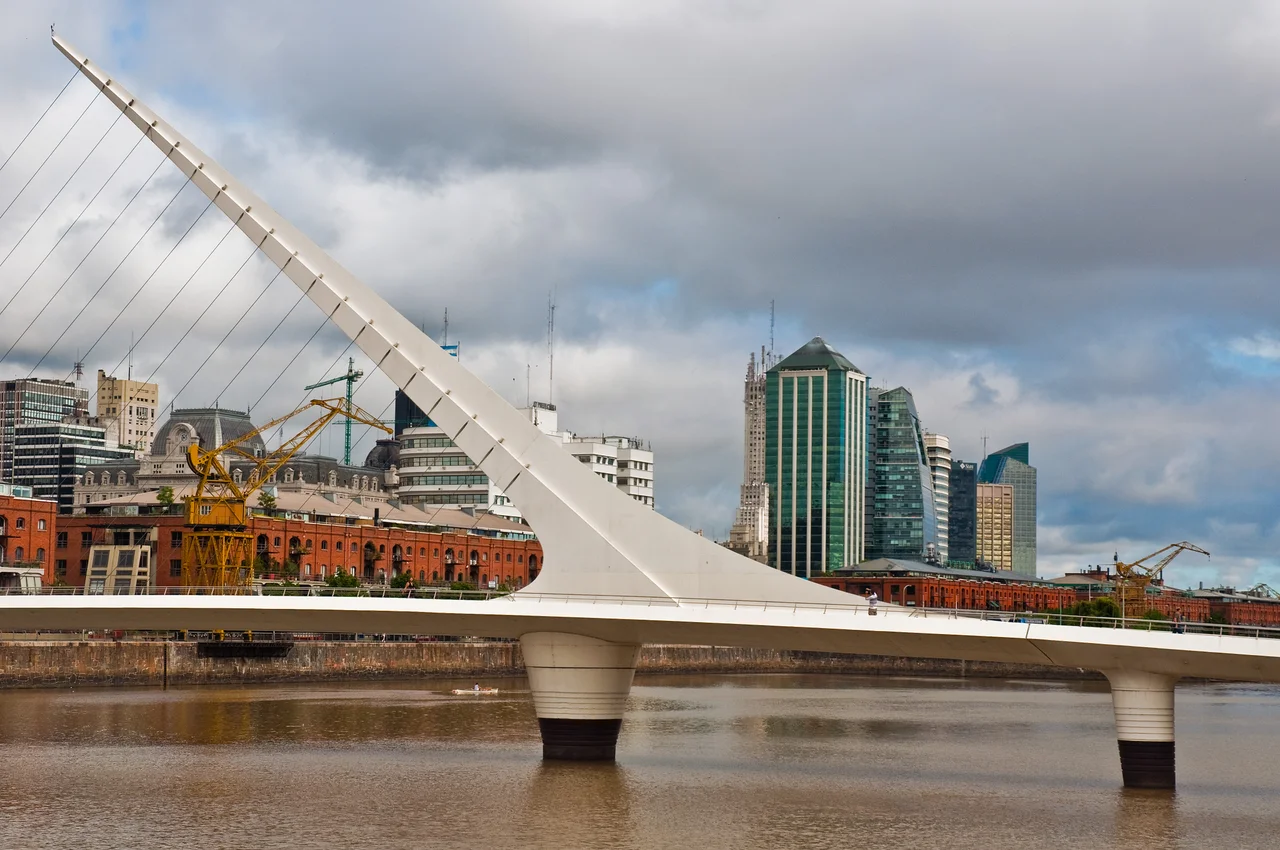
Santiago Calatrava said the design was a couple dancing the tango. Look at it from the right angle on Dock 3 of Puerto Madero, and the comparison stops feeling like an architect's flourish. A single white pylon leans back at a sharp 39 degrees, the way a tango leader leans into the embrace, and the slender deck of the bridge curves away from it like a partner caught mid-turn. There is even a name for the bridge that fits the metaphor. Every street in this district is named for a woman, so the footbridge became the Puente de la Mujer, the Woman's Bridge. It opened on the longest day of the southern summer, 20 December 2001, just as Argentina was sliding into the worst economic crisis of its modern history.
A Dancer Made of Steel
The numbers behind the gesture are precise. The bridge runs 170 meters across the old dock and weighs 800 tonnes, yet only the middle 102.5-meter section actually moves. That central span rotates on a white concrete pylon, swinging a full ninety degrees to let watercraft pass, and it completes the turn in less than two minutes before settling its far end on a small resting pylon across the water. Holding the whole thing aloft is a steel needle with a concrete core, roughly 34 meters tall, from which the suspension cables fan down to the deck. Calatrava had built versions of this idea before, over the Guadalquivir in Seville and over the Sacramento River in Redding, California. Here he reversed the angle of the cantilever so the mast pitches forward rather than back, and the bridge became the first of only two of his structures in all of Latin America.
A District Named for Women
The name is no accident, and it points to something larger about the neighborhood it serves. Puerto Madero made a deliberate choice when it was reborn: every street in the district carries a woman's name, from the activist Azucena Villaflor, a founder of the Mothers of the Plaza de Mayo, to the Mapuche singer and indigenous-rights advocate Aime Paine. A footbridge set among those streets could hardly be called anything else, so it became the Puente de la Mujer, the Woman's Bridge. Calatrava's tango metaphor closes the loop. In the dance, the leader and the follower form a single moving figure, and the architect bent steel and cable into exactly that image, a structure that reads as two partners locked in a turn. A district that set out to honor women gave its most photographed object a woman's name and the silhouette of a dancer.
An Advertisement That Became a Landmark
The bridge exists because of a marketing problem. When developers were trying to draw people to the newly reborn Puerto Madero, the advertising executive Jorge Heymann studied the site and concluded its real obstacle was not awareness but access; people simply could not get easily from one side of the docks to the other. A striking footbridge, he argued, would solve that better than any campaign, and last far longer. The businessman Alberto Gonzalez funded the roughly six million dollars it cost. The steelwork itself was fabricated more than ten thousand kilometers away, in the Basque city of Vitoria-Gasteiz in northern Spain, then shipped across the Atlantic to be assembled on the Argentine waterfront. What began as an alternative to a poster became the visual signature of the entire neighborhood.
Locks, Light, and Second Lives
By night the bridge belongs to couples. Padlocks cluster along its railings, each one a promise left behind by someone who threw the key into the dock, and the white deck glows against the dark water and the office towers stacked along Dock 3. In 2018 the city declared the structure part of its cultural heritage, a remarkable status for something barely old enough to vote. Four years later the deck got its first renovation, and the materials told a quietly Argentine story: the new flooring was made from plastic lumber manufactured out of roughly a hundred thousand recycled bottles, collected at recycling points across Buenos Aires. The dancer, it turns out, was rebuilt partly from the city's own discarded plastic.
From the Air
The Puente de la Mujer sits at roughly 34.608 degrees south, 58.365 degrees west, on Dock 3 of the Puerto Madero waterfront on the eastern edge of central Buenos Aires. From the air the single inclined white mast is the easiest way to spot it, rising over the parallel rectangular docks that separate the restored brick warehouses from the glass high-rises. The Rio de la Plata stretches brown and immense just to the east, with the green wedge of the Buenos Aires Ecological Reserve between the bridge and the open water. The nearest airport is Aeroparque Jorge Newbery (ICAO SABE), only about 2 km to the north along the riverbank, which handles most domestic traffic; the larger Ministro Pistarini International, known as Ezeiza (ICAO SAEZ), lies roughly 22 km to the southwest. Best viewed at low altitude in clear daytime light, when the mast throws a long shadow across the docks.
Nearby Stories
- Ezeiza Massacre 1.9 km away
- Luján, Buenos Aires 5.1 km away
- Curutchet House 13 km away
- Colonia del Sacramento 17 km away
- Martín García Island 28 km away
- Atucha Nuclear Power Plant 37 km away
- Lobos 43 km away
- Cry of Asencio 87 km away