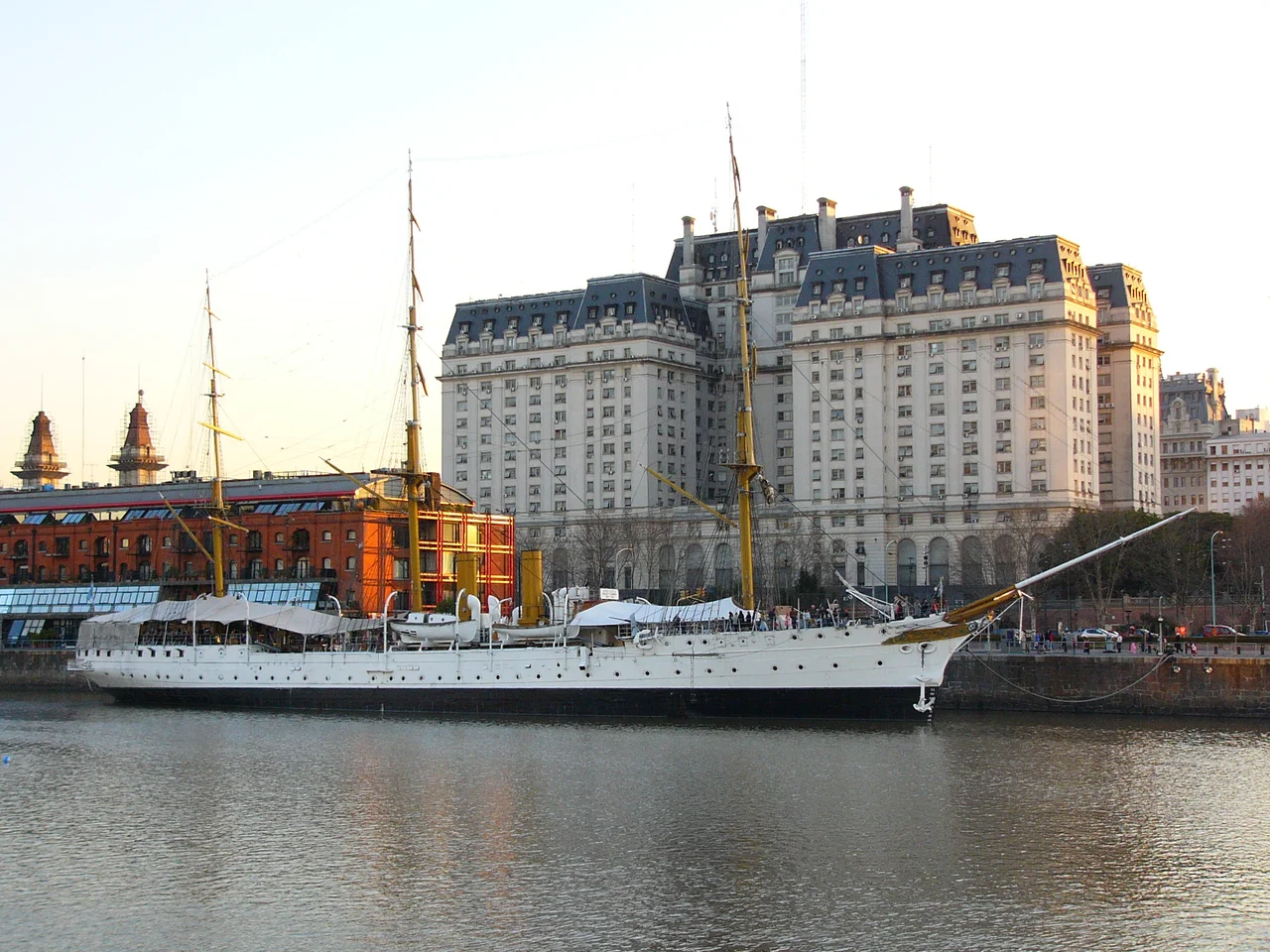

Puerto Madero
Buenos Aires spent a century looking away from the water. The grand boulevards, the opera house, the cafes all faced inland, while the muddy edge of the Rio de la Plata was left to warehouses, rail yards, and weeds. The strangest part is that this neglected strip had once been the city's proud front door. Puerto Madero was built as a state-of-the-art port in the 1890s and rendered obsolete within a decade, then abandoned for the better part of a hundred years, then reborn so completely that it now holds the most expensive real estate in the entire country, worth roughly double that of the next priciest neighborhood.
A Port Outgrown Almost Overnight
From its founding, Buenos Aires had a humiliating problem for a port city: the river was too shallow for big ships to dock. Cargo and passengers had to be ferried ashore on barges. In 1882 the national government hired the businessman Eduardo Madero to fix it, and construction of his enclosed system of docks ran from 1887 to 1897. It was an engineering landmark and an expensive one. It was also obsolete almost immediately. Within roughly ten years of completion, cargo ships had grown too large for Madero's basins, and the government turned to the engineer Luis Huergo, whose rejected earlier design for open, staggered docks now became the Puerto Nuevo that still works the river today. Madero's brand-new port slid into irrelevance before it had truly aged.
Half a Century of Plans That Went Nowhere
What followed was one of the great urban stalemates. By 1926 the new port had made Madero's docks redundant, and the zone decayed into one of the most degraded patches of the city, a no-man's-land of empty lots and crumbling warehouses pressed up against downtown. Planners could not leave it alone, yet could not agree what to do with it either. Proposals to redevelop or simply demolish the old port were floated in 1925, 1940, 1960, 1969, 1971, 1981, and 1985. Every one of them failed. For sixty years the most valuable undeveloped land in Buenos Aires sat in plain sight of the financial district, tangled in overlapping claims from the ports authority, the railways, and the national grain board, while nobody could break the deadlock.
The City Turns Around
The break finally came in November 1989, when the national and city governments signed the old port over to a single corporation charged with one job: urbanize it. Through the 1990s, foreign and local money poured in. The handsome brick warehouses along the west side were not torn down but recycled into lofts, offices, universities, and restaurants, their iron cranes left standing as ornaments. The 2000 opening of the Hilton anchored a wave of hotels and towers on the east side. Architects and designers of international stature, Norman Foster, Cesar Pelli, Philippe Starck, Calatrava, attached their names to the district. In barely a decade a derelict dockland had become one of the most successful waterfront revivals anywhere in the world.
A Skyline of Women's Names
Puerto Madero today is a forest of glass rising straight from the water, with residential and office towers reaching up to fifty stories along Dock 3. The tallest, the Alvear Tower, climbs 239 meters and ranks among the highest buildings in Argentina. Calatrava's white Puente de la Mujer stitches the east and west docks together, and the Fortabat art collection, opened in 2008 by the woman once reckoned the wealthiest in the country, sits among the wharves. One detail gives the neighborhood its particular character: every single street here is named after a woman, from the activist Azucena Villaflor to the Mapuche rights advocate Aime Paine. A district that spent a lifetime as the city's forgotten edge now carries, on every corner, the names of women Argentina had often overlooked too.
From the Air
Puerto Madero occupies the riverfront immediately east of downtown Buenos Aires, centered near 34.612 degrees south, 58.365 degrees west. From the air it is unmistakable: four long parallel docks run roughly north to south, flanked by a row of low restored brick warehouses on the west and a cluster of tall glass towers on the east, with the inclined white mast of the Puente de la Mujer between them. The vast brown sheet of the Rio de la Plata lies just beyond, and the green Buenos Aires Ecological Reserve fills the wedge of reclaimed land along the open water. Aeroparque Jorge Newbery (ICAO SABE) is about 2 km north along the riverbank for domestic flights; Ministro Pistarini International, or Ezeiza (ICAO SAEZ), sits roughly 22 km to the southwest. Clear daylight gives the best contrast between the dark towers and the pale docks.
Nearby Stories
- Ezeiza Massacre 1.9 km away
- Luján, Buenos Aires 5.1 km away
- Curutchet House 13 km away
- Colonia del Sacramento 17 km away
- Martín García Island 28 km away
- Atucha Nuclear Power Plant 37 km away
- Lobos 43 km away
- Cry of Asencio 87 km away