.jpg)
Pura Penataran Agung Lempuyang
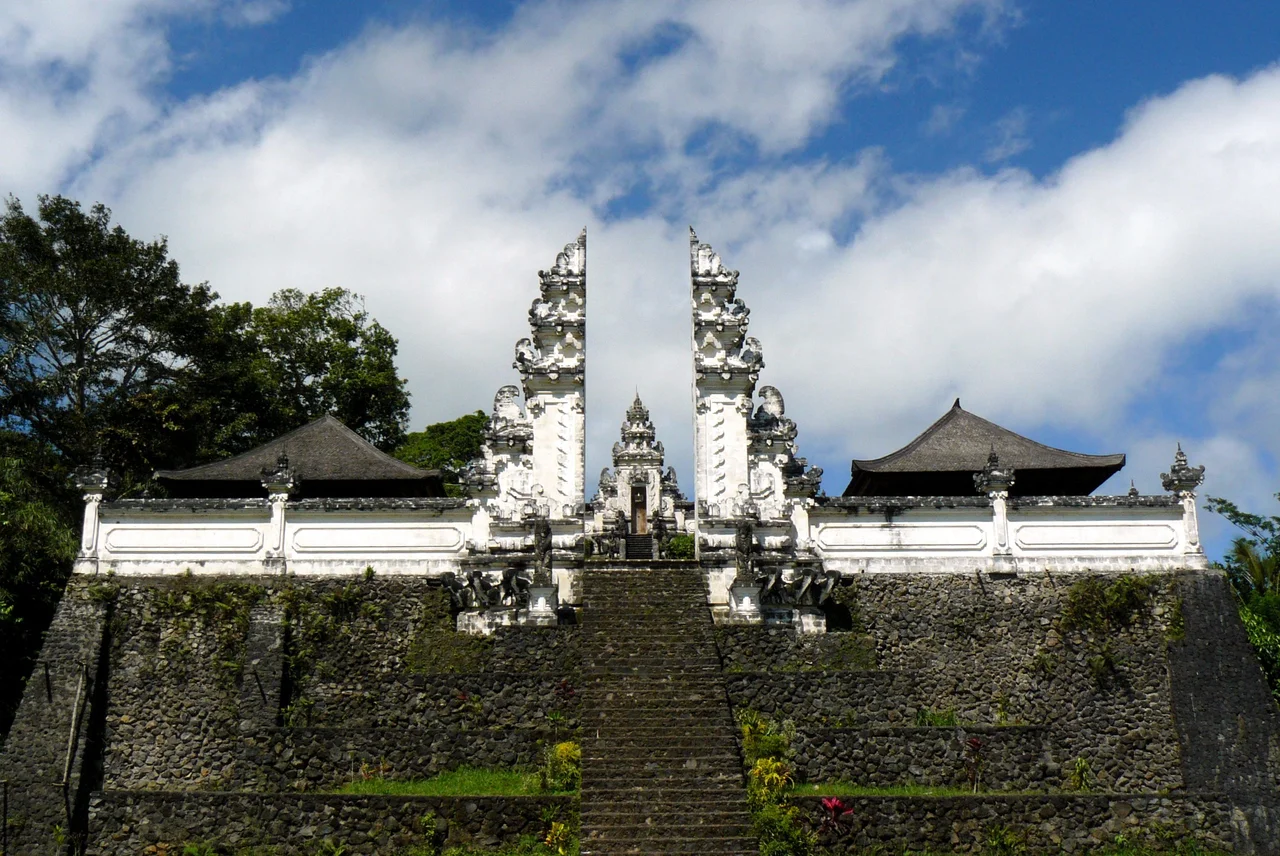
Seven temples climb Mount Lempuyang like vertebrae up a spine, and the first one you reach is the one that takes your breath away. Pura Penataran Agung Lempuyang sits at 600 meters on the mountain's southwestern flank, its white-painted split gate framing a view so perfectly composed that it has become one of the most photographed scenes in all of Indonesia. But this temple was not built for photographs. Ancient epigraphs suggest that worship on Lempuyang predates the majority of Hindu temples on Bali -- that this mountain was sacred before the island's great temple-building era even began. The highest temple in the complex, Pura Lempuyang Luhur, is one of the Sad Kahyangan Jagad, the six sanctuaries of the world, six holiest places of worship on the island. Penataran Agung is where that pilgrimage starts.
A Mountain Divided Among Gods
Balinese cosmology does not merely place temples on mountains. It reads the mountain itself as sacred text. Mount Lempuyang -- known by its Balinese name, Gamongan -- is divided into three vertical zones, each corresponding to a member of the Hindu Trimurti. The base belongs to Brahma, the creator, and is called Sang Ananta Bhoga. The middle section, Sang Naga Basukih, is the domain of Vishnu the preserver. The summit, Sang Naga Taksaka, belongs to Shiva the destroyer. Pura Penataran Agung occupies the middle zone -- Vishnu's territory -- which is why the statue of Krishna, Vishnu's earthly incarnation, presides over the uppermost stairway. The temple is also known by its ceremonial name, Pura Silawana Hyang Sar. At the base stands Pura Dalem Dasar Lempuyang. At the summit: Pura Lempuyang Luhur, the culmination of everything the lower temples prepare you for.
Before the Great Temples
Two ancient inscriptions frame the temple's origins. The Epigraph Sading C records that in 1072 Caka -- corresponding to roughly 993 or 994 in the Gregorian calendar -- Cri Maharaj Jayacakti received instructions from his father to travel to Bali and establish a temple on Mount Lempuyang. The purpose was nothing less than the island's salvation, and the temple was meant to draw more people to the area. A second inscription, the Epigraph Dewa Purana Bangsul, tells of Lord Paramecwara dispatching his son Cri Gnijayacakti to Bali as the island's spiritual protector. These accounts place organized worship on Lempuyang over a thousand years ago, predating much of Bali's later temple architecture. The complex fell into disrepair over the centuries, and Pura Penataran Agung was restored in 2001, but the spiritual continuity stretches back to an era when Bali's religious landscape was still being shaped.
Through Three Sanctuaries
Entering Pura Penataran Agung is an exercise in graduated holiness. The compound divides into three concentric zones, each more sacred than the last. The outer sanctuary, jaba pisan, opens through a white candi bentar, the iconic split gate that appears to cleave a single tower in two. Here stand the bale gong, where gamelans are stored, and the bale kulkul, housing the drum that calls worshippers to prayer. Passing through three white paduraksa portals -- the left for entry, the right for exit, the center opened only during the biannual piodalan festival -- you enter the middle sanctuary, jaba tengah. Mythical naga figures flank the staircases, and sculptures drawn from the Mahabharata line the approach: Arjuna, Bima, Yudhistira, each carved in stone, each guarding the path upward. At the top of the stairs stands Krishna. Beyond lies the jero, the innermost courtyard, where meru towers rise in tiered black pagoda shapes and padmasana shrines -- empty stone thrones -- honor the supreme deity Sang Hyang Widhi and the gods of the Trimurti.
The Compass Rose of Bali
Pura Lempuyang Luhur, the summit temple that Penataran Agung leads toward, serves a structural role in Balinese spiritual geography. It is one of nine directional temples, the Pura Kahyangan Padma Bhuwana, each marking a cardinal point or the center of the island. Lempuyang Luhur represents the east, the direction called purwa, associated with the color white and the god Iswara. These nine temples are not merely places of worship; they are understood as anchoring points that hold Bali in spiritual equilibrium. Remove one, the belief holds, and the island's balance is disturbed. It is a geography of faith as precise and purposeful as any surveyor's map -- except this one measures not distance but devotion.
Festival Days and Living Ritual
Every six months, on the Thursday following the Galungan festival, Pura Penataran Agung holds its piodalan, the temple anniversary celebration. This is when the central paduraksa portal swings open for sacred objects, heirlooms, and offerings to pass through. It is when the temple is most fully alive, most fully itself. On ordinary days, visitors encounter the architecture without the ceremony -- the gates, the carvings, the views. But the piodalan reveals what the stone was built to contain. Incense rises through the meru towers. Offerings of flowers, rice, and fruit crowd the padmasana thrones. The gamelan fills the outer courtyard with the metallic, interlocking rhythms that have accompanied Balinese worship for centuries. The seven temples of Lempuyang have survived earthquake, neglect, and restoration. What sustains them is not preservation but practice -- the same prayers, repeated on the same mountain, following a calendar older than anyone alive can remember.
From the Air
Pura Penataran Agung Lempuyang (8.39S, 115.63E) sits at approximately 600 meters elevation on the southwestern slopes of Mount Lempuyang in eastern Bali. The temple complex is nestled in dense tropical forest and is not easily visible from high altitude, but Mount Lempuyang's ridgeline is a clear landmark east of Mount Agung. Nearest major airport is Ngurah Rai International (WADD/DPS), approximately 85 km to the southwest. The temple lies within Karangasem Regency, Bali's easternmost district. On clear days, views from this area extend across the Lombok Strait to Mount Rinjani.
Nearby Stories
- Nusa Lembongan: Where the Seaweed Farmers Became Surf Guides 8.4 km away
- Eight Patrols and a Midnight Torpedo 9.8 km away
- The Day Seririt Fell Silent 25 km away
- The Words Written on Leaves 28 km away
- Lombok 33 km away
- Alas Purwo: Where Java Begins and the Surf Never Stops 55 km away
- Forty-Five Men and Thirty-Six Depth Charges 70 km away
- Java's Little Africa 71 km away