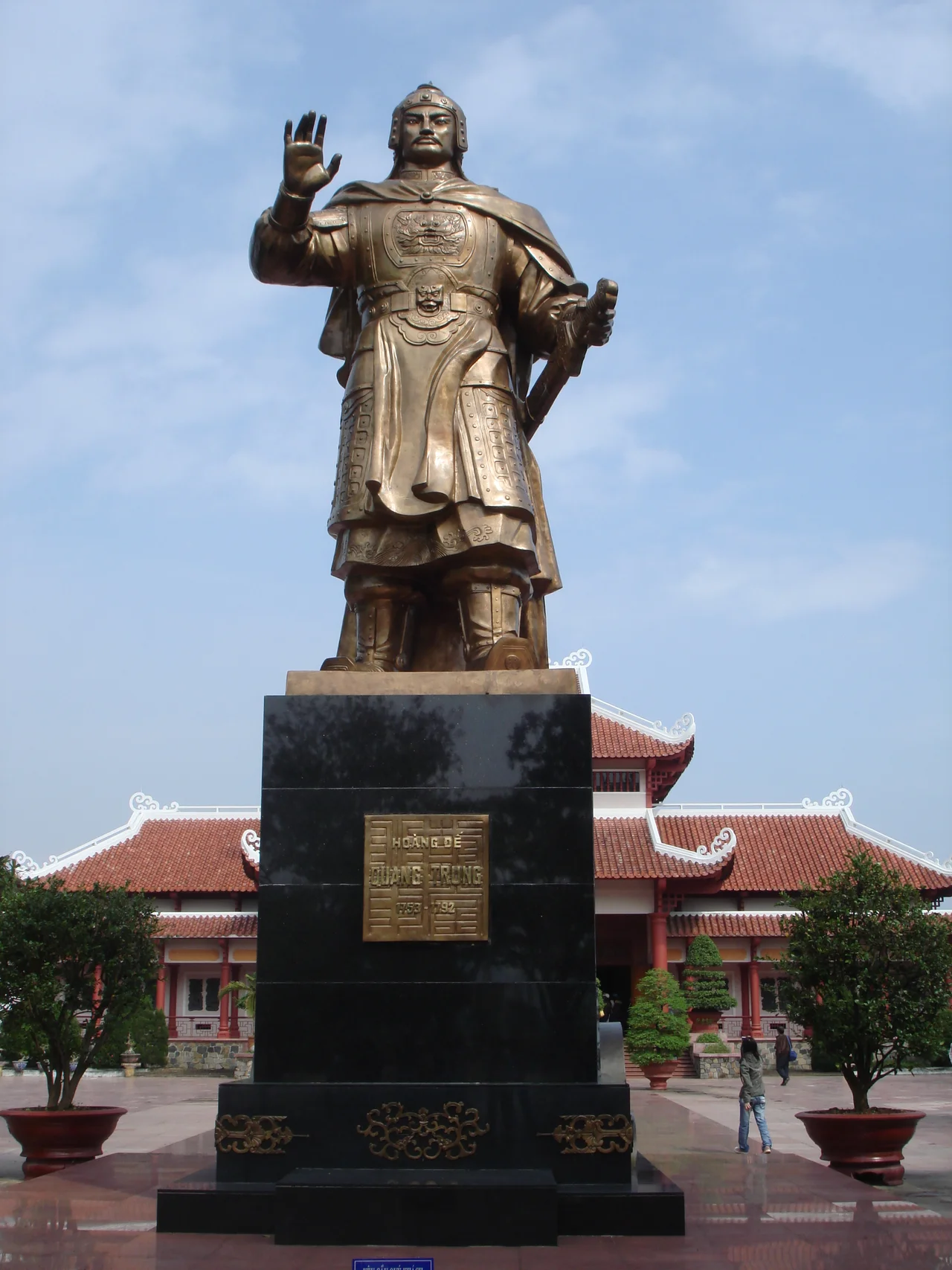

Quang Trung Museum
After the Tây Sơn dynasty fell in 1802, the new Nguyễn rulers did something unusual for victors: they tried to make three brothers disappear from history. They destroyed the ancestral shrines. They suppressed worship. They rewrote the story. It didn't work. In 1823, the villagers of Kiên Mỹ quietly rebuilt a temple on the site of the demolished family home, naming it after the local deity — but everyone knew who they were really honoring. The secret lasted over a century before Vietnam's reunification finally allowed the Quang Trung Museum to be built openly, on the very ground where the three brothers had grown up.
Three Brothers from Tây Sơn
Nguyễn Nhạc, Nguyễn Lữ, and Nguyễn Huệ grew up in the village of Tây Sơn but established themselves in Kiên Mỹ, trading and farming in what is now Phú Phong town in Bình Định Province. From this modest base, they launched one of the most consequential uprisings in Vietnamese history. The Tây Sơn movement overthrew both the Nguyễn lords in the south and the Trịnh lords in the north, reunifying a fractured country under a new order. Their most celebrated moment came in 1789, when the youngest brother, Nguyễn Huệ — who had crowned himself Emperor Quang Trung — led a lightning campaign that expelled a Qing dynasty invasion force of roughly 200,000 men in a matter of days. The victory at the Battle of Ngọc Hồi-Đống Đa is still commemorated annually. That triumph came from this valley.
Suppressed, Then Rebuilt
The Tây Sơn dynasty lasted only from 1778 to 1802 before Nguyễn Ánh — backed by French advisors — defeated the last Tây Sơn emperor and founded the Nguyễn dynasty that would rule until 1945. The new dynasty's vengeance was thorough: the remains of Emperor Quang Trung were exhumed and desecrated, and worship of the brothers was forbidden. But in 1823, villagers constructed the Kiên Mỹ Village Temple on the ruins of the family home, ostensibly honoring the local tutelary deity. In practice, it was a covert shrine. The building the French destroyed in 1946 was rebuilt between 1958 and 1960. After reunification in 1975, the government gave formal approval for a proper museum. Construction began on 11 December 1977 and the Quang Trung Museum opened on 25 November 1979 — recognized that same year as a national historical and cultural relic.
What the Museum Holds
The museum now encompasses 150,000 square meters and houses over 11,000 artifacts: weapons, coins, royal seals, genealogical records, and items from the Tây Sơn era. Ten exhibition rooms chronicle the movement from its origins in this valley to its legacy in Vietnamese national consciousness. Bronze statues of the three brothers and their generals were added to the Tây Sơn Tam Kiệt Temple in 1999 and 2004. In 2015, the province invested more than 200 billion VND in further upgrades. In 2011, the museum received a donation of 21 Tây Sơn-era iron swords — part of a continuing accretion of material that finds its way back here. The museum also includes a performance hall for Tây Sơn martial arts and traditional music, and a Tây Nguyên longhouse representing the ethnic minority cultures of the surrounding highlands.
The Tamarind Tree and the Well
Not everything here is behind glass. In the museum courtyard stands a tamarind tree estimated to be 300 years old — alive since before the Tây Sơn uprising, possibly a tree the brothers knew. Beside it is an ancient well from the family's original homestead. Both were recognized as Vietnamese heritage in 2011. These are the most quietly powerful objects on the grounds: not weapons or seals, but the domestic remnants of an ordinary family that became extraordinary. During Lunar New Year, thousands of visitors make the journey to Phú Phong to attend the festival commemorating the Ngọc Hồi-Đống Đa victory. The museum was designated a special national monument on 31 December 2014. The tamarind tree was there before that recognition, and will likely outlast it.
From the Air
The Quang Trung Museum sits at 13.921°N, 108.921°E in the Phú Phong area of Bình Định Province, on the banks of the Kôn River. Approaching from the air along the river valley, the broad museum complex and its grounds are visible in the agricultural lowlands west of the coastal plain. The nearest airport is Phù Cát Airport (UIH), approximately 20 km to the east — a short hop along National Highway 19. From 2,000–3,000 feet, the broad flat district stretching toward the coast is visible, with the highland ridges rising to the west. The site is roughly 40 km inland from Qui Nhơn and its harbor.
Nearby Stories
- Battle of Mang Yang Pass 4.4 km away
- Firebase Bird 11 km away
- Kon Tum 35 km away
- Sông Cầu 53 km away
- Battle of Ia Drang 63 km away
- Vũng Rô Bay 95 km away
- Vũng Rô Bay Incident 124 km away
- Battle of the Paracel Islands 352 km away