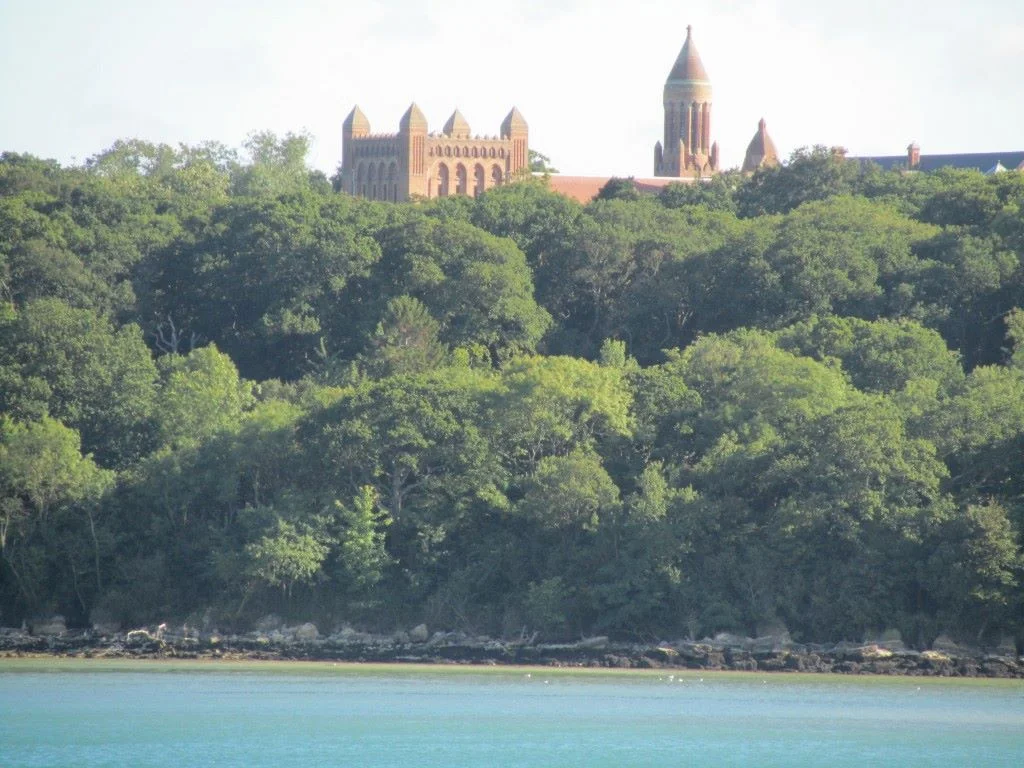

Quarr Abbey
In September 1901, almost an entire French Benedictine community boarded boats at Solesmes, crossed the Channel, and disembarked at a country house called Appuldurcombe on the Isle of Wight. The new French law that had driven them out gave no exceptions and no warnings. What they did not yet know was that they were about to build, from Belgian brick and Flemish know-how, one of the most daring church buildings of the twentieth century - on the site of an English abbey their order had already lost once before, six centuries earlier.
Stone From a Quarry
The name is the giveaway. Quarr comes from quarry, and the quarry came first. In 1132 Baldwin de Redvers, the fourth Lord of the Isle of Wight, founded a Cistercian house here and called it the Abbey of Our Lady and St John, drawing on the local stone that had already, by then, been carried off to build parts of the Tower of London. Baldwin was buried in his abbey in 1155. Later, the princess Cecily of York, second daughter of Edward IV and godmother to the boy who would become Henry VIII, was laid down beside him. Their bones still lie somewhere on the medieval site, unmarked. The abbots, by tradition, served as wardens of the island; the buildings were fortified against piracy in 1340 with a sea gate, a portcullis, and a defensive wall whose ruined courses can still be traced in the grass.
Undone, Then Quarried Again
Henry VIII's commissioners arrived in 1536. A Southampton merchant named George Mills bought the land and pulled the abbey down for its building stone, which went to fortify Cowes and Yarmouth against the threat of French invasion that the dissolution itself had helped to invite. One of the three abbey bells survived, hidden in the belfry of Holy Cross Church in nearby Binstead - a parish church the monks had built for their lay tenants. The rest was scattered. For three and a half centuries the site lay quiet, the great Cistercian house remembered chiefly by historians and by the masonry of nearby buildings, every stone telling a story it could no longer name.
Exile to a Garden
On 1 July 1901, the French parliament passed a new law that ended decades of uneasy tolerance toward religious orders. Abbot Paul Delatte of Solesmes had been preparing for this for years, quietly sending a monk to England to look for a refuge. The community took Appuldurcombe House, a roofless Worsley mansion at Wroxall, on a lease signed 19 August 1901. Within five weeks, on Saturday 21 September, practically the whole community of Solesmes had arrived. Six years later, on 25 June 1907, the first monks moved to Quarr Abbey House, on the site of the old medieval abbey, and began clearing ground, planting an orchard, and putting up a chicken yard. The new abbey, accidentally, had come home.
Brick That Glows
Among the Solesmes monks was a 31-year-old architect named Dom Paul Bellot. He drew the plans himself, and from 1907 a workforce of three hundred islanders - most of whom had built only ordinary houses - raised refectory, cloister, and church from Belgian brick that turns coral-pink in low sun. The Abbey church was consecrated on 12 October 1912. Its tall pointed towers, Flemish in their colour, French in their geometry, with hints of Byzantine and Moorish detail, were unlike anything else on the island. Sir Nikolaus Pevsner later called it "among the most daring and successful church buildings of the early 20th century in England." Both buildings are now Grade I listed.
Days Marked by Bells
Today fewer than a dozen monks live the regular life. The hours run from Vigils at 5:30 to Compline at 8, with Mass at 9 on weekdays and 10 on Sunday. Father Nicholas, the guestmaster, is also the abbey's bookbinder and its beekeeper - each monk gathers two or three offices alongside his prayer life. The Rule of Saint Benedict directs that all guests be received as Christ, and Quarr keeps the rule: stays are paid for by donation, with no minimum, and no one is turned away for being unable to give. Scott Walker stayed here. Phil Collins stayed here. Robert Graves, recovering on the island during the First World War, wrote in Good-Bye to All That that the abbey's fresh bread and vegetables overturned his hostile view of Catholicism. Tony Hendra built a whole memoir, Father Joe, around the years he spent in retreat at Quarr.
What the Quarry Returned
In 2021 Historic England granted £229,817 for roof and window repairs - the same building Bellot raised in eighteen months in 1907 still requires patient attention. The ruined medieval walls of Baldwin de Redvers' original house remain a short walk from the new church, weathered down into hummocks of stone that once held up an entire monastic economy. The new abbey looks across at the old. Both were built from the island's own stone, both were buried by political shifts beyond their walls, and both, in their different ways, came back.
From the Air
Quarr Abbey sits between Binstead and Fishbourne on the north coast of the Isle of Wight at 50.731°N, 1.205°W. Visible at low altitude on approach to Bembridge Airport (EGHJ); from cruising altitude Wootton Creek and the ferry route to Fishbourne are the nearest navigation features. Portsmouth Harbour and the Solent lie a few miles north across the water.
Nearby Stories
- 1958 BOAC Bristol Britannia Crash 6.1 km away
- The Salisbury Museum 10 km away
- Hampshire 11 km away
- Amberley Museum & Heritage Centre 24 km away
- Charterhouse School 25 km away
- HMS Warrior (1917) 33 km away
- Operation Donnerkeil 74 km away
- D-Day: The Longest Day 138 km away