
Queen Elizabeth Hall
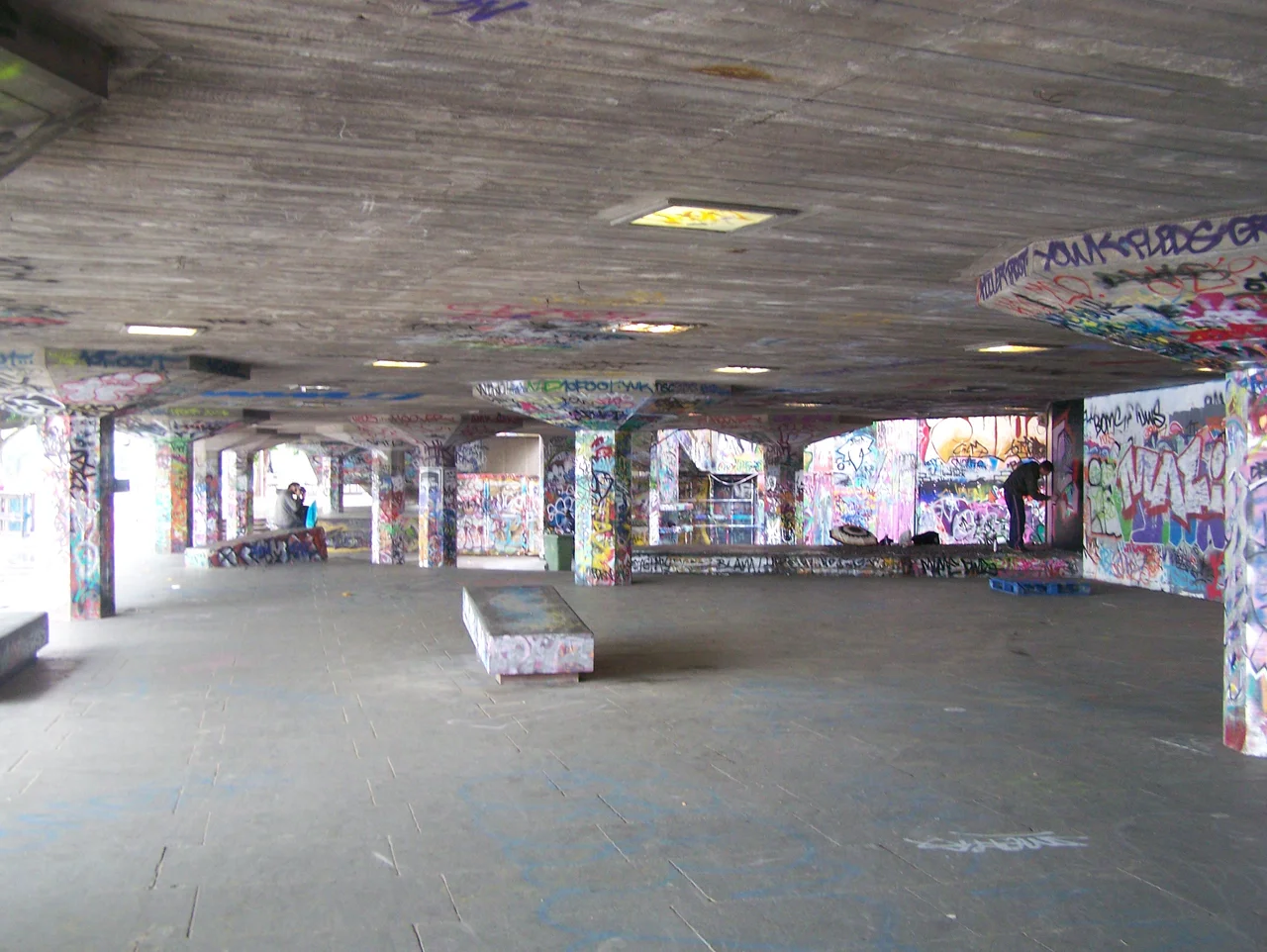
In 1973, six years after the Queen Elizabeth Hall opened on London's South Bank, a few teenagers with skateboards noticed something. The undercroft beneath the foyer building - a sheltered concrete plaza laid out as a pedestrian walkway between the Royal Festival Hall and the Hayward Gallery - had banks and steps and ledges that seemed to have been designed for tricks. They were not. They were just the by-product of Hubert Bennett's brutalist architecture for the Greater London Council. But the skateboarders adopted the space, and over the next fifty years they made it London's most distinctive and defended street-skating spot.
Britten Opens the Hall
The Queen Elizabeth Hall opened in March 1967 with a concert conducted by Benjamin Britten. It is the middle building of the South Bank Centre arts complex - smaller than the 1951 Royal Festival Hall next door, larger than the 360-seat Purcell Room it shares a structure with. Capacity is just over 900. The architects worked under Hubert Bennett, head of the GLC architects department, with Jack Whittle, F.G. West, and Geoffrey Horsefall on his team. The Hayward Gallery, opened in October 1968, completes the trio. The whole complex was designed to express its separate masses and elements rather than blend together. Bennett wanted the QEH to read as a distinct building, refusing to compete with the scale of the Royal Festival Hall's grand riverside front.
Concrete and Conviction
The Queen Elizabeth Hall is brutalism in concentrated form. Octagonal reinforced-concrete columns support a foyer building shaped like a vee, linked to the auditorium by cast concrete tubes that look, depending on your mood, like spaceship docking ports or industrial ductwork. The main entrance is a horizontal slit in the concrete wall with six pairs of cast aluminium doors. A great concrete prow encasing the air-conditioning ducts protrudes towards the Thames at roof level. The 1972 William Pye stainless-steel sculpture Zemran sits on the riverside terrace. The materials are unsoftened, the forms are powerful and austere, the design celebrates the plasticity of concrete. It is the kind of building people argue about - some call it a masterpiece of an era, others call it a mistake.
An Acoustic of General Excellence
What the building does extraordinarily well is hold sound. In 1968, after a period of testing and adjustment by music critics and engineers, the hall's acoustics were judged of general excellence in the three key categories that matter: reverberation time, tone and definition, and singing tone. Reverberation can be tuned by opening and closing cavities in the vertical wood panels lining each side wall. Tone and definition come from minimum use of deflectors, allowing the sound to diffuse over the seating rather than at the platform. The singing tone benefits from a ceiling held 25 feet above the highest seats even though the rear stalls are steeply raked. The hall hosts classical, jazz, and avant-garde music, talks, and dance performances. The acoustic was respected enough that when the 2015-2018 "Let the Light In" refurbishment threatened to compromise it with heavier stage lighting rigs, the architects added a retracting gantry at ceiling level to restore the original geometry when needed.
Long Live Southbank
When the Southbank Centre proposed in the early 2010s to convert the skating undercroft into cafes and shops as part of a GBP 120 million Festival Wing development, the skaters fought back. The campaign called itself Long Live Southbank. It collected signatures, gathered media attention, made a public case that the undercroft was not just a space being used informally - it was an internationally recognised piece of skate culture, the place where British skateboarding had its first and most enduring home. In early 2014 the then Mayor of London Boris Johnson backed Long Live Southbank, and the Festival Wing scheme was suspended. The Southbank Centre and the campaign agreed instead on a refurbishment programme that has since preserved and renewed the undercroft. Photographers, graffiti artists, BMX riders, and performance artists share the space with the skaters. The Graffiti Archaeology Project maintains a photographic record of the walls.
Let the Light In
From 2015 to 2018, the entire 1960s complex - Queen Elizabeth Hall, Purcell Room, and Hayward Gallery - underwent complete internal refurbishment under the banner Let the Light In. The architecture practice Feilden Clegg Bradley led the work, the Arts Council put up GBP 10 million, the remainder came from sponsorship and private donations. The exterior was deliberately left as it was. The foyer was restored, with better integration for visitors with reduced mobility and a new glazed extension into the southern terrace bringing daylight into a space that had been growing dim with partitions. The Hall reopened in April 2018, and the temporary structure A Room for London - architect David Kohn's one-bedroom installation shaped like a boat run aground on the auditorium roof - has been perched up there since 2012. The QEH is a hall best appreciated at night, especially when approached from the eastern of the Golden Jubilee Footbridges beside Hungerford Bridge - the lights inside burning against the river, the concrete forms reading clean against the dark sky.
From the Air
The Queen Elizabeth Hall sits at 51.5067 N, 0.1164 W on the South Bank of the Thames in the London Borough of Lambeth, immediately west of Waterloo Bridge and between the Royal Festival Hall and the Hayward Gallery. From altitude, find the Waterloo Bridge crossing and look for the cluster of concrete cultural buildings on the south bank just east of the bridge. Nearest airports are London City (EGLC) 7 nm east and London Heathrow (EGLL) 14 nm west. The South Bank lighting is striking at dusk.
Nearby Stories
- Stevenage 5.7 km away
- Malling Abbey 5.7 km away
- 1952 Farnborough Airshow Crash 7.7 km away
- Ingatestone Hall 8.2 km away
- Hellfire Caves 9.1 km away
- The Carrington Event: The Solar Storm That Could Happen Again 9.8 km away
- Bletchley Park 16 km away
- Castle Hedingham 23 km away