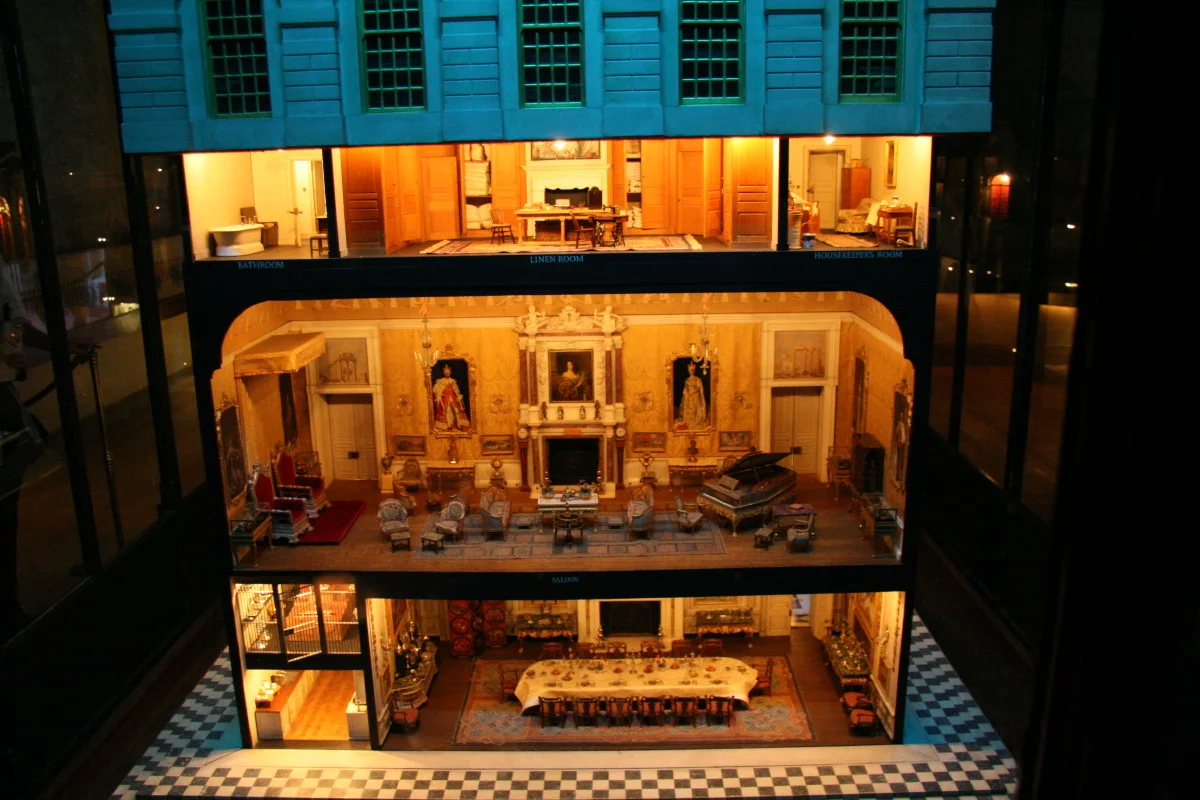

Queen Mary's Dolls' House
The wine cellar holds 1,200 bottles. The toilets flush. The pianos play - real pianofortes, the donors specified, with soundboards and cast-steel frames and proper strings and hammers. Two Otis lifts work; one serves three principal floors, the other adds the mezzanines. The Chubb safes lock. The Purdey shotguns in the gun cabinet "break and load." The wireless plays. The six motor cars in the basement garage have operational engines. Every detail of an Edwardian royal residence has been miniaturised to 1:12 scale, then made to work. Queen Mary's Dolls' House isn't really a toy. It is a working sample of an entire civilization, built between 1921 and 1924 by some of the finest craftsmen of the age, and presented to a queen who almost certainly never played with it.
An Idea at the Summer Exhibition
Princess Marie Louise, Queen Mary's cousin, had the idea first. She was talking with the architect Edwin Lutyens at the 1921 Royal Academy Summer Exhibition. Lutyens at this point was finishing the Cenotaph and starting on New Delhi, but he agreed to design the dolls' house anyway. Marie Louise then sat down and wrote, by hand, around two thousand letters to the leading artists and craftsmen of Britain, asking them to contribute. Most said yes. George Bernard Shaw refused to write a tiny volume of his work. Edward Elgar declined to compose a miniature score. Almost everyone else agreed: 171 writers, 25 composers, 700 painters, and entire firms - Cartier, Rolls-Royce, Daimler, Singer, Hoover - each donating their finest miniature product. The dolls' house was conceived as a national gift to Queen Mary and also, more interestingly, as a historical document. Marie Louise wanted to capture how a royal family actually lived in 1924, in case future generations wondered.
The Library Nobody Could Read
Arthur Conan Doyle wrote a new Sherlock Holmes story for the library: "How Watson Learned the Trick." A. A. Milne contributed "Vespers," the small poem that begins "Little Boy kneels at the foot of the bed." M. R. James, the master of the English ghost story, wrote "The Haunted Dolls' House" - exactly the story you would hope he would write. Thomas Hardy contributed. So did Kipling, Conan Doyle, Galsworthy, Joseph Conrad, Hilaire Belloc, G. K. Chesterton, Aldous Huxley, Vita Sackville-West, Siegfried Sassoon, Edith Wharton, Robert Graves, Walter de la Mare. Agnes Jekyll wrote a Dolls' House Cookery Book. The surgeon Sir John Bland-Sutton wrote Principles of Dolls' Surgery. The books were bound to scale by Sangorski & Sutcliffe. Reference works - Whitaker's Almanack, Who's Who, Bradshaw's railway timetables - were reproduced by microphotography. Seven hundred miniature watercolours about the size of two postage stamps were stored in folio cabinets. No one could ever actually read or look at any of it without enormous magnification. The contributions were genuine art, not toys, by the people who made the period.
Plumbing and the Crown Jewels
Lutyens designed a neoclassical building over three feet tall, painted to resemble Portland stone, roofed with miniature Welsh slates. An electric mechanism in the roof raises and lowers the external shell to reveal the interior. The dining room sets a table for eighteen with Garrard silver and Webb crystal. The kitchen has a coal-fired range, tiled walls, a woodblock floor, a humane mousetrap holding three mice, and a cat. The wine cellar is stocked with real wines and spirits in proper proportion - 1,200 bottles brought together by Francis Berry of Berry Bros & Rudd. Two thrones sit gilded in the saloon next to a Broadwood grand piano with casework painted by T. M. Rooke. The strongroom contains a working Chubb safe and a 1:12 set of the Crown Jewels. The bathrooms have running water; one toilet flushes with miniature lavatory paper. The garage drawer pulls out from beneath the house to reveal six royal-livery cars - two Daimlers, a Rolls-Royce, a Vauxhall, a Sunbeam, a Lanchester - plus a Rudge-Whitworth motorcycle with sidecar. Every wheel is properly spoked.
Exhibition and Aftermath
The Dolls' House debuted at the 1924-25 British Empire Exhibition at Wembley, where more than 1.6 million people paid sixpence each to see it - the proceeds going to Queen Mary's charities. It moved to the 1925 Ideal Home Exhibition, then to Windsor Castle, where it has remained on display ever since. Lutyens designed the display room itself, with murals by Philip Connard and a glass cabinet donated by Pilkington. Despite the name, there are no dolls inside, except for a pipe major and five guardsmen at the sentry boxes. The empty rooms have a quiet, watchful quality - as if everyone has just stepped out and might return. In 2024, the centenary, new miniature books were added: tiny editions of Anthony Horowitz and Julia Donaldson, keeping faith with Marie Louise's original concept that this house should be a living document of British literature and craft.
From the Air
Queen Mary's Dolls' House lives inside Windsor Castle, on the south bank of the Thames at 51.484 N, 0.603 W, across the river from Eton College. From above, the castle's massive Round Tower and the Lower Ward dominate the view. The Dolls' House is housed in what was formerly a china room near the State Apartments, invisible from outside. The castle sits 7 nautical miles east-southeast of London Heathrow, directly under one of the busiest approach corridors in the world. On a clear day, the line of jets stacked at flight level 60 traces a curve over Windsor Great Park, and the dolls' house beneath - with its working clocks ticking, its tiny gramophone records playable, its 1,200 bottles untouched for a century - sits unaware in the room Lutyens designed for it.
From the Air
Located within Windsor Castle at 51.484 N, 0.603 W in Windsor, Berkshire. Best viewed at 1,500-3,000 feet AGL when overflying Windsor. Nearest major airport: London Heathrow (EGLL), 7 nm east. RAF Northolt (EGWU) 11 nm east-northeast. Windsor Castle airspace requires coordination with Heathrow approach; the Royal flight restrictions may apply when the monarch is in residence. The castle is unmistakable from the air - the only major medieval fortress visible on the Thames upstream of London.
Nearby Stories
- Waltham Abbey 0.7 km away
- Queen Victoria Hospital 1.9 km away
- Hither Green rail crash 3.3 km away
- Ufton Nervet rail crash 4.2 km away
- Kings Langley Palace 5.8 km away
- Magdalen College, Oxford 16 km away
- Hyde Abbey 20 km away
- Amberley Museum & Heritage Centre 28 km away