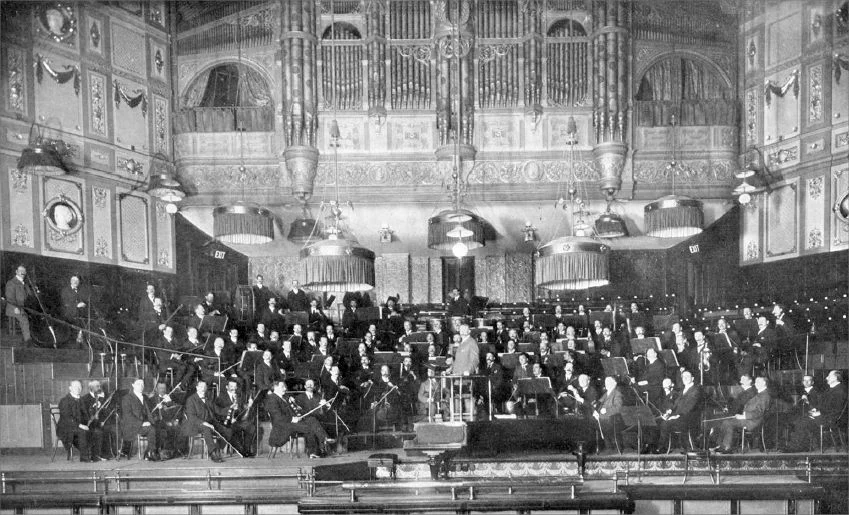

Queen's Hall
Knightley wanted the paint to be the colour of "the belly of a London mouse." To get it right, the architect kept a string of dead mice in the paint shop and matched the pigment to their actual fur. The Queen's Hall opened on 25 November 1893 with grey and terracotta walls, Venetian-red seating, a central fountain stocked with goldfish and waterlilies, and an audience capacity of 2,500. Bernard Shaw soon praised its acoustics as "a happy success." The conductor Thomas Beecham would later record that the fountain provided constant entertainment of its own: "Every three or four minutes some fascinating young female fell into the fountain and had to be rescued by a chivalrous swain. It must have happened thirty-five times every night."
Built Like a Violin
Knightley designed Queen's Hall using a floor plan previously prepared by C. J. Phipps. The auditorium covered 21,000 square feet and was deliberately built like a musical instrument: the walls were lined with wood fixed clear of the structure on thick battens, coarse canvas stretched over the wood, then sealed and decorated. Knightley calculated that the unbroken surface and the wooden lining would resonate "like the body of the violin." He was right. From its first weeks the hall was celebrated for acoustics unmatched by any other large hall in London, and the design influenced concert-hall engineering for decades. The Queen's Small Hall at the top of the building, seating 500, was cigar-shaped with windows in the ceiling. Shaw called it "reminiscent of a ship's saloon" and the most comfortable small concert room in London.
The First Proms
To fill the hall during the slow late-summer months, the manager Robert Newman planned a ten-week season of promenade concerts at low prices - one shilling for the standing promenade area, two for the balcony, three or five for the grand circle. To keep costs down, Newman hired a young and little-known conductor named Henry Wood to lead every single concert. The first Promenade Concert took place on 10 August 1895. Newman's deal with his backer, the ear-nose-and-throat specialist Dr George Cathcart, required Wood to lower the orchestral pitch by nearly a semitone to match the European standard. The brass and woodwind players refused to buy new instruments, so Cathcart imported a set from Belgium and lent them out; the players bought them after a season. Smoking was permitted at the Proms - it would not be formally banned until 1971 - and refreshments were sold during the music, not just at intervals. Newman wanted the Proms to be popular without being condescending. "I am going to run nightly concerts and train the public by easy stages," he said. "Popular at first, gradually raising the standard until I have created a public for classical and modern music."
Composers Conducting Themselves
By the early twentieth century the Queen's Hall had become Britain's most important musical venue. Edvard Grieg and Camille Saint-Saens conducted their own works in the 1894-95 season. Composers who appeared at the hall in its first twenty years included Debussy, Elgar, Ravel, Schoenberg, Richard Strauss, and Sullivan. Soloists included Joseph Joachim, Fritz Kreisler, Nellie Melba, Pablo de Sarasate, Eugene Ysaye, and - most expensive of all - Ignacy Jan Paderewski. Arthur Nikisch and Hans Richter conducted. On 14 January 1896, the UK's first public film show was presented in the hall to members of the Royal Photographic Society by Birt Acres and Arthur Melbourne-Cooper, projecting an improved version of the early Kinetoscope. The London Symphony Orchestra was founded on this stage in 1904 by forty players who had walked out of the Queen's Hall Orchestra in protest at Newman's banning of the deputy system.
The Bombing Year
On the outbreak of the Second World War in September 1939, the BBC moved its musical department, including the BBC Symphony Orchestra, to Bristol, and withdrew financial support for the Proms. Wood insisted that the 1940 season would go ahead anyway. The Royal Philharmonic Society and the entrepreneur Keith Douglas backed an eight-week run with the London Symphony Orchestra. After four weeks, intense German bombing forced the Queen's Hall to close. The last Prom at the Queen's Hall was performed on 7 September 1940. On 8 December the doors and windows were blown out by blast. Temporary repairs went in. Further damage on 6 April 1941 came, and was repaired again. On the afternoon of 10 May 1941, Malcolm Sargent conducted Elgar's Enigma Variations and The Dream of Gerontius with the London Philharmonic and the Royal Choral Society. The Times called the performances ones of real distinction. That night a single incendiary bomb hit the Queen's Hall, and the auditorium burned down beyond any hope of replacement.
What Survived
The same air raid destroyed the chamber of the House of Commons and seriously damaged the British Museum and Westminster Abbey. The London Philharmonic lost thousands of pounds' worth of instruments in the Queen's Hall fire. All that remained intact on the site was a bronze bust of Sir Henry Wood, retrieved from the debris. The Proms were relocated to the Royal Albert Hall, which has remained their principal venue ever since. The Royal Festival Hall, opened in 1951, took up the role of London's main symphony venue. The Crown Lands Commissioners raised the ground rent on the site after the war from GBP 850 to GBP 8,000, foreclosing on plans for a rebuild. In 1954 a government committee chaired by Lord Robbins concluded that on musical grounds it would be desirable to replace the Queen's Hall, but the audiences to support it might not exist. The site is now occupied by the Saint Georges Hotel. A green plaque marks where the violin-bodied auditorium once stood.
From the Air
The former site of the Queen's Hall is at 51.5181 N, 0.1425 W on Langham Place, just north of Oxford Circus and adjacent to BBC Broadcasting House. From altitude over central London, look for the curve of Regent Street and the All Souls Church spire opposite Broadcasting House. The Saint Georges Hotel now occupies the footprint. Nearest airports are London City (EGLC) 9 nm east and London Heathrow (EGLL) 12 nm west.
Nearby Stories
- Stevenage 5.7 km away
- Malling Abbey 5.7 km away
- 1952 Farnborough Airshow Crash 7.7 km away
- Ingatestone Hall 8.2 km away
- Hellfire Caves 9.1 km away
- The Carrington Event: The Solar Storm That Could Happen Again 9.8 km away
- Bletchley Park 16 km away
- Castle Hedingham 23 km away