
Quetta Memorial Precinct
On the evening of 28 February 1890, the steamship Quetta was threading through the Torres Strait when it struck an uncharted rock and sank. One hundred and thirty-four people died. The disaster shocked colonial Queensland, and within weeks a visiting Anglican priest named A.A. Maclaren conducted a burial service over the wreck site and proposed that a church be built on Thursday Island as a memorial. What grew from that proposal was not a single building but an entire precinct -- a cathedral, a bishop's house, and a parish hall -- that still stands on Douglas Street as the spiritual center of Anglican life in the Torres Strait.
A Church Born from Wreckage
The movement to build the memorial church gathered momentum quickly. At a meeting of the Thursday Island Church of England Committee on 10 April 1890, Maclaren formally proposed that Anglicans across Australia be invited to subscribe to the construction. By July, the congregation had endorsed the idea at a general meeting chaired by Bishop Stanton. The resulting building -- All Souls and St Bartholomew's Cathedral Church -- is a Gothic Revival structure in mass concrete, rendered to resemble stonework. Its steeply pitched gabled roofs and pointed-arch windows follow the conventions of English ecclesiastical architecture, but with an unusual orientation: the chancel and sanctuary sit at the northwest end rather than the traditional east, so that the entrance faces Douglas Street from the southeast. A 1960s extension of concrete and fibrous cement sheeting added a front section, but the original nave and sanctuary survive.
The Bishop's College at the Edge of the Map
The precinct's second major building, the Bishop's House, tells a less solemn but equally remarkable story. In the early 1900s, Bishop White established a theological college inside the See House on Thursday Island, enlarging it to eleven rooms to accommodate four students alongside the bishop and the local rector. It was known as Bishop's College, and for a few years this remote tropical island -- reachable only by ship through reef-studded waters -- served as a training ground for Anglican clergy serving the Torres Strait and New Guinea. The college attracted support from Lord Beauchamp, among others, but closed in 1907 when a more accessible theological college was established at Nundah near Brisbane. The Bishop's House survives, its verandahs enclosed and its ecclesiastical arched balustrade a relic of its dual purpose as both residence and seminary.
Concrete, Coral, and Community
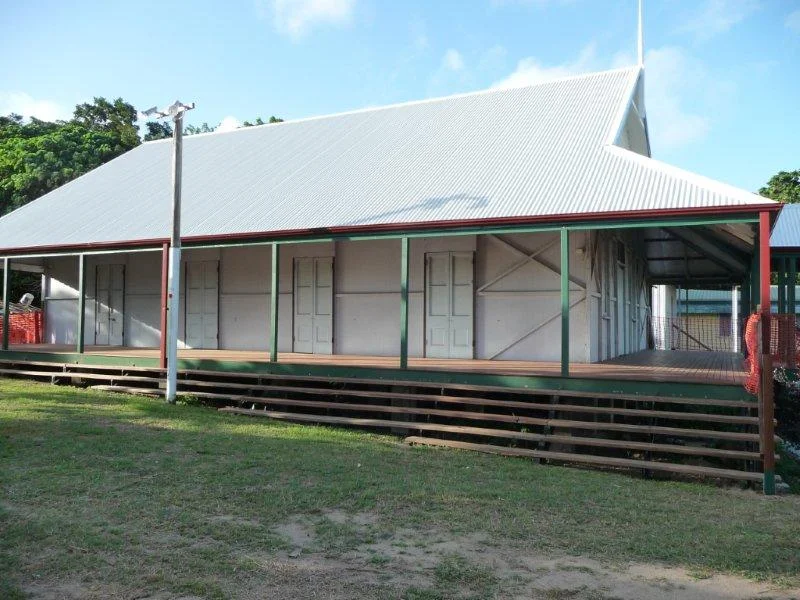
The cathedral's construction materials reflect its isolation. Mass concrete was used for the walls, rendered and scored to mimic cut stone -- an act of architectural aspiration in a place where quarried stone was unavailable. The Church Hall, positioned near the Douglas Street frontage, is a more typical Queensland building: timber-framed, raised on concrete stumps, with a high gabled roof and verandahs. A tall finial decorates the front gable. Inside the cathedral, the original furnishings include timber pews, a carved altar, and decorative fretwork. The precinct's significance extends beyond architecture. It represents the establishment of the Anglican Church in one of Australia's most culturally diverse communities, where Japanese pearl divers, Malay fishermen, Pacific Islander laborers, and Indigenous Torres Strait people lived and worked alongside European settlers.
Memory and the Strait
The Quetta disaster was not an isolated tragedy but part of a pattern. The Torres Strait is one of the most dangerous navigational passages in Australian waters, a maze of reefs, shoals, and tidal currents between Cape York and New Guinea. Ships had been wrecking in these waters for centuries -- the crew of HMS Pandora, sent to capture the Bounty mutineers, shipwrecked on a Torres Strait reef in 1791. The Quetta Memorial Precinct was listed on the Queensland Heritage Register on 21 October 1992, recognized for its demonstration of Queensland's history, its Gothic Revival architectural character, and its deep significance to the Thursday Island community. The precinct is both a place of worship and a monument to the human cost of navigating Australia's northern frontier -- 134 names remembered in concrete and timber on a small island at the top of the continent.
From the Air
The Quetta Memorial Precinct is located on Douglas Street, Thursday Island, at approximately 10.58S, 142.22E. The cathedral's distinctive gabled roofline is visible among the township buildings on the ridge. Thursday Island is accessed via Horn Island Airport (YHID). Recommended viewing altitude: 1,500-2,500 feet. The Torres Strait itself, with its visible reefs and shoals, provides context for the maritime disaster that inspired the precinct. The wreck site of the Quetta lies in the strait waters nearby.
Nearby Stories
- Jardine River 2.3 km away
- Badu Island 29 km away
- Yam Island 53 km away
- HMS Pandora (1779) 146 km away
- All Saints Anglican Church, Darnley Island 161 km away
- Duyfken Point 186 km away
- Wasur National Park 218 km away
- Australia–Indonesia Border 272 km away