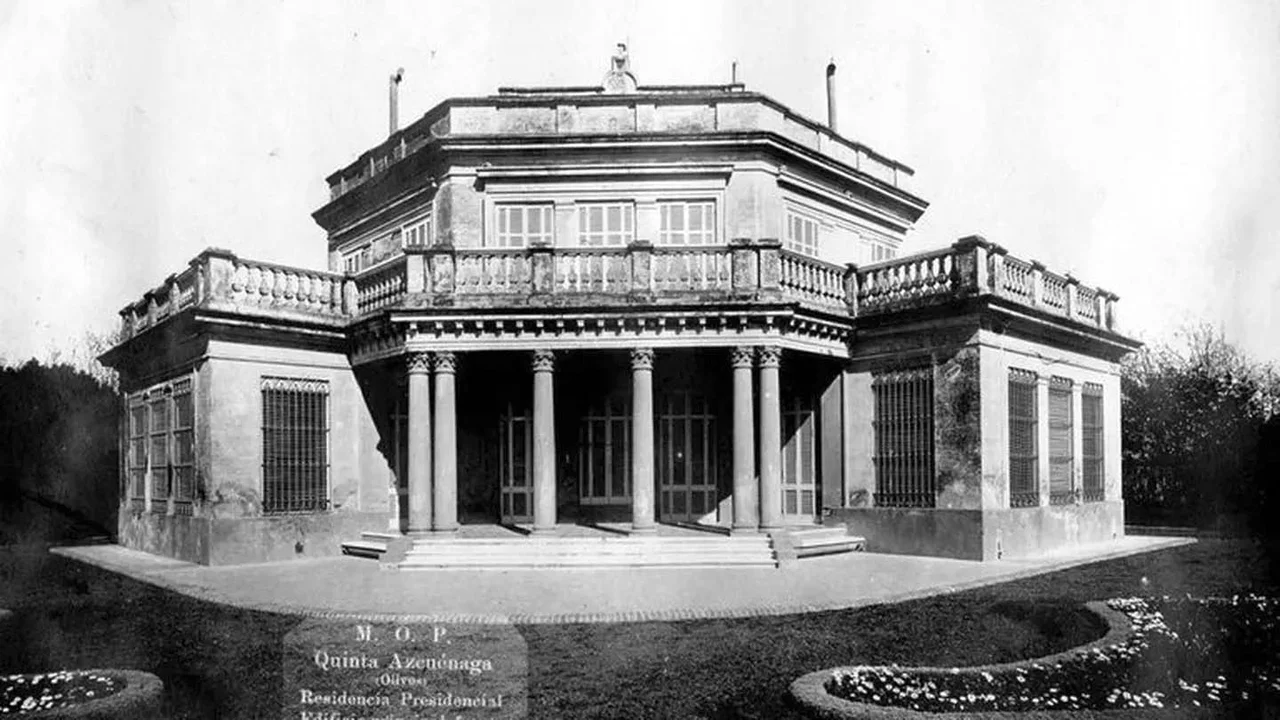

Quinta de Olivos
In 1961, on a wooded estate north of Buenos Aires, the president of Argentina sat down for a secret meeting with one of the most wanted revolutionaries on the planet. Arturo Frondizi was trying to mediate between Washington and Havana, and the man across from him was Che Guevara, the Argentine-born guerrilla who had become Cuba's minister of industries. The talks were meant to stay hidden behind the gardens and palm groves of the Quinta de Olivos. When they leaked, they helped topple Frondizi the following year. That is the kind of history this place holds. For more than a century the Quinta has been the official residence of Argentina's presidents, and almost every twist of the country's turbulent politics has passed through its rooms.
From Birdcage to Bequest
The land goes back nearly to the city's founding. When Juan de Garay re-established Buenos Aires in 1580, this bluff overlooking the Rio de la Plata, about 20 kilometers north of the center, was among the first lots handed out. In 1774 a section was bought by Manuel de Basavilbaso, postmaster general of the viceroyalty, and it passed by marriage to Miguel de Azcuenaga, an officer who would take part in the 1810 May Revolution that began Argentina's road to independence. He kept bees on the grounds and turned the estate into a place for horses. In 1851 he commissioned the architect Prilidiano Pueyrredon to build a manor blending Neogothic and Baroque styles; finished in 1854, the owner fondly called it his "birdcage." Childless, Azcuenaga willed it down a line of nephews until one of them, Carlos Villate, attached a condition: on his death the property should pass to the nation, to serve as the president's summer home.
A Reluctant Palace
The state was slow to embrace the gift. Villate died in 1913, but for years officials debated turning the 35-hectare estate into a public park, since Argentine presidents had always lived in their own houses. President Hipolito Yrigoyen finally accepted the deed in 1918, then handed the place to his foreign minister rather than move in. Its first taste of presidential use was almost accidental: when the coup of 1930 installed the ailing General Jose Felix Uriburu, he retreated here during a 1931 heat wave for the river breeze. Even decades later, the compound's sheer opulence made some leaders uneasy. General Leopoldo Galtieri preferred officers' quarters at an army base, and Eduardo Duhalde, who took office amid the 2002 economic collapse, declined to live in such grandeur while the country went hungry.
Where Power Came to Rest, and to Fall
Few residences have witnessed so much. Juan Peron embellished the grounds with an amphitheater, a reflecting pool, and a greenhouse, and the estate later became entangled in the scandals that helped bring him down in 1955. He died here on 1 July 1974, having returned from exile to govern with his inexperienced wife Isabel as vice president; during her presidency the coffins of both Juan and Eva Peron lay in state in the mansion before the 1976 coup sent them to separate cemeteries. A 1969 concert here sparked a fire that badly damaged the historic house, though most of its original structure survived. And in November 1993 the Quinta hosted the Olivos Pact, the deal between Carlos Menem and the opposition leader Raul Alfonsin that paved the way for the 1994 reform of the constitution.
A Working Estate Still
The Quinta has never stopped evolving with its occupants. Successive presidents have layered their own tastes onto the grounds: a heliport added in 1969, a chapel in 1972, even a miniature golf course installed by Menem in 1991. The landscaping that Azcuenaga began endures in the towering palms, the cedars and cypresses, and the row of plane trees that once shaded his favorite path. From the air the estate reads as an unusual swath of dense green on the affluent northern riverside, a private wood in a crowded metropolis. It remains a place where Argentina's leaders sleep, host visitors, and weather their crises, the quiet backdrop to a public life lived under constant pressure.
From the Air
The Quinta de Olivos lies in the riverside suburb of Olivos, north of the capital, at roughly 34.515 degrees south, 58.483 degrees west. From the air it appears as a large, densely wooded green estate set back from the Rio de la Plata, conspicuous among the dense residential blocks of Greater Buenos Aires, with the immense brown river just to the east. The nearest airport is Aeroparque Jorge Newbery (ICAO SABE), about 10 km south along the riverbank; the larger Ministro Pistarini International, or Ezeiza (ICAO SAEZ), is roughly 30 km to the south-southwest. As an active presidential residence it sits within restricted airspace, so it is a landmark to identify from a distance rather than to overfly. Clear daylight best reveals the canopy of old palms and plane trees that distinguish the grounds.
Nearby Stories
- Ezeiza Massacre 1.9 km away
- Luján, Buenos Aires 5.1 km away
- Curutchet House 13 km away
- Colonia del Sacramento 17 km away
- Martín García Island 28 km away
- Atucha Nuclear Power Plant 37 km away
- Lobos 43 km away
- Cry of Asencio 87 km away