
Qustul
In 1964, as the waters behind the new Aswan High Dam began rising, archaeologists worked against the clock at a Lower Nubian cemetery called Qustul. They pulled out an incense burner carved from limestone, its surface showing what looked like a procession of boats and - more arrestingly - a figure wearing the White Crown of Upper Egypt. The object was dated to 3800-3000 BCE, which meant Nubian rulers might have been wearing pharaonic regalia before Egypt had pharaohs. The lake rose. The debate over what that means has never drained.
Cemetery L and the Incense Burner
Qustul sits - or rather, sat - on the east bank of the Nile in Lower Nubia, just across from Ballana near the modern Sudanese-Egyptian frontier. Three significant A-Group cemeteries were excavated here, dating to the times of Egypt's First Dynasty and earlier - at least 5,800 years ago. The most important was Cemetery L, whose graves held the kind of wealth that told archaeologists they were looking at rulers, not villagers. The incense burner from one of those tombs, now at the University of Chicago, is where things got interesting. Bruce Williams of the Oriental Institute argued in the 1980s that the iconography showed pharaonic kingship already established in Nubia before it appeared in Egypt. Other scholars disagreed, sometimes sharply. More recent discoveries at Abydos in Upper Egypt - elite iconography of the Naqada I period - suggest royal symbolism was developing on both sides of the frontier simultaneously.
A Debate That Wouldn't Die
For a long time, the idea that Nubia might have contributed to the birth of pharaonic civilization was treated as vaguely heretical. Christopher Ehret, writing in 2023, put it bluntly: Williams' findings were challenged because of "long-held assumptions of ancient Egypt as somehow in but not of Africa." The tombs at Qustul, Ehret argued, were simply exceptional - comparable in scale and wealth to the earliest Egyptian royal burials at Abydos. Maria Carmela Gatto wrote in 2020 that whatever the claim, the tombs' importance remained "a fact." The Nubian contribution to pharaonic culture - iconography, symbolism, perhaps ritual - was real, even if Williams' strongest version of the argument overreached. Robert Bianchi countered in 2004 that the Qustul incense burner was carved from Egyptian limestone and should be read as an import, not a Nubian invention. The scholarship goes back and forth. The tombs stay underwater.
The X-Group Kings With Crowns
Qustul has a second, later story. In 1931 to 1933, the British Egyptologist Walter Emery excavated a necropolis here belonging to the X-Group culture, dating from the fourth to the sixth centuries CE. These were enormous tumulus graves with bed-burials for kings - and the royal status of the deceased was not in any doubt. When the excavators opened the chambers they found bodies still wearing their crowns. Horses had been sacrificed alongside their masters, along with their trappings and - disturbingly - servants, whose deaths accompanied their ruler's. The X-Group kings of Qustul and neighboring Ballana ruled a post-Meroitic Nubian kingdom during the twilight of Roman Egypt. They are not well known outside specialist circles, but they buried themselves like emperors, and for a brief few centuries, they more or less were.
A Site Beneath Water
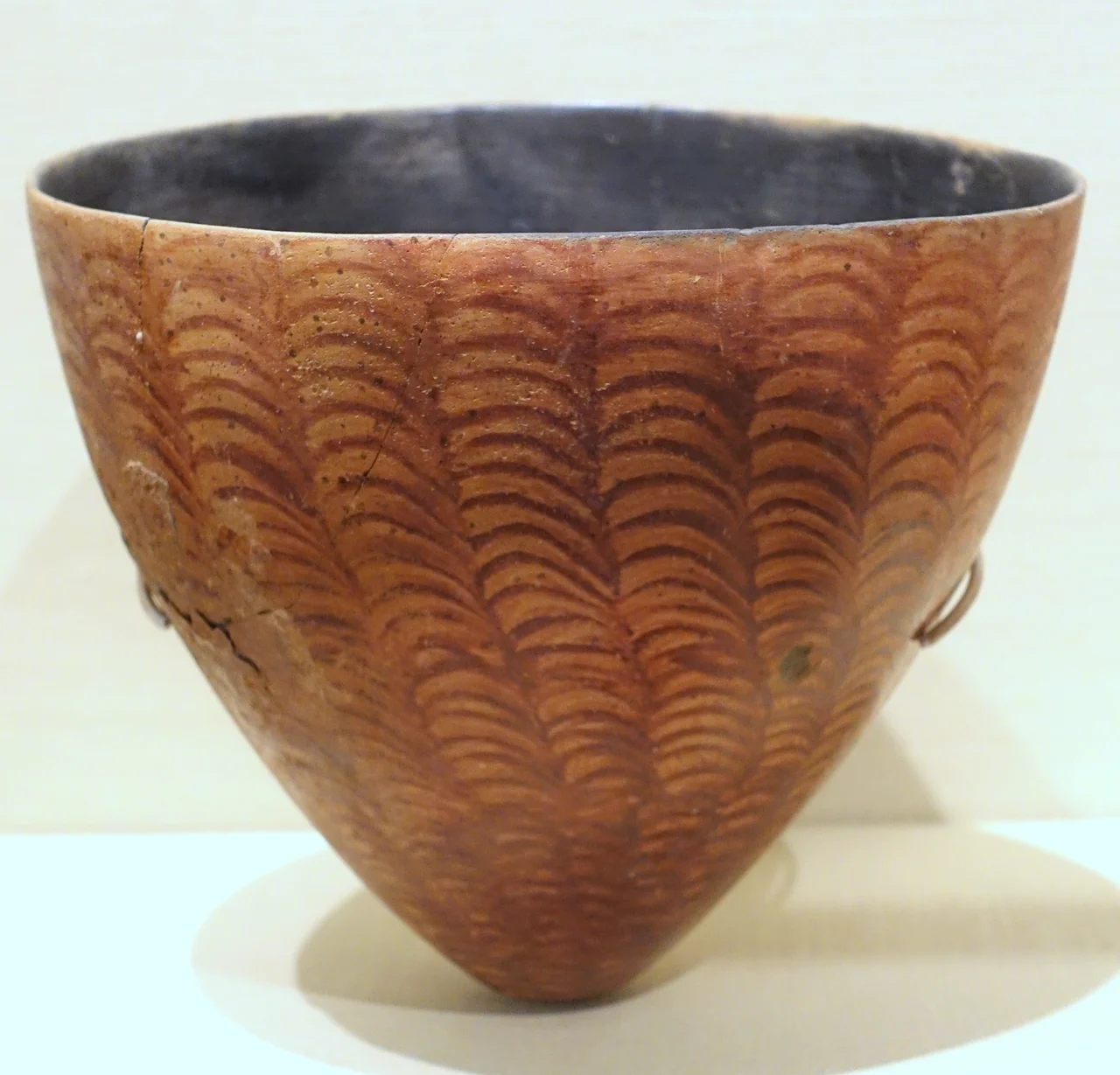
The Qustul cemeteries are no longer available for excavation. The cliffs that once held them lie beneath Lake Nasser, the reservoir created by the Aswan High Dam in the 1960s. David Wengrow has noted that the A-Group polity of the late 4th millennium BCE remains poorly understood precisely because so many of its remains are now submerged. Some of the Qustul material survived in museum collections - the incense burner, the crowns, the ceramic bowls from Cemetery V with their painted scallop decoration. The rest is underwater, or gone, or never found at all. What remains of Qustul is a question still unfolding about where kingship came from on the Nile, and who wore a crown first, and whether that question even has the shape we have been assuming.
From the Air
Historical location at approximately 22.23N, 31.62E - now submerged beneath Lake Nasser in far southern Egypt, just north of the Sudanese border. Recommended viewing altitude: 4,000-6,000 feet AGL to see the distinctive shape of the reservoir and the surrounding Nubian Desert. The site itself is underwater, but the Abu Simbel relocated temples (HEBA airport, about 50 km north) make the region a common VFR destination. Aswan International (HEAS) is roughly 280 km to the north. The flat tablelands on both banks of the lake are the same sandstone cliffs where Qustul's tombs once stood.
Nearby Stories
- Buhen 20 km away
- Qasr Ibrim 57 km away
- Kulb 105 km away
- Kulubnarti 135 km away
- Temple of Dendur 139 km away
- Bi'r Tawīl 180 km away
- Bir Tawil 184 km away
- Kharga Oasis 308 km away