
Rachel Chiesley, Lady Grange
On the night of 22 January 1732, men forced their way into Rachel Chiesley's lodgings in Edinburgh, bound her, gagged her with a cloth that loosened two of her teeth, and carried her down a back stair into a sedan chair. She was forty-three years old, the mother of nine children, the wife of one of the most senior judges in Scotland. Her husband had arranged the abduction. He did not want her dead; he wanted her silenced. For the next thirteen years and three months she was held against her will in some of the most remote places in the British Isles - the Monach Isles, the Atlantic outpost of St Kilda, the island of Skye. She died in captivity in May 1745. The legal apparatus of Scotland, in which her husband sat at the highest level, did not intervene.
Daughter of a Murderer
Rachel was baptised in Edinburgh on 4 February 1679, one of ten children of John Chiesley of Dalry and Margaret Nicholson. Her parents' marriage was unhappy. When her mother sued for aliment - the Scottish term for financial maintenance - the court awarded her 1,700 merks, a substantial sum. Rachel's father refused to accept the judgement. On Easter Sunday 1689 he walked up the Royal Mile and shot the judge, Sir George Lockhart of Carnwath, dead in the street as Lockhart walked home from church. He made no attempt to flee. He was tried the next day before the Lord Provost, condemned, and four days after the murder taken from the Tolbooth to the Mercat Cross, where his right hand was cut off, the pistol he had used was hung around his neck, and he was hanged. Rachel was ten years old when her father was executed in a public square of her city. Her childhood was not gentle, and the shadow of that violence followed her into adulthood.
Marriage to Lord Grange
Somewhere around 1707, when Rachel was about twenty-eight, she married James Erskine, a Scottish advocate who would later sit as a Senator of the College of Justice under the judicial title Lord Grange. He was the younger brother of John Erskine, Earl of Mar, the man nicknamed Bobbing John for his shifting loyalties during the political turmoil that followed the union of the Scottish and English parliaments in 1707. The Earl led the Jacobite rising of 1715 against George I and, when it collapsed, fled into exile from which he never returned. James Erskine survived in Edinburgh as a successful jurist, but he kept his Jacobite sympathies. By the 1720s the Granges had nine children. The marriage, by all later accounts including Rachel's, had become a war.
What She Knew
Sometime in the late 1720s the marriage collapsed completely. The couple separated. Rachel moved into Edinburgh lodgings. She produced letters and documents which, she said, were evidence that her husband was actively engaged in treasonable correspondence with the exiled Jacobite court. To produce them publicly would have ended his career and possibly his life. He did not want them produced. He had her watched. He calculated, correctly, that the men of his political and social circle - some of whom shared his Jacobite sympathies, some of whom were the most powerful figures in the Highlands - would help him solve the problem if he asked. He asked Simon Fraser, Lord Lovat, the chief of Clan Fraser. The abduction was planned in detail and carried out, and Rachel disappeared into the network of Highland chiefs who owed favours to the men who arranged it.
The Long Imprisonment
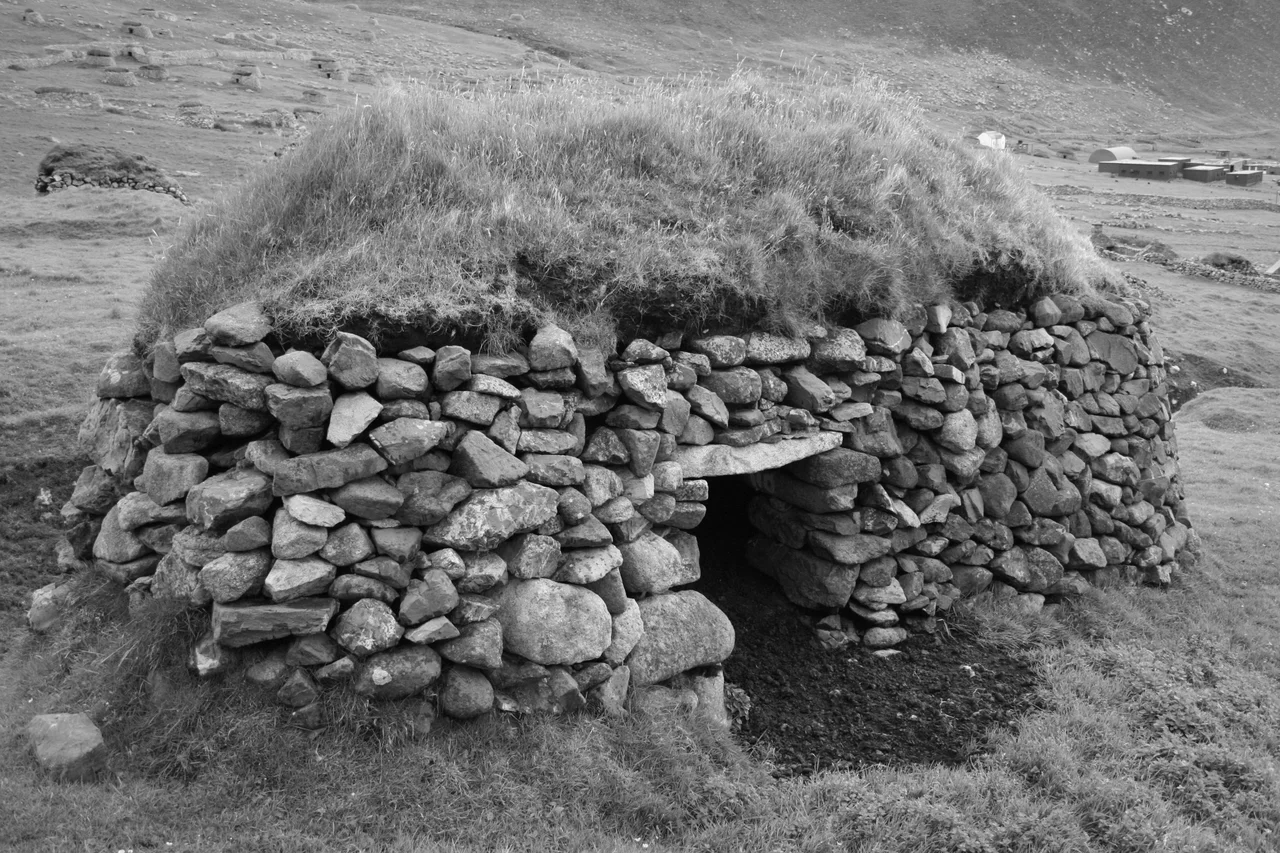
She was taken first west, then north, then by boat from the mainland. For two years she was held in a turf house on a tiny uninhabited Monach Isle off North Uist, watched by minders, allowed almost no contact. In 1734 she was moved further out, to the cluster of cliffs and grass that is St Kilda, 40 miles from any other land, the most isolated permanently inhabited place in Britain. She lived among the Gaelic-speaking islanders in a small stone cleit, neither prisoner exactly nor free. She wrote, year after year, smuggled letters out by visiting ministers and rare passing ships. Most never reached anyone who could help. One eventually did. In 1740 her Edinburgh lawyer, Thomas Hope of Rankeillor, organised a rescue attempt that failed when the rescuers arrived to find she had been moved. She was moved again, this time back across the Minch to Skye, kept in turn at Idrigill on the Duirinish peninsula and then at Trumpan, then at Waternish. She died at Trumpan on 12 May 1745, having been imprisoned for thirteen years and three months. She was buried at Trumpan Church on Skye. There is a marker in the graveyard there for her, and another at Duirinish.
Her Voice
Several letters in her own hand survived. They are unlike anything else in 18th-century Scottish prose. She describes the cold, the food, the people who guarded her, the husband she still calls hers, the children who did not come. She does not pretend to be calm; she is by turns furious, despairing, sharp, sometimes funny. She is not what her husband and her captors wanted her to be, which is a woman of mental instability who could be safely written out of the historical record. She was a difficult woman in a society that did not tolerate difficult women, and she was also a wife who had stumbled on her husband's treason and had been removed for it. After her death the Scottish poet Edwin Morgan wrote a long poem in her voice, called Lady Grange on St Kilda. The playwright Sue Glover wrote The Straw Chair. Both works do what her husband most wanted to prevent: they let her speak.
From the Air
Trumpan, on the Waternish peninsula of Skye where Lady Grange died and is buried, lies at approximately 57.62°N, 6.62°W. Idrigill, where she was earlier held on Skye, is at 57.45°N, 6.40°W on the Duirinish peninsula. St Kilda, her remote prison from 1734 to about 1740, lies at 57.81°N, 8.58°W, 40 nautical miles west of the Outer Hebrides; from the air the Hirta cliffs rise more than 400m straight from the sea. The Monach Isles, her first captivity from 1732, sit at 57.51°N, 7.62°W off North Uist. Nearest airports are Benbecula (EGPL) for the Monach Isles and a feasible base for St Kilda overflights; Stornoway (EGPO) for Skye approaches; Inverness (EGPE) for mainland connections. Recommended viewing altitude 2000-4000 ft AGL, but the St Kilda group should not be overflown at low level in marginal weather - the Atlantic squalls there can be sudden and severe.
Nearby Stories
- Talisker 4 km away
- Corriechatachan 8.4 km away
- Eilean Glas Lighthouse 8.6 km away
- Lochmaddy 8.8 km away
- Rua Reidh Lighthouse 10 km away
- BUTEC 12 km away
- South Uist 18 km away
- Flannan Isles Lighthouse 60 km away