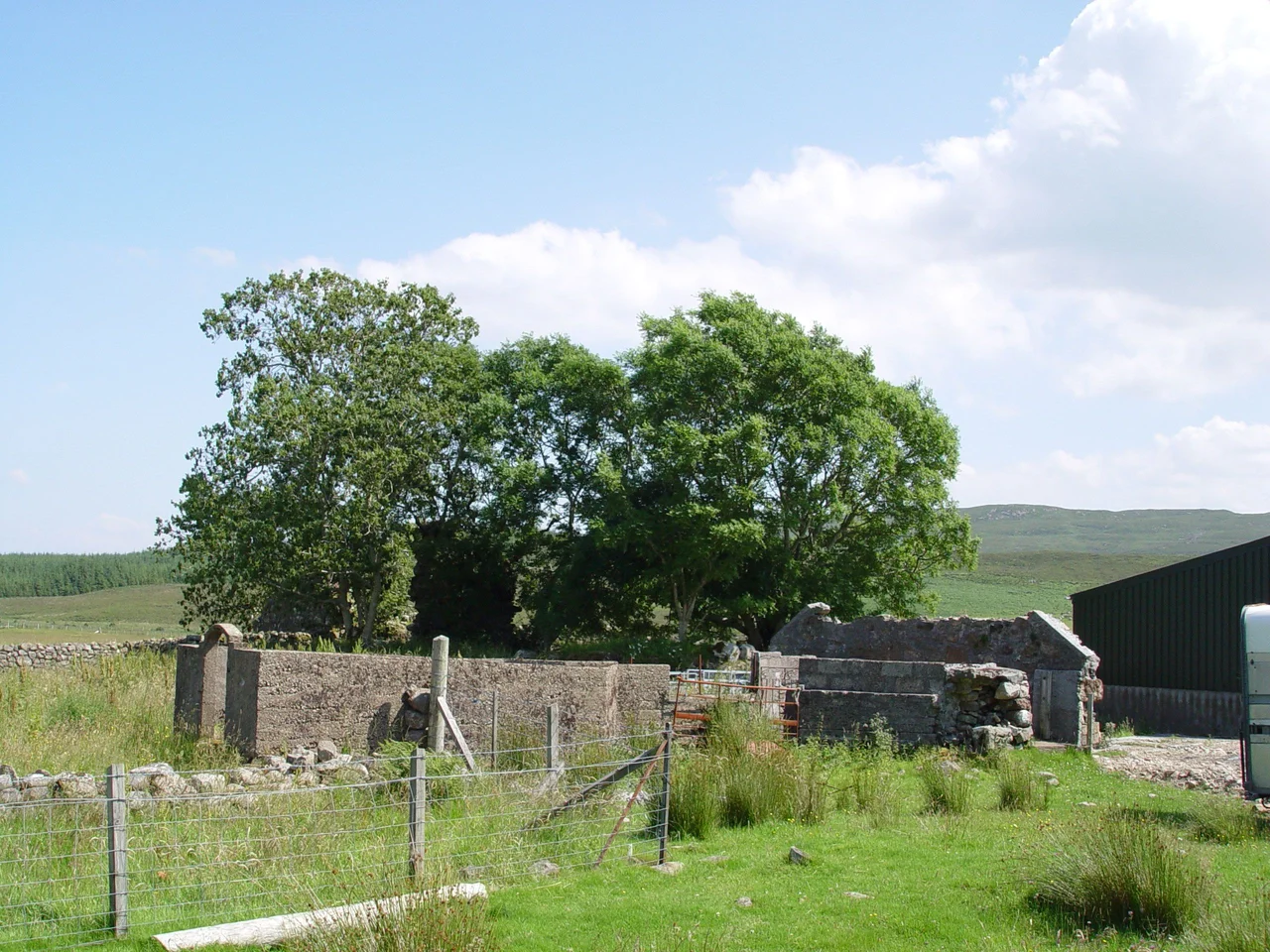

Corriechatachan
The name is Gaelic for "corrie of the wild cats" - a corrie being a high bowl carved by ice, the wild cats being long gone. The farmstead itself lies at the foot of Beinn na Caillich near Broadford on Skye, between two brooks, with one of the highest hills on the island rising behind it. Until about 1790 it belonged to a cadet branch of Clan Mackinnon and served as a tack - a tenanted farm with social standing. Its place in the literary record comes from a single visit, or rather two visits, in 1773, when Samuel Johnson and James Boswell arrived on their famous tour of the Highlands and found themselves drawn into the warmth of Mackinnon hospitality.
"A House Very Pleasantly Situated"
Johnson, never given to enthusiasm without reason, wrote: "From Armidel we came at night to Coriatachan, a house very pleasantly situated between two brooks, with one of the highest hills of the island behind it. It is the residence of Mr. Mackinnon, by whom we were treated with very liberal hospitality, among a more numerous and elegant company than it could have been supposed easy to collect." The elegance was real. Boswell catalogued the library: Hector Boece's history in Latin, William Cave's Lives of the Fathers, Baker's Chronicle, Jeremy Collier's Church History, Johnson's own small Dictionary, Craufurd's Officers of State. This was a Highland tacksman's house in 1773, not a rural backwater but a household well stocked with the European intellectual furniture of its age.
The Lap of the Rambler
On their second visit, Boswell recorded a scene he found highly comic: "This evening one of our married ladies, a lively pretty little woman, good-humouredly sat down upon Dr Johnson's knee, and, being encouraged by some of the company, put her hands round his neck, and kissed him." Johnson's reply, in Boswell's transcription: "'Do it again,' said he, 'and let us see who will tire first.' He kept her on his knee some time, while he and she drank tea. He was now like a BUCK indeed." Boswell, ever the appreciative observer, called it "highly comick, to see the grave philosopher - the Rambler - toying with a Highland beauty." Whatever else Corriechatachan was, it was for one evening a place where Johnson laughed.
Pennant and the Tourists Who Followed
Johnson and Boswell were not the first literary travellers through this country. Thomas Pennant had passed through in 1769, on the travels that produced A Tour of Scotland in 1769 (1771) - a book that did much to make the Highlands fashionable for educated travel. Pennant's account, with its careful natural history and ethnographic detail, primed an English reading public for the more famous accounts that followed: Johnson's A Journey to the Western Islands of Scotland in 1775, and Boswell's Journal of a Tour to the Hebrides published a decade later. Together these three books transformed the Hebrides from a remote curiosity into a place that the literate sought out. Corriechatachan, briefly, was part of the itinerary.
The Move to Broadford
The Mackinnons left Corriechatachan around 1790 and moved to Corry Lodge in Broadford, the larger village nearby. The reasons are not recorded with much detail - likely a combination of changing economics, the growing convenience of village life, and the slow drift of tacksmen toward more accessible holdings. The old farmstead became, and remains, a sheep fank: an enclosure for working with sheep. The walls are partly standing. The two brooks Johnson noted still run on either side. Beinn na Caillich rises behind, as it did when the books were in Latin on the shelves and a Mackinnon hostess sat down on the lap of the most famous man in English letters and dared him to make her tire first.
From the Air
Coordinates 57.2319°N, 5.93972°W roughly 1 nm southwest of Broadford on the Isle of Skye, at the foot of Beinn na Caillich. From 2,500-3,500 ft AGL the ruined steading is a small grouping of low walls in green ground between two visible burns, with the prominent red granite cone of Beinn na Caillich (732 m) immediately behind. Broadford Bay sits to the north. Nearest fields: Plockton (EGPO) 11 nm northeast, Broadford bay 1.5 nm north. Watch for orographic lifting and wave activity off Beinn na Caillich in westerlies.
Nearby Stories
- Arisaig 5.3 km away
- Talisker distillery 9.7 km away
- Loch Torridon 11 km away
- Uig 12 km away
- Neptune's Staircase 16 km away
- Glen Affric 18 km away
- Corrieshalloch Gorge 34 km away
- Coll 39 km away