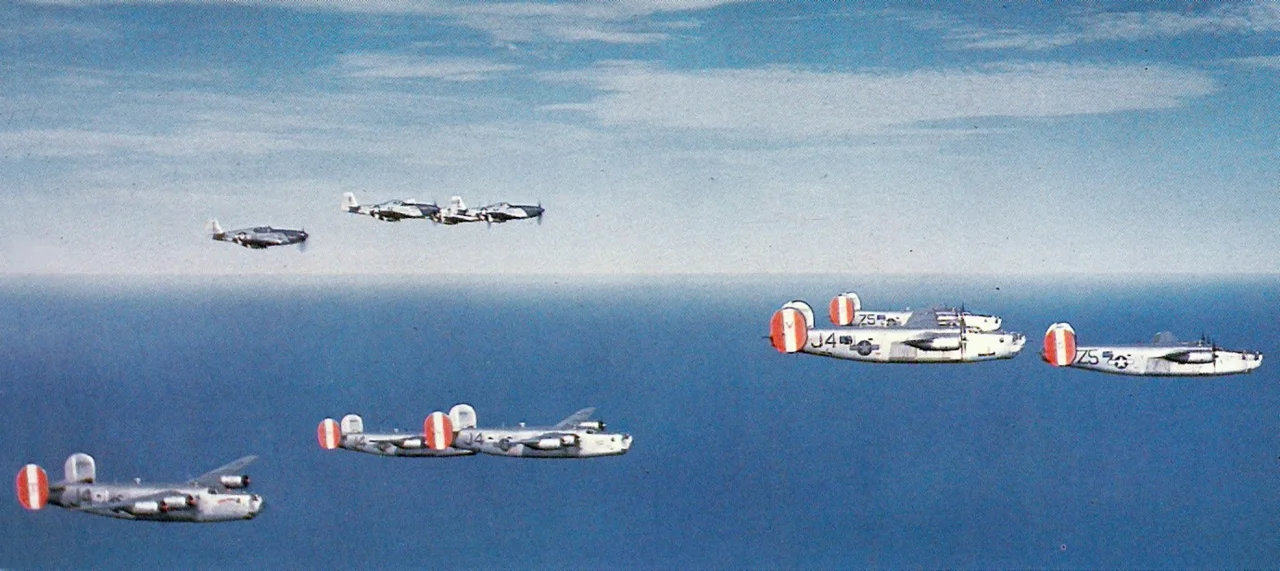
![Photo: USAF; smaller version [1] uploaded by User:Bwmoll3 on en.wikipedia, 26 September 2006 (original upload date) | Public domain](https://commons.wikimedia.org/wiki/File:B-24s_458th_BG_with_P-51s.jpg)
RAF Horsham St Faith
In August 1941 a Bristol Blenheim of No. 18 Squadron RAF, briefed for a power-station raid at Gosnay in occupied France, took a detour. The crew flew over the German airfield at Saint-Omer and dropped a wrapped parcel by parachute onto the grass below. Inside was a pair of artificial legs. They were for Wing Commander Douglas Bader, the famous double-amputee fighter ace, who had been shot down over France two months earlier and had lost his prosthetic legs in the process of bailing out. The Blenheim was based at RAF Horsham St Faith, a brick-and-tile bomber station just north of Norwich. Today that same airfield is Norwich International Airport, ICAO EGSH, and you can still see three of the original five C-type hangars from the perimeter road.
A Bomber Station with Central Heating
Horsham St Faith was not a hasty wartime improvisation. The station was developed in 1939 and formally opened on 1 June 1940 as a bomber base of the kind the RAF had been building before the war - five permanent C-type hangars, brick-and-tile permanent buildings, central heating, a high standard of accommodation for both officers and men. By 1944 most British and American airfields in East Anglia were Nissen-hut shantytowns thrown up in months, and Horsham's brick warmth had become a luxury. The first aircraft to arrive in 1939 were dispersed Bristol Blenheims of No. 21 Squadron. The first operational aircraft were Supermarine Spitfires of No. 19 and No. 66 Squadrons flying down from RAF Duxford. Boulton Paul Defiants of No. 264 Squadron began sorties from here on 12 May 1940 in the desperate first weeks of the German offensive in France. Then No. 139 and No. 114 Squadrons brought their Blenheim IVs in as the first proper bomber units, beginning the field's long career of low-level raids across the Channel.
Mosquitoes and Marauders
In December 1941 No. 105 Squadron arrived from RAF Swanton Morley to begin training on a new aircraft: the de Havilland Mosquito, a wooden, twin-engine fast bomber that was about to change the math of daylight raids over occupied Europe. From June 1942 the squadron began flying photographic and bombing missions over Germany. Two famous visitors had already inspected the airfield - the former Prime Minister Neville Chamberlain in his last years, and General Sir Alan Brooke, the Chief of the Imperial General Staff. In September 1942 the field was handed over to the U.S. Army Air Forces' Eighth Air Force as Station 123. The first American arrivals were Martin B-26 Marauders of the 319th Bombardment Group, who arrived on 4 October and were redeployed to North Africa six weeks later. The 56th Fighter Group followed in April 1943 with their Republic P-47 Thunderbolts and entered combat with a fighter sweep over St Omer on 13 April. The 56th would become the highest-scoring fighter group in Europe; their stay at Horsham was brief because the field was being torn up to accommodate heavy bombers, and they were moved unhappily to the mud of RAF Halesworth in July.
The 458th Bomb Group
When the rebuild was finished and the runways could take Liberators, the 458th Bombardment Group (Heavy) arrived in late January 1944 from Tonopah, Nevada. They flew their first mission on 24 February with Consolidated B-24s. On 2 March one of those B-24s, heavily loaded for a mission, crashed on take-off and came down on nearby Hellesdon, which lay directly under the climb-out path. The group flew 240 combat missions, losing 47 aircraft in combat and 18 more to accidents. In September 1944 they took part in what came to be called the trucking missions - using B-24s as fuel tankers to ferry petrol across the Channel to Patton's Third Army, which was outrunning its supply lines. They flew their last combat mission on 25 April 1945 and returned to Sioux Falls Army Airfield, South Dakota in July.
Mosquitoes, Meteors and a Polish Squadron
After the Americans left in July 1945 the airfield went back to RAF Fighter Command. It was occupied by four Gloster Meteor squadrons - among the first British jet units. One of them, No. 307 Squadron, was Polish: pilots and crews who had flown with the RAF since 1940 and now had nowhere to call home. From 1946 to 1948 Meteors were the dominant noise overhead. A Swedish North American Mustang squadron paid a visit in June 1946. Postwar Horsham remained a frontline RAF station for nearly twenty years, hosting an unusual variety of aircraft - Mosquito night fighters, Vampires, English Electric Canberras, de Havilland Venoms, Gloster Javelins, Hawker Hunters, Bristol Sycamores, Westland Whirlwind helicopters. The station was finally deactivated on 1 August 1963 and redeveloped as Norwich International Airport.
EGSH
Most of the wartime buildings are still here. Three of the five great C-type hangars are still used for aircraft maintenance. Two have been converted for commercial use. The original control tower still exists, though it has been restored at the top and a new control tower has been built next to the current main runway. Other wartime buildings are scattered through the airport industrial estate. The old RAF accommodation blocks toward Catton were used by the University of East Anglia as student housing - known to UEA students as Fifers Lane or Horsham Halls - until 1993, when they were demolished and the site redeveloped. Most of the original runways and taxiways are still visible. Only east-west runway 09-27 is in active use; it was extended in 1956 to keep take-offs and landings clear of built-up areas. A section of the old main runway hosts light aircraft. Next to the modern terminal a USAAF memorial display preserves photographs, paintings and a plaque. Behind the modern control tower, isolated by the Norwich Northern Distributor Road, sits the City of Norwich Aviation Museum, where you can stand in a Vulcan bomber and look out over fields that still echo the layout of a 1943 American heavy-bomber base.
From the Air
Norwich International (EGSH), the former RAF Horsham St Faith, sits at 52.6758N, 1.2828E approximately 3 nm north of Norwich city center. Field elevation 117 ft. The main active runway is 09-27, approximately 6,000 ft long, extended eastward by the RAF in 1956. Three original C-type hangars survive on the field. The City of Norwich Aviation Museum lies behind the modern control tower, isolated by the Northern Distributor Road. ATIS, Tower and Approach frequencies should be obtained from current charts. The cathedral and castle of Norwich are 3 nm south; Mousehold Heath (former RAF Mousehold Heath / RFC) lies between airport and city.
Nearby Stories
- Sheringham 2.7 km away
- Wingfield Castle 4.4 km away
- Castle Acre Castle and Town Walls 6.3 km away
- Brancaster 7.1 km away
- West Stow Anglo-Saxon Village 9.3 km away
- Four Days' Battle 80 km away
- Battle of Lowestoft 80 km away
- SM U-97 110 km away