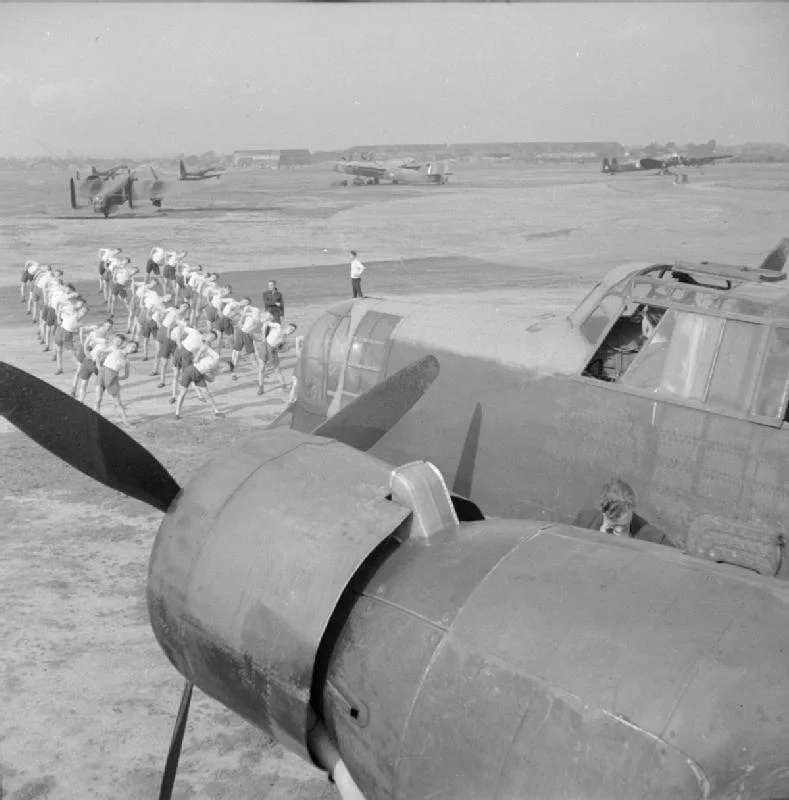
_Parachute_Battalion_training.jpg)
RAF Ringway
Manchester Airport's terminals and runways now cover the place, and the last building from the war years was demolished after 2011 to make room for more car parking. But for a few crucial years in the 1940s, this corner of Cheshire was a hidden engine of the war effort. Every Allied paratrooper trained in Europe, around 60,000 of them, made their first jumps from this airfield. The first Avro Lancaster bomber was built here. Men and women of the Special Operations Executive learned to drop from barrage balloons over the nearby parkland before being sent into occupied France. Today's passengers wheel their cases over the ground where, in July 1940, RAF instructors made the first live jumps that turned Britain into a paratroop nation.
Before the War
Manchester had been looking for a real airport for years. The grass strips at Wythenshawe, opened in April 1929, and at Barton west of Eccles, opened in January 1930, were always going to be temporary. By 1934 it was obvious that the Douglas DC-2 and DC-3 needed more runway than Barton's small boggy field could ever offer. A new site was chosen at Ringway, eight miles south of the city centre, and construction of an all-grass airfield began in late 1935. The first portion opened in June 1937 for Fairey Aviation; the terminal building and the rest of the airfield followed on 25 June 1938, opening as Manchester (Ringway) Airport. Within a year, the country was at war, and the place was about to acquire a second identity.
The Parachute School
In spring 1939 the RAF began building its own station in the north-east corner of the field: two large hangars, workshops, barracks, and ancillary accommodation, with phased completion through early 1940. From June 1940, Ringway became the wartime home of No. 1 Parachute Training School, charged with training every Allied paratrooper trained in Europe and developing techniques for equipment drops and military gliding. Between 1940 and early 1946, roughly 60,000 trainees passed through, from Britain and from the Free forces of occupied Europe. They learned to fall first from cages suspended beneath barrage balloons over Lord Egerton's parkland at neighbouring Tatton Park, then from aircraft taking off at Ringway and dropping them over the same fields from around 800 feet, in batches of ten or twenty. Some trainees asked to land in Tatton Mere or in the trees, to prepare for the kind of jumps that combat operations would actually demand.
Agents and the Roman Candle
Men and women agents of the Special Operations Executive were trained to jump here too. Their holding centre, the comedian Frank Muir later remembered, was an Edwardian house on the airfield's edge, with another in nearby Bowdon. Muir himself served at Ringway in the photographic section, working on a slow-motion film project that tried to understand why parachutes sometimes failed to open, a problem grimly known as a Roman Candle. He was also called in to photograph SOE agents for the forged identity documents they would carry into France. The same airfield therefore launched the visible mass armies of D-Day and the invisible single operatives of the secret war, often within yards of each other, with the agents stopping at Muir's camera before disappearing into the darkness over France.
Lancasters in the Hangars
Ringway was a factory as well as a training ground. Over 4,400 warplanes were built here by Fairey Aviation and Avro. The aircraft included the Fairey Battle, Fairey Fulmar, Fairey Barracuda, Bristol Beaufighter, Handley Page Halifax, and Fairey Gannet. Avro's experimental department occupied the 1938 northside hangar from mid-1939 to late 1945, and in 1939 they completed the prototype of the Avro Manchester, a twin-engined bomber that failed in service. Only 202 were built, but in January 1941 the heavily modified Manchester Mk III flew here as the prototype of the Avro Lancaster. The four-engined heavy bomber that would carry Bomber Command through the rest of the war first lifted off from this grass field. The last warplane prototype assembled at Ringway was the Avro Lincoln, which flew on 9 July 1944, with over 100 Avro York transports following from the southside hangars.
After the Whistle
When the war ended, No. 14 Ferry Pilots Pool of the Air Transport Auxiliary stood down. The veterans of the ATA, who had delivered thousands of military aircraft into and out of Ringway, Woodford, Barton, and the other north-west factories, dispersed. No. 613 (City of Manchester) Squadron returned to its prewar base and flew Spitfires and then de Havilland Vampire jets out of the airfield until 1957, when the entire Royal Auxiliary Air Force was disbanded. RAF Ringway closed with it. The hangars and other buildings were handed over for civil airline operations. The two original 1939 hangars survived until late 1995, when they were demolished to make room for Terminal 3. By January 2009 only the old Officers Mess remained, Building 217 on Ringway Road, used by the Airport Archive. It was disused by November 2011, and was later demolished for more car parking. A small garden by Olympic House near Terminal 1 still holds the carved stone memorials to the wartime units and to 613 Squadron. In the railway station now stands a monument to Alcock and Brown, the Manchester pair who first crossed the Atlantic by air.
From the Air
RAF Ringway sits at 53.3539 N, 2.275 W, beneath what is now Manchester Airport (EGCC). The site is entirely active controlled airspace. The Tatton Park dropping zone lies roughly 4 miles north-west; the wartime memorial there marks the far edge of the area used for parachute training. Liverpool John Lennon (EGGP) is roughly 25 miles to the west. Recommended viewing altitude over the surrounding area is 2,500 to 4,000 feet AGL, but movement directly above the airport requires ATC coordination.
Nearby Stories
- Hope Cement Works 1.5 km away
- Liverpool John Lennon Airport 3 km away
- Diglake Colliery Disaster 3.4 km away
- Holt Castle 4.6 km away
- Bank Hall 6.9 km away
- Rochdale Pioneers Museum 8.3 km away
- National Coal Mining Museum for England 9.6 km away
- Belper North Mill 19 km away