
RAF Thornaby
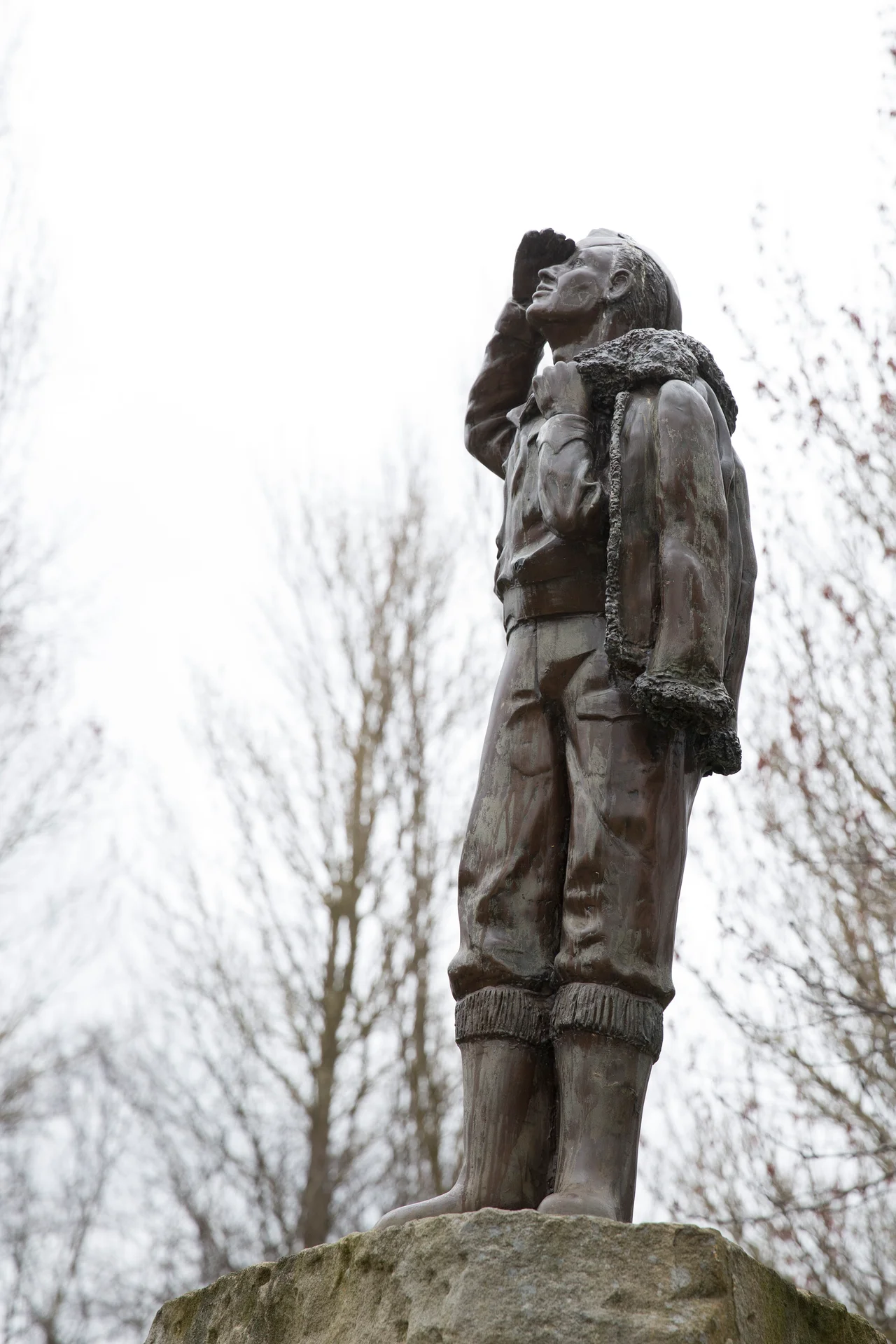
The Thornaby Bag burst open at sea more often than it stayed shut. Designed at this airfield as a survival pack to drop to ditched aircrew, full of food, cigarettes, and a flask, it failed in any but the calmest water and was eventually replaced by the better-engineered Lindholme Gear. But the name stuck, because RAF Thornaby was the kind of place that fixed problems by attaching its own name to them. From 1929 to 1958, this aerodrome on the south bank of the Tees ran fighter sweeps, bombing missions, and the largest Air Sea Rescue operation on Britain's east coast. Almost nothing of it survives on the ground today except a single brick barrack block, a memorial, and a full-size replica Spitfire on a roundabout at the corner of Bader Avenue and Trenchard Avenue.
From Flying Display to Fighter Station
Flying came to Thornaby in 1912 when Gustav Hamel staged a display at Vale Farm. The Royal Flying Corps used the same fields as a staging post between Catterick and Marske from 1914 to 1918. In 1920, the government bought fifty acres of farmland from Thornaby Hall, and the new aerodrome opened officially on 29 September 1929. No. 608 (County of York) Squadron was the first unit to occupy the base, formed here on 17 March 1930 and flying Westland Wapitis and Avro 504Ns. They were the first of three Yorkshire auxiliary squadrons. The station headquarters formed proper on 1 June 1937 under Wing Commander John Leacroft, and within months Thornaby had been transferred to Coastal Command, the role that would define it.
Coastal Command and the Long War
By September 1939, No. 608 Squadron had been embodied into the regular RAF for war work. The station alternated between Coastal and Bomber Commands through the late thirties, with squadrons flying Ansons, Hampdens, Hudsons, and the briefly notorious Blackburn Botha. The Botha was supposed to be a torpedo bomber. It handled badly, suffered airframe fatigue, and by December 1940 the squadron had reverted to the Anson. Spitfire detachments arrived through 1942, including from the Norwegian No. 332 Squadron and the Canadian No. 401 and 403 Squadrons. Air Sea Rescue became the station's specialty from October 1943, when 280 Squadron arrived with Vickers Warwicks, soon joined by 281 Squadron. They flew over the cold North Sea looking for ditched crews, dropping survival gear, marking positions, sometimes recovering survivors directly. In the war's closing months, Beaufighters of No. 455 Squadron RAAF flew anti-shipping strikes from Thornaby into the Baltic. Their last sortie of the war hit Kiel on 3 May 1945.
The Helicopter Years
After the war, Thornaby reinvented itself for the jet age. No. 608 Squadron reformed in May 1946 in the light bomber role, then converted to night fighters with Mosquito NF 30s, then to Spitfire F22s and Harvards as a day fighter unit, then through de Havilland Vampires from 1949 to 1955. On 18 November 1954, No. 275 Squadron arrived from RAF Linton-on-Ouse with Bristol Sycamore HR.13 helicopters. This was the only helicopter Search and Rescue unit in the RAF at the time, on 24-hour standby, capable of airborne within ten minutes. Detached flights spread to strategic points around the British coastline. The squadron eventually ranged from Scotland to the south of England. In September 1957, Hawker Hunter F6s of No. 92 Squadron arrived temporarily while runways at RAF Middleton St George were extended. They left again a year later. The station closed to flying on 13 October 1958. The last entry in the station diary recorded the reduction to Care and Maintenance status. It was signed by the Camp Commandant, a single Flight Lieutenant named H.J. Grant.
Spitfire on the Roundabout
Thornaby-on-Tees Borough Council bought the airfield in 1962. Most of the runway and apron now lie under houses, light industrial units, and the Pavilions shopping centre, with street names borrowed from the RAF: Tedder, Trenchard, Havilland, Bader. In 1976, the Archbishop of York unveiled a stained glass window at St Paul's Church on Thornaby Road. A memorial went up in 1997. In 2007, a full-size replica Spitfire was mounted on the roundabout at Thornaby Road, Bader Avenue, and Trenchard Avenue. It is the most unmissable monument to what stood here. Beneath it, somewhere under the supermarket car parks and three-bedroom semis, lies the outline of an aerodrome that ran fighter sweeps, bombed ports, sank minesweepers, and pulled men out of the freezing sea. Most of Thornaby never lets it be forgotten.
From the Air
Located at 54.53°N, 1.30°W on the south bank of the Tees opposite Stockton, the former airfield sits just southwest of Middlesbrough. From the air today, the rough outline of the runways and dispersals can still be picked out among the housing estates of southern Thornaby. The Pavilions shopping centre covers much of the apron. Teesside International Airport (EGNV) is six miles west and is the spiritual successor to all the region's wartime fields. Durham Tees Valley airspace dominates the lower altitudes. Newcastle (EGNT) lies about 35 miles north. The Tees curves north of the site, with Middlesbrough's Transporter Bridge visible a few miles east.
Nearby Stories
- Raby Castle 3.1 km away
- Crook Hall 3.4 km away
- Middleham Castle 4.8 km away
- Seaham Hall 7.4 km away
- Rievaulx Abbey 9.9 km away
- Whitby 12 km away
- Scampston Hall 17 km away
- German submarine U-2367 48 km away