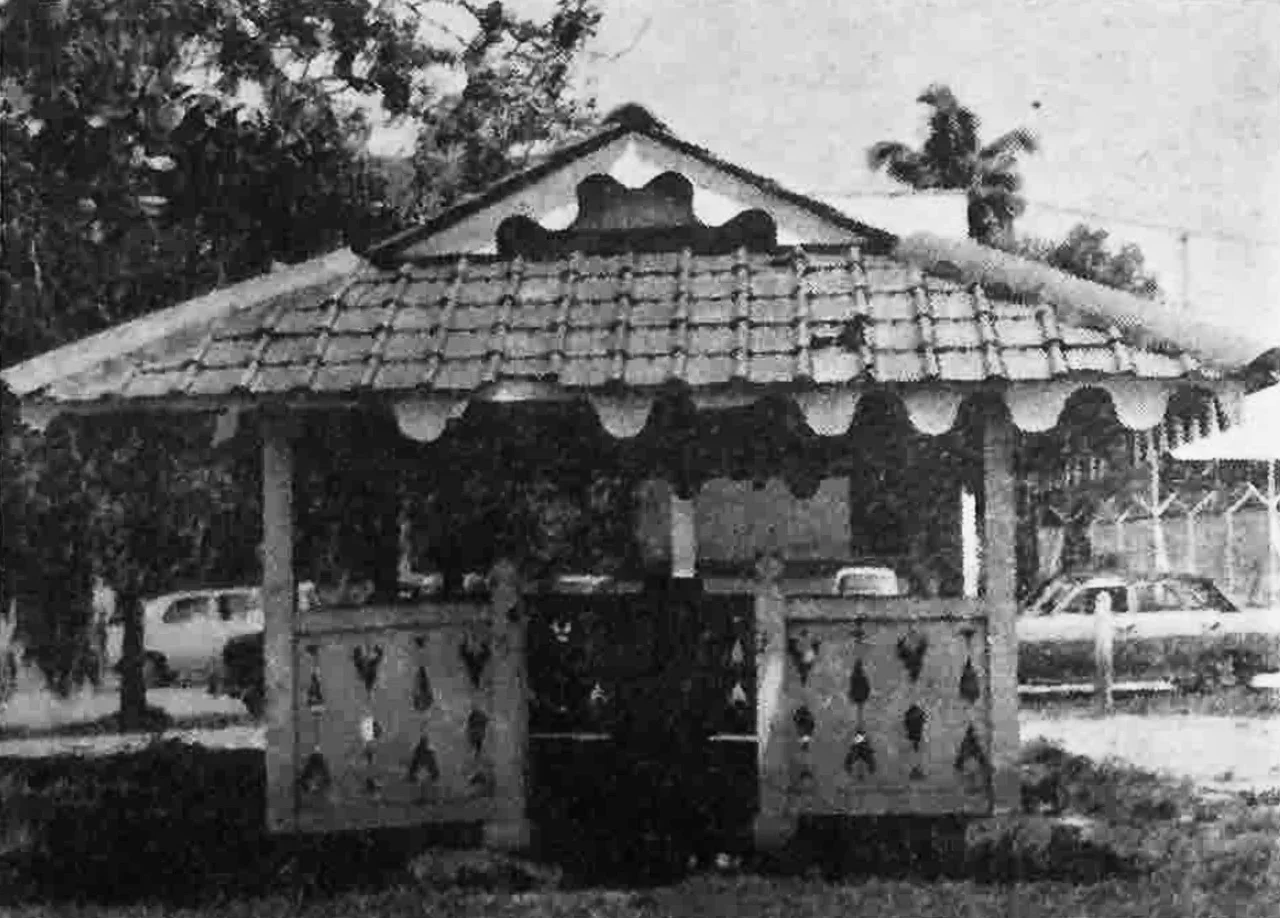

The Tomb That Visitors Keep Destroying with Devotion
Candle wax has rendered the inscriptions nearly illegible. That is the paradox at the heart of the Raja Ayang Mausoleum: the very devotion that has sustained this site for over five centuries is also destroying it. Visitors arrive after dark -- Muslims and non-Muslims alike -- bearing candles, perfume, and sometimes bouquets of chicken feathers, seeking blessings from a tomb whose occupant was, according to legend, not blessed at all but punished. The gravestone dates to 859 in the Hijri calendar, or 1454 AD, and it sits in an octagonal iron fence in the center of Bandar Seri Begawan, a whisper of the 15th century surrounded by the hum of a modern capital.
A Princess and a Hollow Hill
The legend of Raja Ayang has circulated in Brunei's oral tradition for centuries. She was a member of the royal family, a descendant of Sultan Yusof, and she had an affair with her biological brother. The transgression occurred during the reign of Sultan Sulaiman, a ruler remembered for strict Islamic governance following in the tradition of his father, Sharif Ali. The punishment, according to the oral accounts, was extraordinary: Raja Ayang, her brother, and their concubines were sealed inside a man-made hill -- roughly three meters high, six meters wide, and eight meters long. The interior was hollow, divided into compartments like a gigantic inverted crater. A chimney provided ventilation and allowed cooking smoke to escape. They were given food. When the smoke stopped rising, the people outside knew the prisoners had died.
The Codex and the Tombstone
The historical record, fragmentary as it is, both supports and complicates the legend. The Boxer Codex, a Spanish colonial document compiled by a traveler who lived in Brunei, describes Sultan Yusof as a ruler who arrived from Cauin in the southern Arabian Peninsula with a large fleet, conquered the Bisaya people of Brunei, then traveled to China, married a royal princess, and returned. His descendants became the ruling line of the sultanate. The tombstone inside the mausoleum, examined and photographed by the Brunei Museums Department in 1973, bears Javanese script inscriptions dating to 1454 -- a date close to the death of Rokayah, the daughter of Sultan Abdul Majid Hassan, in 1457. The gravestone of Rokayah bears Sultan Yusof's name, though historical records do not explain the connection. Whether Raja Ayang and Rokayah are the same person, or related, or entirely separate figures whose stories have merged across five centuries of retelling, remains an open question.
Bombs, Roads, and the Vanishing Hill
The burial site survived five centuries of Bruneian history, but the 20th century proved harder to endure. Allied bombing during the Borneo campaign in May 1945 damaged the site. According to elders' oral histories, the legendary hollow hill -- the physical structure of the punishment itself -- remained standing until 1946, through the Japanese occupation. What finally destroyed it was not warfare but urban development. The construction of Jalan Elizabeth II, a tarred road running close to the mausoleum, along with the 1950s construction of the General Post Office and the old Radio Brunei building nearby, likely contributed to the hill's disappearance. By the time the Omar Ali Saifuddien Mosque rose on the nearby skyline, the man-made hill that had once sealed a royal family's shame was gone.
Devotion Against the Grain
What remains is a small hut with an iron fence and a pillared roof, sheltering three stone tombstones. One is sandstone, carved with inscriptions in Javanese script. Another is plain gravel, without markings. The mausoleum sits in the city center, enclosed by a gated but unguarded fence that anyone can enter. And enter they do. Visitors come seeking blessings for personal aspirations -- success in gambling is a commonly cited motivation -- leaving candles, perfume, and unusual offerings. The belief in a benevolent guardian spirit watching over the tomb fuels reverence for the site, even though Islamic law expressly forbids this kind of supplication at graves. The irony is tangible: centuries of devotion have left the gravestone surfaces burned and blackened with candle wax, rendering the inscriptions that might answer fundamental questions about Raja Ayang's identity increasingly unreadable. The very reverence that preserved the site's cultural importance is erasing its historical evidence.
Preservation Under the Dome
In September 2008, as part of the National Development Plan 2007-2012, the Public Works Department completed a reconstruction of the mausoleum, transforming its roof into a dome structure. The renovated site was handed over to the Brunei History Centre in October 2009. The reconstruction aimed to protect the tombstones from further deterioration while maintaining the site's accessibility and spiritual significance. A 1986 investigation had identified fragments of calligraphy on the stones: one facing south may contain verses from Surah Al-Mu'min, while a broken stone to the west displays six vertical lines of Jawi script in Arabic naskh calligraphy. These surviving fragments, along with the 1973 photographs taken by the Museums Department, may be all that remains of the original inscriptions -- a slim but precious thread connecting a modern capital to a medieval punishment, a legend to a gravestone, and a princess to whatever truth lies beneath five centuries of wax.
From the Air
Coordinates: 4.8901N, 114.9429E. Located in the Pusat Bandar district of Bandar Seri Begawan, very close to the iconic Omar Ali Saifuddien Mosque whose golden dome is the most prominent aerial landmark in the capital. The mausoleum sits within the urban grid near Jalan Elizabeth II. Kampong Ayer, the world's largest water village, extends along the Brunei River to the north. Brunei International Airport (WBSB) is approximately 9 km northeast. Best viewed at 2,000-3,000 feet to pick out individual structures in the dense city center. Typical equatorial weather with hazy afternoons; morning passes offer sharper definition.
Nearby Stories
- From Residency to Memory 28 km away
- Twenty Years on the Seattle Run 30 km away
- The Abode of Peace on Borrowed Coastline 31 km away
- USS Salute: The Minesweeper That Found the Last Mine 33 km away
- The Ants of Borneo 50 km away
- Sabah State Railway 55 km away
- Starcevich Monument 74 km away
- Luconia Shoals 209 km away