
Ratcliff Highway murders
On the night of 7 December 1811, Margaret Jewell was sent out to buy oysters. She was the servant girl in a small linen draper's household at 29 Ratcliffe Highway in Wapping. Her employer Timothy Marr - twenty-four or twenty-seven years old, a former East India Company sailor - wanted a late-night supper for himself and his young wife Celia, who was still recovering from the recent birth of their first child, also named Timothy. The baby, fourteen weeks old, slept upstairs. The apprentice James Gowan worked alongside Marr in the shop. Jewell had been gone perhaps twenty-five minutes when she returned to find the door locked and the house dark. She heard a footstep on the stairs. The baby cried out. Nobody came to let her in.
The Marr Family
When the neighbours and the watchman finally forced their way in, they found Timothy Marr, Celia Marr, James Gowan, and the baby Timothy dead inside. The killers had used a heavy maul - the head of a sailor's mallet - and a sharp blade. Margaret Jewell was alive only because she had been out trying to find an oyster shop still open after midnight on Saturday, the busy pay-day of working London. She returned to a house where four people including an infant had been killed. The narrow shop was "so floated with gore," one account recorded, "that it was hardly possible to escape the pollution of blood in picking out a path to the front door." The Marrs were buried under a single monument in the parish church of St George in the East, where the baby Timothy had been baptised just three months earlier.
The Investigation
The coroner's jury met on 10 December and concluded the killers had been watching the shop for an opportunity, struck during Jewell's brief absence, and fled out the back door when she returned. Cornelius Hart - a carpenter who had worked at the shop that day and reported losing a chisel - was detained but released. Marr's brother was held for forty-eight hours and exonerated on a firm alibi. A former servant girl was questioned but lacked motive and was too small to have done the killing alone. On 19 December the maul itself was cleaned, and initials emerged carved into the handle with what looked like a seaman's coppering punch: "I.P." or "J.P." The same night the initials surfaced, the killer struck again.
The Williamson Family
Twelve days after the Marr killings, on 19 December 1811, the King's Arms tavern at 81 New Gravel Lane - half a mile from the Marr shop - became the second crime scene. The victims were John Williamson, the 56-year-old publican who had run the tavern for fifteen years; Elizabeth Williamson, his 60-year-old wife; and their servant Bridget Anna Harrington, in her late fifties. Williamson had warned a constable just hours earlier that a man in a brown jacket had been lurking around the tavern. When the cry of "Murder!" went up, John Turner, a journeyman lodger who had lived in the building for eight months, climbed nearly naked out of an upstairs window on a rope of knotted sheets and dropped into the street, shouting incoherently. Seven people - the Marr family of four and the Williamson household of three - were now dead in the same East End streets.
John Williams
On 24 December the maul was identified as belonging to a sailor named John Petersen, who was away at sea. The identification came from a Mr Vermiloe, the landlord of a lodging house called The Pear Tree, who was sitting in Newgate Prison for debt - and who stood to clear his debts with the reward money. Constables searched Petersen's trunk and found the maul missing. A lodger at The Pear Tree, John Williams, became the prime suspect. Williams was educated, popular with women, of medium height and slight build - not at all matching Turner's description of a tall man in a dark flushing coat - and he had been drinking at the King's Arms shortly before the murders. The evidence against him was largely circumstantial: he had money after the killings but not before, his laundress had seen blood and a tear on his shirts, his landlady's stockings had been borrowed and returned muddied and bloodstained. On 28 December, before any trial, Williams used his scarf to hang himself from an iron bar in his cell at Coldbath Fields Prison. He had appeared in good spirits the previous day, telling other prisoners he expected to be released. The suicide was treated as a confession.
Justice as Spectacle
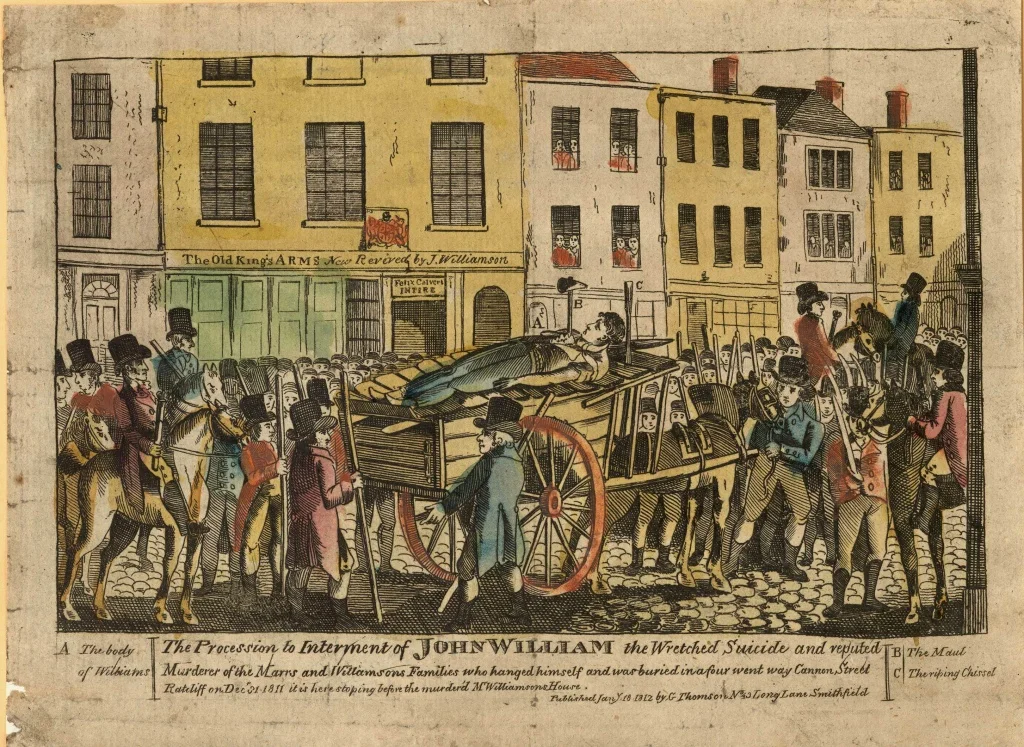
The Home Secretary ordered Williams's body paraded through Wapping and Shadwell. On New Year's Eve 1811, the corpse was removed from prison at 11 a.m. and conveyed by cart up the Ratcliffe Highway. An estimated 180,000 people lined the route - one of the largest crowds in London's history. The procession stopped for nearly fifteen minutes in front of the Marr family's house, and for ten minutes in front of the King's Arms, where the coachman reportedly whipped the dead man three times across the face. As a suicide, Williams could not be buried in consecrated ground. He was put in the earth at a crossroads on Cannon Street Road - the stake meant to keep his spirit from wandering, the crossroads to confuse it, the grave deliberately made too small. Quicklime was added. In August 1886, a gas company digging a trench at the corner of Cannon Street Road and Cable Street unearthed his skeleton, buried upside down with the wooden stake still through its torso. The landlord of the nearby Crown and Dolphin pub kept the skull as a souvenir; its whereabouts today are unknown.
What We Still Don't Know
The motive for the Ratcliff Highway murders has never been adequately explained. P.D. James and her co-author T.A. Critchley argued in their 1971 book The Maul and the Pear Tree that the proceedings were rushed to appease a terrified public, and that Williams may have been a tragic and unfortunate scapegoat. An eyewitness claimed to have heard two men talking outside the King's Arms calling to each other by a name that sounded like "Mahoney" or "Hughey" - not Williams. William "Long Billy" Ablass, a sailor who had served with Williams aboard the Roxburgh Castle, had a history of aggressive behaviour, was lame in a way that matched eyewitness descriptions of one of the men fleeing the Marr scene, and was drinking with Williams at the King's Arms on the night of the second killings. He was detained but released. Thomas De Quincey would later anatomise the crimes in his 1827 essay "On Murder Considered as One of the Fine Arts." The murders feature in Arthur Conan Doyle's first Sherlock Holmes novel A Study in Scarlet, in Peter Ackroyd's Dan Leno and the Limehouse Golem, and in Alan Moore's graphic novel From Hell. The Marrs, the Williamsons, and Bridget Anna Harrington - seven people who lost their lives in two December nights more than two centuries ago - remain, in the strict legal sense, victims of a crime that was never tried.
From the Air
The site of the Ratcliff Highway murders lies at 51.5092 N, 0.0625 W in Wapping, East End of London. The two crime scenes were about half a mile apart on what is now called The Highway. From altitude, look for the curve of the Thames around the Isle of Dogs and the docks of Wapping immediately north. Nearest airports are London City (EGLC) 3 nm east and Heathrow (EGLL) 18 nm west. The historic area is now mixed residential and commercial.
Nearby Stories
- Stevenage 5.7 km away
- Malling Abbey 5.7 km away
- 1952 Farnborough Airshow Crash 7.7 km away
- Ingatestone Hall 8.2 km away
- Hellfire Caves 9.1 km away
- The Carrington Event: The Solar Storm That Could Happen Again 9.8 km away
- Bletchley Park 16 km away
- Castle Hedingham 23 km away