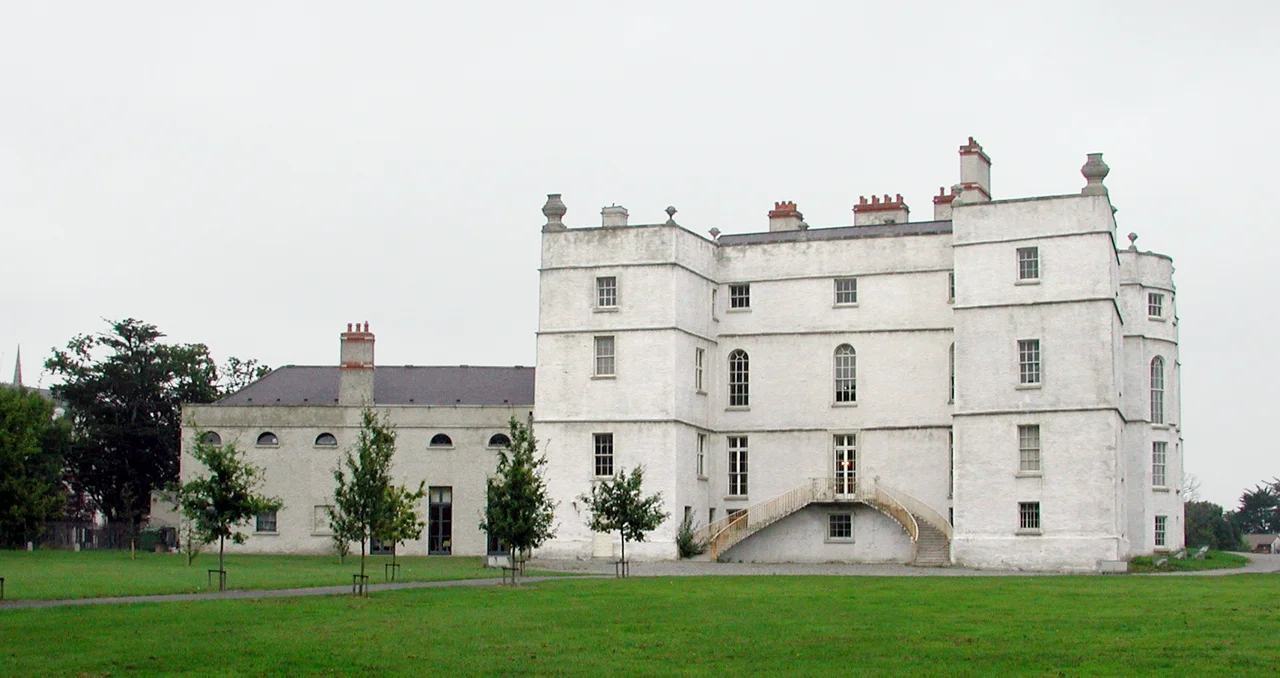

Rathfarnham Castle
Five-foot-thick walls and a square plan with a tower at each corner do not look like architecture - they look like a calculation. Build it like this, the geometry says, and your enemies will need cannon. Adam Loftus did the calculation around 1583, when he was Archbishop of Dublin and the surrounding Wicklow Mountains were full of Gaelic clans who occasionally remembered they had once owned this land. Seventeen years after the castle was finished it had to absorb its first attack. It did so successfully. Four centuries of sieges, sales, dairy farming and demolition threats later, Rathfarnham Castle still stands - rescued at the last possible moment by the Irish state, peeled back layer by careful layer in the conservation work that continues to this day.
An Archbishop's Calculation
Rathfarnham was a 'waste village' when Loftus bought it - lands confiscated from the Eustace family of Baltinglass after they joined the Second Desmond Rebellion against the English Crown. The Pale, the English-administered hinterland of Dublin, ended somewhere near here, and the Wicklow Mountains beyond were Gaelic territory. Loftus chose to build a fortified house rather than a true castle: a four-storey block with corner towers, a dome, and walls thick enough to absorb musket fire but elegant enough to entertain in. Two vaulted apartments on the ground floor were divided by an internal wall nearly ten feet thick, rising the full height of the building. When the Wicklow clans attacked in 1600 during the Nine Years' War, the castle held.
Three Times in Eight Years
The Irish Confederate Wars of 1641 to 1653 turned Rathfarnham into a possession that kept changing hands. English Royalist troops garrisoned it for six years. In 1647 the Royalist commander Ormonde surrendered Dublin to Parliament, and Parliamentary troops moved in. In the summer of 1649 the castle was stormed and taken without a fight by Royalists trying to retake Dublin - a few days before the Battle of Rathmines, the engagement that decided the campaign and put Cromwell's republic in control of Ireland. After the Roundhead victory the Parliamentarians simply walked back in. Oliver Cromwell himself is said to have held a council at Rathfarnham before marching south to besiege Wexford. Adam Loftus the younger, the family head of the time, sided with the Parliamentarians and died at the Siege of Limerick in 1651. The family kept the castle anyway.
Doric Columns and a Public Dairy
The eighteenth century gave Rathfarnham its great hall - a terrace, a portico of eight Doric columns, a dome painted in fresco with the signs of the Zodiac. Stained glass bore the Loftus arms; busts on coloured marble pedestals lined the walls. By 1723 the property had passed through marriage to Philip Wharton, the young Duke of Wharton, who lost his fortune in the South Sea Bubble and sold the castle for sixty-two thousand pounds to William Conolly, Speaker of the Irish House of Commons. It travelled through a series of owners before returning in 1767 to a Loftus descendant. Then came the long decline. By the time a 19th-century guidebook described it, the great house had become 'a public dairy' - the painted dome cracking above three hundred acres of pasture. 'The fish-pond clogged with weeds,' the visitor wrote, 'the ice-houses open to the prying sun.'
The Jesuit Seismograph
In 1913 the Jesuit Order bought the castle and the southwestern part of the estate; the east became the Castle Golf Club, the north became housing. The Jesuits used the building as a house of religious formation - tertianship, the final stage of Jesuit training. One of them, Father William O'Leary SJ, installed a seismograph in the castle that could detect earthquakes anywhere in the world. For decades Rathfarnham was the national source of earthquake bulletins, the Jesuits phoning newspapers when distant tremors registered. They also commissioned stained glass for the chapel from Harry Clarke, Ireland's greatest modern glass artist. When the Jesuits sold the castle in 1986 they took the Clarke windows with them - donating some to Tullamore Catholic Church, which had burned in 1983, and others to Our Lady's Hospice in Harold's Cross and Temple Street Children's Hospital. The glass is still in use; the chapel is empty.
Saved at the Last Moment
In 1985 a developer called Delaware Properties bought the castle. The likely fate of a four-hundred-year-old building in a developer's hands was obvious to everyone in Rathfarnham. A public campaign followed - fierce enough that in 1987 the Irish state bought the building outright and declared it a National Monument. The Office of Public Works has been peeling it back ever since. In 2016 archaeologists working under the floorboards uncovered three-hundred-year-old high heels, sealed cups of tea, and ornamental goblets - the everyday debris of seventeenth-century life caught in the gaps between joists. The castle is open in summer from 5 May to 12 October. Ely's Arch, the granite triumphal gate the Loftuses built in the 1770s to celebrate becoming Earls of Ely, still stands further down the Dodder, an Irish version of the Porta Portese in Rome marking what was once the entrance to all this.
From the Air
Rathfarnham Castle stands at 53.30°N, 6.28°W in south Dublin, about 6 km south of the city centre on the south bank of the River Dodder. From altitude the four-storey square block is visible within a small surviving parkland enclave amid suburban housing, with the Castle Golf Club's fairways immediately to the east. The Wicklow Mountains rise sharply to the south, a wall of green hills marking the old edge of the English Pale. Dublin Airport (EIDW) lies 15 km north.
Nearby Stories
- Wicklow Mountains 12 km away
- Mornington 14 km away
- German submarine U-1051 16 km away
- Abbey of Kells 18 km away
- Irish Military Intelligence Service 20 km away
- HMS Manners (K568) 37 km away
- Templemore 42 km away
- Irish Sea Bridge 43 km away