
Rathfarnham
On Easter Sunday morning, 1916, Patrick Pearse cycled out of the gates of the Hermitage in Rathfarnham and turned north toward Dublin. He would never come back. By the following Friday he was a leader of the Easter Rising and the signatory of a Proclamation read outside the General Post Office; by 3 May he was dead, executed by firing squad at Kilmainham Gaol. The granite-faced house he was leaving behind had been his school, St Enda's, where he had tried to invent a new kind of Irish education in a building once decorated with fake dolmens and a hermit's cave built by an eighteenth-century dentist with too much money and too much imagination.
On the Edge of the Pale
Rathfarnham village grew up around a fortification at a ford on the River Dodder, on the southern edge of the Pale - the medieval enclave of Anglo-Norman control around Dublin. The Wicklow Mountains rose just beyond, and the Gaelic clans who lived in them did not consider the Pale's borders binding. In 1199 the lands were granted to Milo le Bret, who built a motte-and-bailey fort on what is now the start of the Braemor Road. For a century the Royal Forest of Glencree south of here served as a buffer, until the Clan O'Toole overran it in the 1300s. From then on Rathfarnham was a frontier village, and the Eustace family - granted the land for guarding it - would lose it to the Crown in 1583 after joining the Second Desmond Rebellion. Adam Loftus, Archbishop of Dublin, built the fortified house known today as Rathfarnham Castle on the confiscated estate.
The Dentist's Antiquities
Across the Dodder from the castle stood the Hermitage, an eighteenth-century granite-fronted house bought by Edward Hudson, an eminent Dublin dentist with a passion for Irish antiquities and the income to indulge it. Hudson did not collect antiquities so much as fabricate them. Around his grounds he built a watchtower, a hermit's cave, a dolmen, a ruined abbey, a Brehon's Chair, a grotto with a stone pillar, a small temple in a glen, and a crenellated mock-fortification known as Emmet's Fort. He cut an Ogham inscription into a boulder mocking his neighbours' opinion of his obsession - 'the neighbours laugh at Edward Hudson moving these clods of earth.' The estate appeared on contemporary maps as the 'Fields of Oden.' Hudson's son William Elliot Hudson, born here in 1796, became a scholar and patron of Irish literature and endowed the Royal Irish Academy's Irish Dictionary.
St Enda's
In 1910 Patrick Pearse leased the Hermitage from its then-owner, William Woodburn, and moved his Irish-language school St Enda's into the building. Cullenswood House in Ranelagh, where he had founded the school the previous year, was too cramped for his ideas about outdoor education. At the Hermitage he converted a long billiard room into a study hall and chapel, a drawing room into a dormitory, and the stables around an enclosed yard into classrooms. He wrote in 'The Story of a Success' that the school fulfilled the central ambition of his life. After the Easter Rising and his execution, his sister Margaret Mary Pearse kept the school open until 1935. When she died in 1968 the property passed to the Irish state. The Hermitage is now the Pearse Museum, set in Saint Enda's Park - one of the four large green spaces (with Marlay, Dodder and Bushy parks) that ring modern Rathfarnham.
The Priory and the Lost Grave
Directly opposite St Enda's stood the Priory, home of the great orator and barrister John Philpot Curran. In October 1792 Curran's twelve-year-old daughter Gertrude died after falling from a window. He buried her in the grounds of the Priory and laid over the grave a stone slab inscribed with her name and her twelve years. Eleven years later his daughter Sarah Curran's secret engagement to the United Irishman Robert Emmet was exposed when Emmet was captured after his failed 1803 rising and executed for treason. Sarah died at twenty-six, asking to be buried beside her sister Gertrude - a request her father refused. The Priory was demolished in pieces over the twentieth century. In 1979 a developer cleared the field where Gertrude's grave had been; a citizen-led excavation searched the location carefully and dug deeper, but found nothing. The vault and the body had vanished. Local folklore still claims Robert Emmet himself was secretly buried somewhere in these fields.
Marlay and the Yellow House
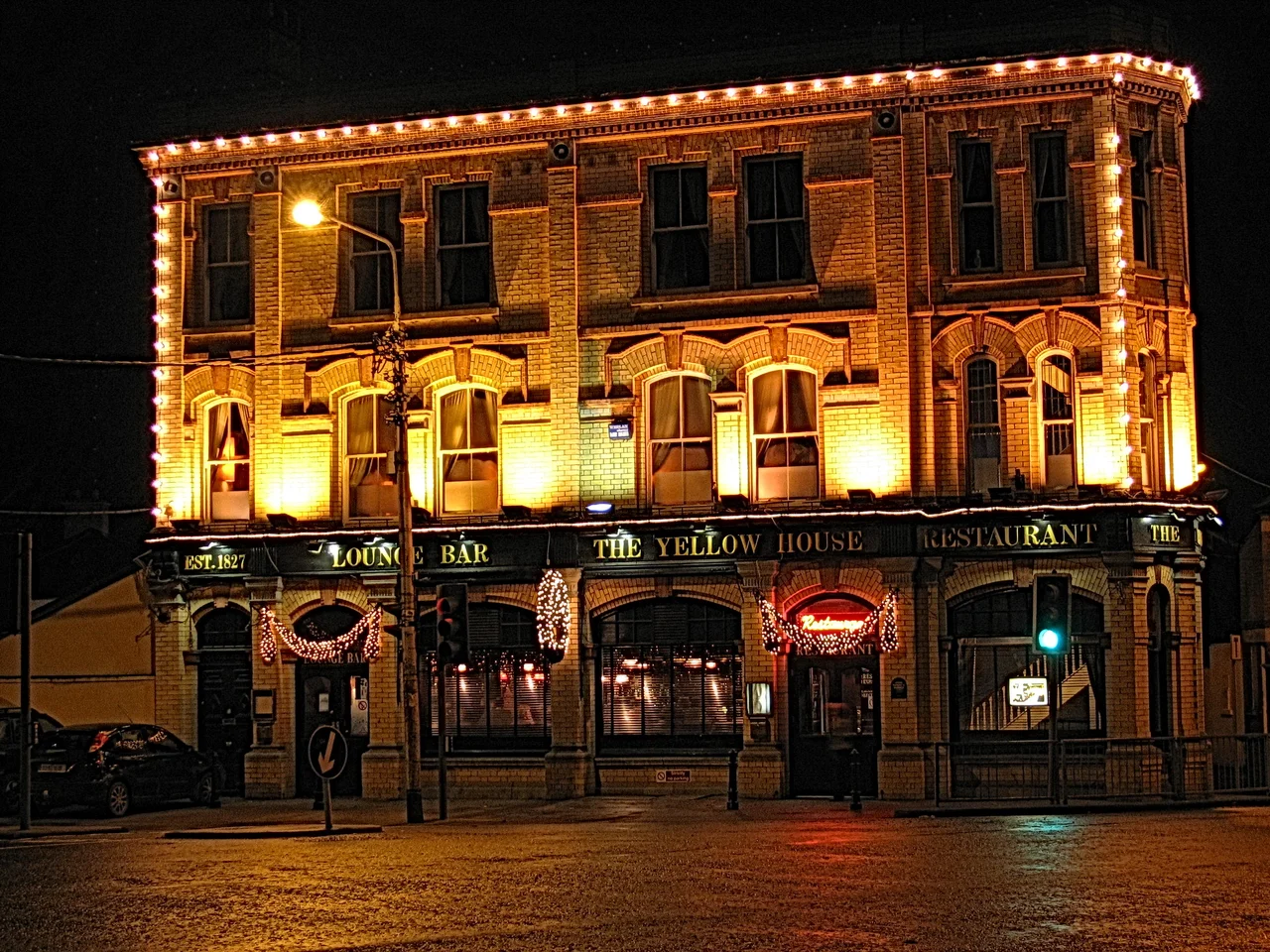
Modern Rathfarnham is built around its surviving green spaces and its old pubs. Marlay Park - the eighteenth-century estate of the La Touche banking family - became a public park in 1975, and since the early 2000s has hosted summer concerts on a scale that pulls in headliners. Aerosmith and Peter Gabriel and The Who played here in 2007; Metallica in 2009; the Longitude Festival every July since 2013. Closer to the village, on the corner of Willbrook and Grange Roads, stands the Yellow House, the current building dating from 1885 but the licence reaching back into the early 1700s. The young poet Francis Ledwidge, soon to die in Flanders during the Great War, worked there as an apprentice for exactly two days before homesickness for his native Slane sent him back to County Meath. Rathfarnham collects stories like that - lived in, mostly half-finished, all of them only a few hundred yards from somewhere else that matters.
From the Air
Rathfarnham village lies at 53.30°N, 6.29°W in south Dublin, about 6 km south of the city centre on the River Dodder. From altitude the most recognisable features are the green expanse of Marlay Park to the south and St Enda's Park nearby, with the wall of the Wicklow Mountains rising sharply just beyond - the old southern edge of the English Pale. Dublin Airport (EIDW) lies 15 km north.
Nearby Stories
- Wicklow Mountains 12 km away
- Mornington 14 km away
- German submarine U-1051 16 km away
- Abbey of Kells 18 km away
- Irish Military Intelligence Service 20 km away
- HMS Manners (K568) 37 km away
- Templemore 42 km away
- Irish Sea Bridge 43 km away