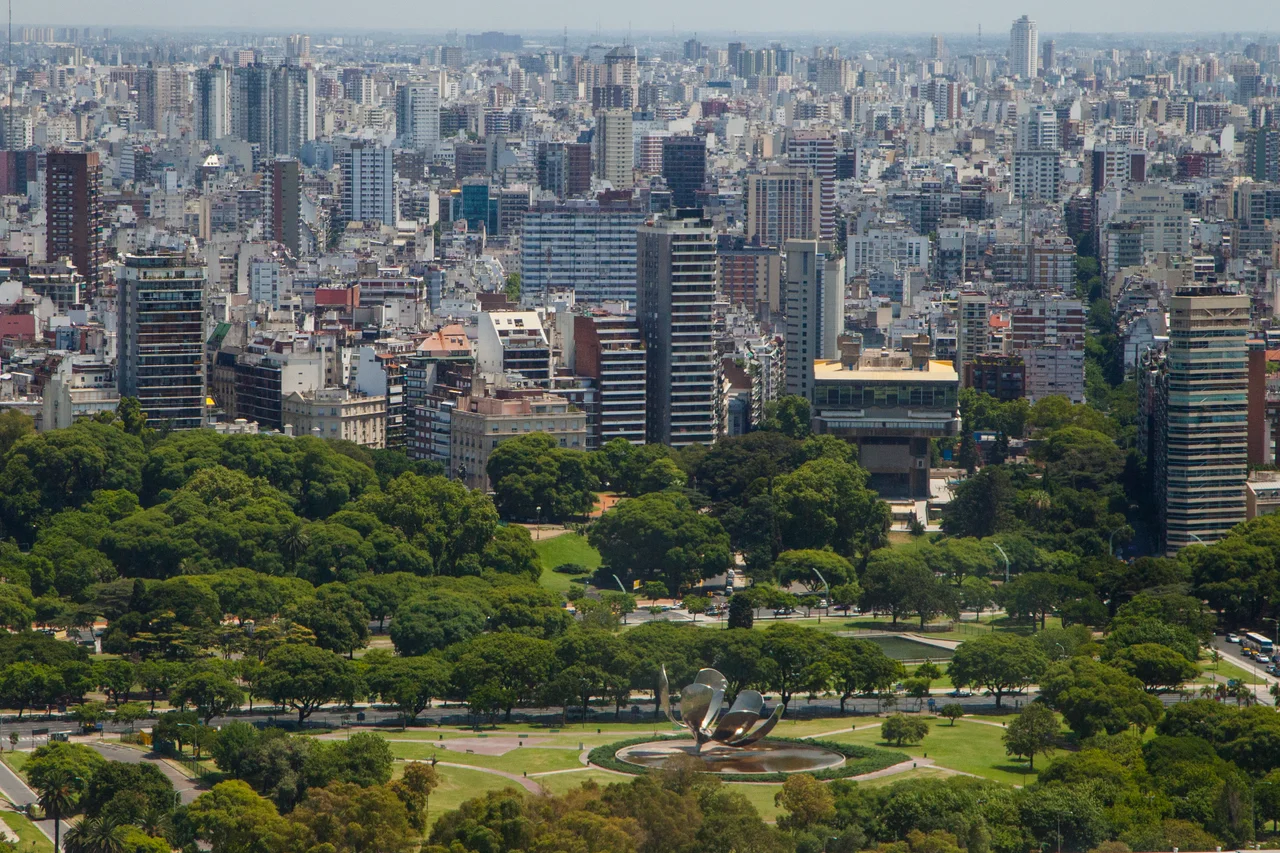

Recoleta, Buenos Aires
Recoleta owes its elegance to a plague. In 1871, yellow fever tore through the low, crowded southern quarters of Buenos Aires, and the wealthy families who could afford to run did exactly that. They climbed north to higher, drier ground where fewer mosquitoes carried the disease, and they built their mansions there and stayed. What began as flight from death turned into the most fashionable address in the city. Today Recoleta is a quarter of French-style townhouses, embassies in former palaces, and shaded avenues that earned Buenos Aires its old nickname, the Paris of South America. Its single most famous resident, though, never has to worry about the rent. She has been dead since 1952.
The City of the Dead
The Recoleta Cemetery is the reason most visitors come, and it is unlike any ordinary graveyard. Behind its neoclassical gate stand 4,691 vaults, all above ground, packed into narrow lanes like a miniature city of marble streets. Elaborate mausoleums rise in Art Nouveau, Baroque, and Neo-Gothic styles, guarded by stone angels and wrought iron. The French architect Prosper Catelin laid it out at the request of President Bernardino Rivadavia, and it was dedicated in 1822. Inside rest some 26 Argentine presidents, Nobel laureates, generals, and the founder of the Argentine navy. The most visited tomb belongs to none of them. Eva Peron, the actress turned political icon adored as Evita, was finally interred here in 1976 in her family's vault, her coffin lowered beneath layers of concrete so that no one could ever disturb it again.
A Convent, Then a Refuge
The neighborhood takes its name from the men who came first, the Recollect friars of the Franciscan order, who established a monastery here early in the eighteenth century along with a church and an attached cemetery. The church they raised, Nuestra Senora del Pilar, was completed in 1732 and still anchors the district; for a time the whole area was simply called El Pilar. It stood on a bluff that sloped down toward the Rio de la Plata, one of the highest points in the city. That elevation was no small thing. When cholera and yellow fever swept Buenos Aires in the 1870s, the height meant fewer disease-carrying insects, and so the families who fled the epidemics chose this ridge above all others. The friars' quiet hilltop became, almost overnight, the refuge of the ruling elite.
Palaces, Books, and a Tree That Ate a Terrace
The wealth left its mark in stone and culture. Along Alvear Avenue stand the surviving grand houses, the Palacio Duhau, the Vatican's nunciature, the French and Brazilian embassies in former family palaces, and the storied Alvear Palace Hotel. Building materials, from marble staircases to crystal chandeliers, were shipped in from Europe. Recoleta also became the city's intellectual heart, home to the National Library and to the writer Jorge Luis Borges, who lived on Quintana Avenue and directed that library for years; arguably the most influential writer Argentina ever produced kept his rooms here. And then there is the Gran Gomero, an immense rubber tree in the plaza facing the cemetery. Planted in 1791, its branches spread some 50 meters across, so heavy that props hold them up while they shade the terrace of the famous La Biela cafe below.
Where Tango Climbed the Social Ladder
Recoleta also helped make tango respectable. In its early decades the dance belonged to the working-class fringe, to the cabarets where ruffians and tough-guys, known in the city's florid slang as malevos and compadritos, brawled into the night, and where a young Carlos Gardel was known to sing. The upper classes kept their distance. That changed at the Palais de Glace, once an ice-skating rink in Recoleta, which became a dance hall in the 1910s. It was there, the story goes, that tango finally won acceptance among the elite of Buenos Aires, helped along by the fact that the dance had already become a craze in Paris. The neighborhood that began as a hilltop escape from disease had become the place where the city's grandest families learned to dance to the music of its streets.
From the Air
Recoleta sits in the northern part of central Buenos Aires, near 34.591 degrees south, 58.391 degrees west, on slightly elevated ground set back from the Rio de la Plata. From the air, look for the dense grid of leafy avenues and the green expanse of its plazas and parks just inland from the riverside Avenida del Libertador; the white labyrinth of the Recoleta Cemetery and the dome of the Nuestra Senora del Pilar church mark its core. The broad brown river lies to the northeast. Aeroparque Jorge Newbery (ICAO SABE) is the closest airport, roughly 3 to 4 km to the northeast along the waterfront; the larger Ministro Pistarini International, or Ezeiza (ICAO SAEZ), lies about 22 km to the southwest. Clear daylight best shows the contrast between the neighborhood's green squares and the tightly packed mansions and apartment blocks around them.
Nearby Stories
- Ezeiza Massacre 1.9 km away
- Luján, Buenos Aires 5.1 km away
- Curutchet House 13 km away
- Colonia del Sacramento 17 km away
- Martín García Island 28 km away
- Atucha Nuclear Power Plant 37 km away
- Lobos 43 km away
- Cry of Asencio 87 km away