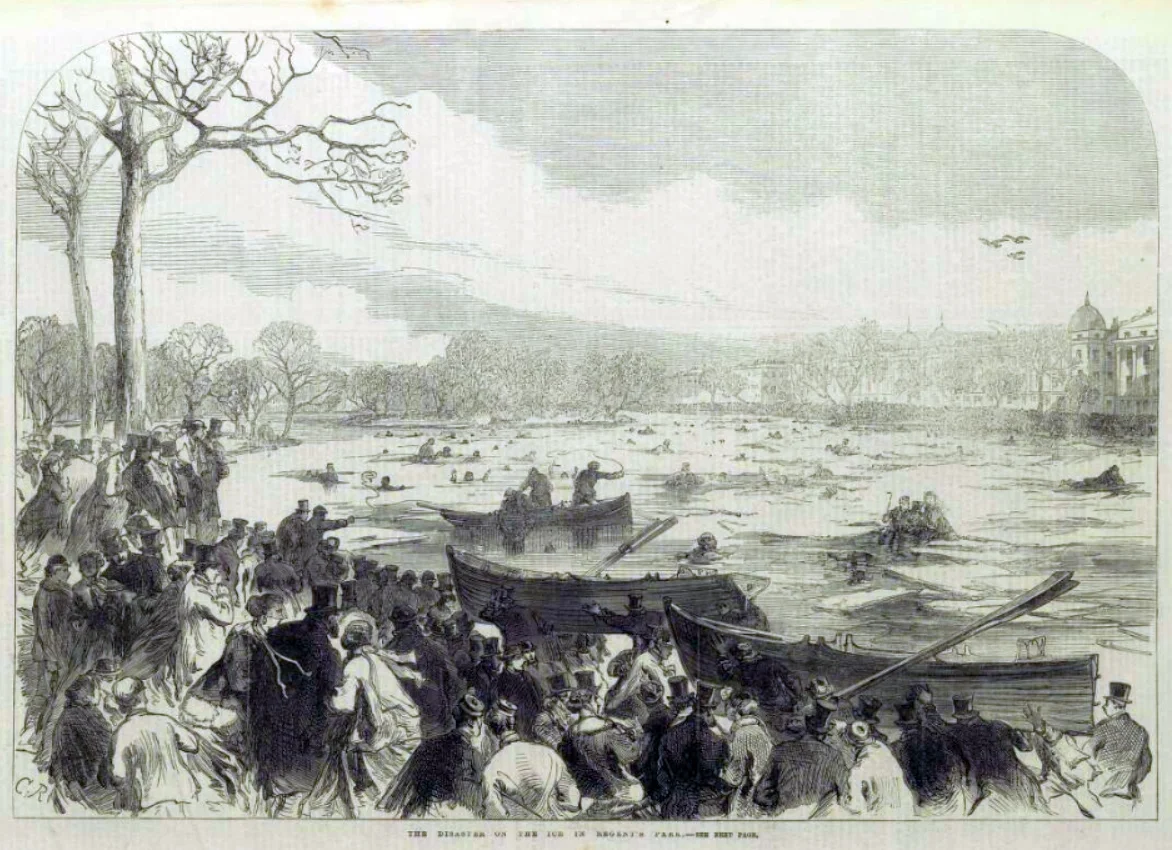

Regent's Park skating disaster
At 3:30 in the afternoon on 15 January 1867, somebody on the frozen boating lake in Regent's Park heard the ice crack. Then half of the five hundred people skating on that ice were in the water. Many could not swim. Most were wearing the heavy wool coats and dresses of a cold London winter. Two thousand more spectators watched from the banks. By the time bystanders had pulled who they could from the water, about forty people were dead - some from hypothermia, others from drowning under the ice. It was, at the time, the worst weather-related accident in British history.
A Cold January
January 1867 had been bitter. Open waters across Britain had frozen over in the kind of winter that nineteenth-century Londoners considered an opportunity rather than a hardship. Ice skating was a popular pastime, and the boating lake in Regent's Park - then one of the largest open public waters in central London - became a destination for skaters of every level. Hundreds visited each day. On 14 January, the day before the disaster, the ice had already cracked once: twenty-one people went into the water that day, but all of them were pulled out alive. Overnight the temperature stayed low enough for the lake to refreeze. The next morning, what had been a serious warning was treated as a passing scare.
The Ice Goes
About five hundred people came out onto the lake on the afternoon of 15 January. An estimated two thousand more watched from the banks - lovers, families, off-duty workers, children. Skating was as much a social occasion as a sport. The lake was deep. In places, the water beneath the ice reached twelve feet. When the ice finally went at 3:30 p.m., almost half of the skaters fell through. Some sank immediately, weighed down by their winter clothing. Others surfaced and were pulled out by friends or by spectators rushing onto the broken floes. The lake kept refreezing as the rescue continued, and divers were needed in the days that followed to recover bodies from the bottom. Survivors with hypothermia and the recovered bodies were both taken to the Marylebone workhouse, which served the area as a kind of emergency infirmary.
Naming the Dead
An inquest was opened at the Marylebone workhouse on 16 January, presided over by Edwin Lankester, the coroner for Central Middlesex. By the time the hearing convened, thirty-four bodies had been recovered and twenty-nine had been identified. The inquest resumed on 19 January to identify the remaining victims, and the formal taking of evidence began on 21 January. The named dead included men, women, and children: London Sunday afternoon skaters, families who had come to take advantage of the rare frozen lake. Newspapers across the country - the Luton Times, the Cheltenham Journal, the Wrexham Advertiser, the Oxford Chronicle - carried accounts of the catastrophe for weeks. The Sun's headline of 16 January read simply "The Great Loss of Life at the Regent's Park." The disaster touched homes far from London.
The Wildfowl Ice-Breakers
An uncomfortable detail surfaced at the inquest. Witnesses testified that on the morning of the tragedy, workmen had been employed in breaking the ice around the islands on the lake to give the park's wildfowl open water. The ice had been weakened deliberately - to make life easier for the ducks - just hours before the skaters arrived. The inquest jury recommended that the depth of the lake be reduced. Lord John Manners, the First Commissioner of Works, agreed. In June 1868, just over a year after the disaster, it was reported that the lake had been drained, the bottom levelled and lined with concrete, and the new maximum depth set so that a person of adult stature could not be drowned. The lake was raised to about four feet at its deepest. The decision was an admission. Forty people had not died because they could not swim, or because the ice was thin, or because they should not have been out there. They had died because a great public lake in the centre of London had been allowed to be deeper than the city could afford for it to be.
What Stayed
Regent's Park's boating lake still exists - shallow, safe, lined with the same concrete that was put down after 1867. People still skate when London freezes, though not in the numbers that gathered before the disaster, and not on this particular water. The 1867 incident was an early instance of a kind of inquiry that has become more familiar since: a community calamity producing a public investigation, a coroner's recommendation, and a permanent change to the built environment. The mass of people lost that afternoon does not appear on a single monument. They live now in the local-newspaper accounts archived in libraries from the Welsh borders to the Home Counties, in the depth of the lake itself, and in the regulation that since June 1868 has held that public water in a park should be too shallow to take an adult's life. Forty-plus skaters bequeathed that lesson to the city, paid for at a price no one would have chosen on a Tuesday afternoon in mid-January.
From the Air
The Regent's Park boating lake sits at 51.5278 N, 0.1594 W in the southwestern corner of Regent's Park, in the City of Westminster about a mile north of Oxford Street. From altitude, look for the large green oval of Regent's Park immediately north of the Marylebone district; the lake reads as a curving body of water on the park's western side. Nearest airports are London Heathrow (EGLL) 13 nm west-southwest and London City (EGLC) 9 nm east. The park is one of the most distinctive open spaces in central London.
Nearby Stories
- Stevenage 5.7 km away
- Malling Abbey 5.7 km away
- 1952 Farnborough Airshow Crash 7.7 km away
- Ingatestone Hall 8.2 km away
- Hellfire Caves 9.1 km away
- The Carrington Event: The Solar Storm That Could Happen Again 9.8 km away
- Bletchley Park 16 km away
- Castle Hedingham 23 km away