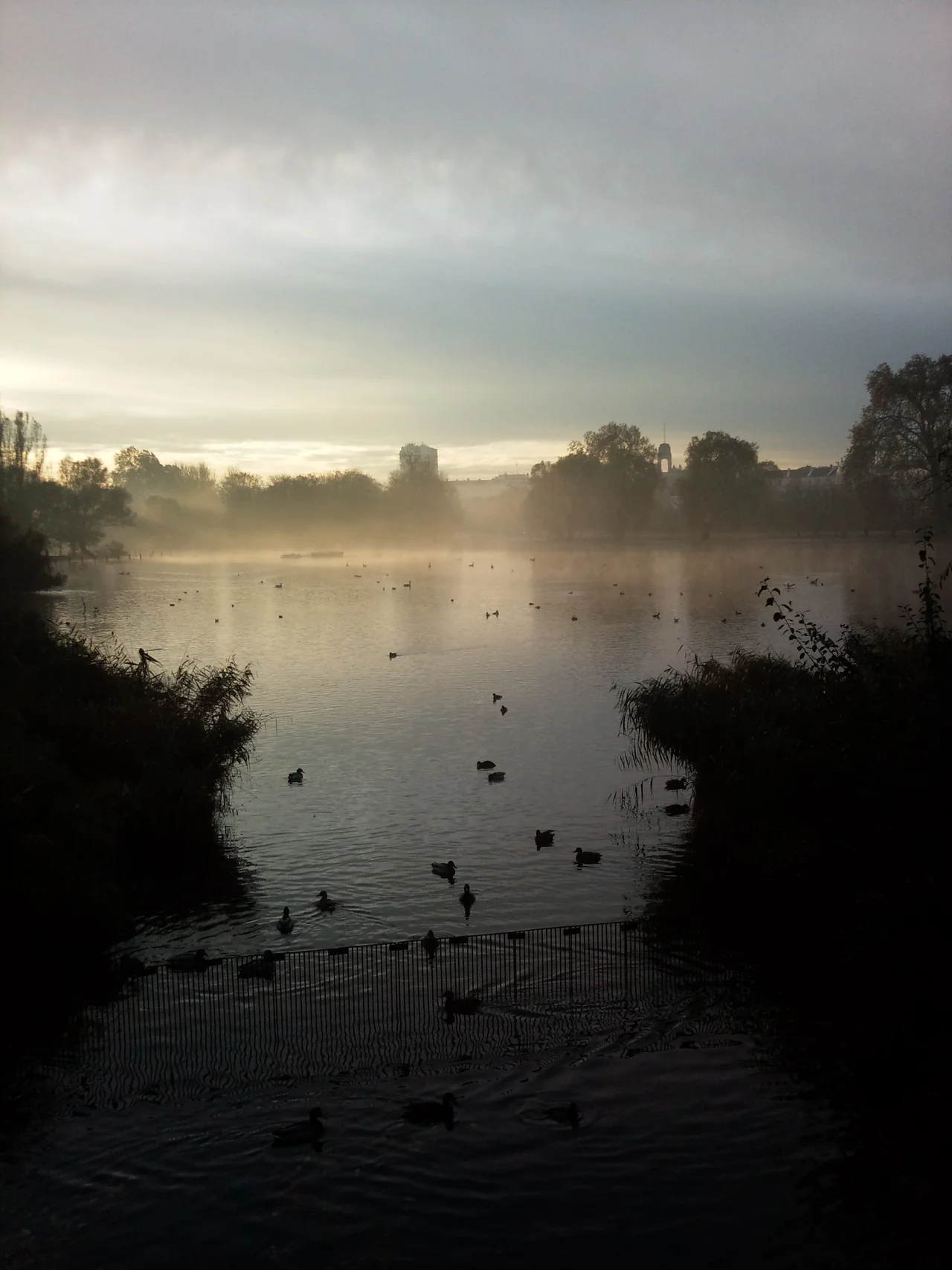

Regent's Park
On a January afternoon in 1867, the ice on the boating lake gave way. Two hundred skaters plunged into the freezing water, and forty of them never came out. The lake was later drained and rebuilt at four feet deep, but for almost any other park in London, that would have been the defining story. Regent's Park has too many stories for any single tragedy to dominate. A king claimed it from monks. A property developer financed it when the Crown lost its nerve. An architect dreamed it into being and then watched his pupil ignore his designs. Today its 4.45-kilometre Outer Circle ring road carries cyclists past white stucco terraces, a private American ambassador's garden, the world's oldest scientific zoo, and an open-air theatre tucked inside a rose garden that bears a queen's name.
From Hunting Ground to Pleasure Garden
The land was monastic property until Henry VIII took it during the 1530s Dissolution of the Monasteries, and the Crown has held the freehold ever since. For nearly three centuries it served as Marylebone Park, first a royal hunting ground, then a patchwork of dairy small-holdings producing milk and hay for London. The transformation began in the 1810s, when the Prince Regent, the future George IV, decided that this scrap of state-owned countryside on the city's north-west edge should become his pleasure garden. He commissioned John Nash, an architect already shaping Regent Street and Carlton House Terrace into a grand processional sweep from St James's to Primrose Hill. The idea was audacious: a great park ringed by elegant terraces and dotted with villas, one of the first garden suburbs in the world.
The Architect, the Patron, and the Son
Nash needed money he did not have. When the Crown Estate rescinded its pledge to bankroll construction, the project would have collapsed without James Burton, the era's most prolific London property developer. Burton put up the capital and built most of the terraces. He also brought along his son Decimus, a young draughtsman with a precocious gift for the classical style. Decimus listened to Nash politely and then designed the terraces his own way. The older architect was so appalled by Chester Terrace that he demanded its demolition and complete rebuilding. He lost the argument. James Burton built the terraces his son had drawn, and today the longest facade in the park stands as Decimus envisioned it, not as Nash wanted. The park finally opened to the public in 1835, two days a week.
The White Stucco Ring
The terraces still ring the park's south, east, and most of the west, ten of them in all. Cumberland Terrace, finished in 1826, looks like a palace strung along a London street. Sussex Place, originally twenty-six houses by Nash, was rebuilt in the 1960s behind its preserved facade to house the London Business School. Hanover Terrace and Kent Terrace face the western edge. Behind those white columns are some of the most expensive addresses in the city. Inside the park, scattered among the lawns, sit private villas tied to royal families abroad. The Holme is owned by the Saudi royal family; St John's Lodge by Brunei's; Nuffield Lodge by Oman's. Winfield House, the United States Ambassador's official residence, has the second-largest private garden in London after the King's at Buckingham Palace.
Roses, Lions, and the Bandstand
Queen Mary's Gardens at the Inner Circle were created in the 1930s on a former plant nursery, opening that part of the park to the public for the first time. The Open Air Theatre stands among the roses, staging Shakespeare and musicals under summer skies. Just outside the Outer Circle on the northern edge is London Zoo, run by the Zoological Society of London since 1828 and still home to elephants, lions, and the gorilla house that taught generations of London children what an ape looks like up close. The Regent's Canal threads along the north end, linking the Grand Union to the old London docks. The bandstand in the centre carries a quieter memory: in July 1982, an IRA bomb detonated there during a Royal Green Jackets concert, killing seven soldiers. A small memorial nearby names them.
A Park in the Imagination
Virginia Woolf set scenes of Mrs Dalloway here in 1925. The Dearly family walked their dalmatians along these paths in Dodie Smith's 1956 novel and the Disney films that followed. Harry Potter went to London Zoo with his cousin Dudley and accidentally set a boa constrictor free. Ian Fleming located James Bond's MI6 in a tall grey building near the park, a fictional address that Mick Herron borrowed for his Slough House novels by calling MI5's headquarters simply Regent's Park. Twenty-two thousand cyclists have logged 1.6 million laps of the Outer Circle on Strava, finding their own steady rhythm around a 4.45-kilometre loop that the Prince Regent commissioned, James Burton paid for, John Nash designed, and Decimus Burton quietly improved without permission.
From the Air
Coordinates 51.53°N, 0.16°W in central London. From cruising altitude the park appears as a large green rectangle just north-west of central London, ringed by the distinctive white terraces and bisected by the curving Regent's Canal. Nearest major airport is London Heathrow (EGLL) about 22 km west; London City (EGLC) sits about 14 km east. Best viewed in clear conditions from 3,000-8,000 feet for the full ring of terraces and the zoo on the northern edge.
Nearby Stories
- Stevenage 5.7 km away
- Malling Abbey 5.7 km away
- 1952 Farnborough Airshow Crash 7.7 km away
- Ingatestone Hall 8.2 km away
- Hellfire Caves 9.1 km away
- The Carrington Event: The Solar Storm That Could Happen Again 9.8 km away
- Bletchley Park 16 km away
- Castle Hedingham 23 km away