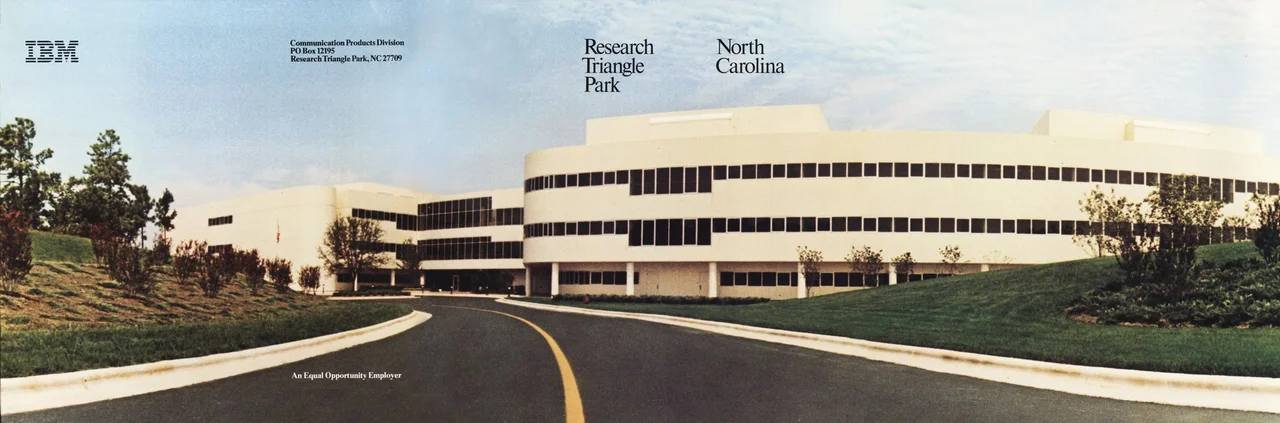

Research Triangle Park
By 1953 a North Carolina contractor named Romeo Guest had an idea. North Carolina's economy was hemorrhaging - agriculture, textiles, furniture all losing market share to other regions and other countries - and the state's three big research universities (Duke in Durham, UNC in Chapel Hill, and NC State in Raleigh) sat roughly at the corners of a triangle. What if you put a research park inside it? What if you used the universities' graduate programs as bait to lure pharmaceutical companies, electronics firms, the kinds of high-wage employers that would replace the dying mills? Guest had already tried, and failed, to bring Merck to Aberdeen in the early 1940s. This time he had a name for the idea. He called it the Research Triangle.
From Pine Forest to Park
The project officially got its green light from Governor Luther Hodges in 1956. Hodges - a former textile executive who would go on to serve as Secretary of Commerce under Kennedy - is widely credited with leading the transformation of North Carolina from one of the poorest states in the Union to one of its most prosperous, and Research Triangle Park is the most concrete piece of that legacy. The three universities were initially wary. So was the business community. A real estate developer named Karl Robbins bought the initial tract of land. Then came Archibald "Archie" Davis - former Wachovia Bank chairman, state senator, and president of the U.S. Chamber of Commerce - who changed everything by switching the project from a for-profit business to a non-profit foundation. Davis raised $1.425 million in donations from North Carolinians to buy the RTP land outright. Governor Terry Sanford, an ally of President Kennedy, helped close the deal. By 1959 the park was real. It occupied 7,000 acres of pine forest in Durham and Wake counties, almost equidistant from the three universities.
IBM Arrives, Then Everyone Else
The early years were slow. The park needed an anchor tenant - someone large enough that other companies would believe RTP was a real place. IBM came in 1965, eventually building out to a four-building complex totaling 774,000 square feet. After that, the floodgates opened. GlaxoSmithKline built one of its largest global R&D centers here with about 5,000 employees. Cisco Systems' RTP campus, also around 5,000 employees, is the company's second-largest location after its Silicon Valley headquarters. The National Institutes of Health placed its National Institute of Environmental Health Sciences inside the park - the NIH's only major research campus outside Bethesda. In 1976 the three universities formed TUCASI, the Triangle Universities Center for Advanced Studies, to develop joint research facilities. That consortium spun off the National Humanities Center, the Microelectronics Center of North Carolina, the North Carolina Biotechnology Center, and the National Institute for Statistical Sciences. Each one of those is now a national institution. All of them grew out of one park in a Carolina pine forest.
The Quiet Giant
Today, RTP is the largest research park in the United States by acreage - 7,000 acres, with 22.5 million square feet of built space, more than 300 companies, and roughly 65,000 workers. It is owned and managed by the Research Triangle Foundation, the non-profit Archie Davis set up. Driving through it is strange. The park is so deliberately landscaped that for long stretches you see nothing but pines and signs marking the entrances to corporate campuses - IBM, GSK, Lenovo, Cree, UBS, Cisco - with the buildings themselves set hundreds of yards back from the road. There is no downtown. There never was a downtown. For sixty years, RTP was a workplace, not a place. People drove in from Raleigh, Durham, Cary, Morrisville, and Chapel Hill, worked nine hours, and drove home. The park functioned brilliantly as an economic engine and somewhat awkwardly as a piece of geography.
Hub RTP and Boxyard
That has started to change. In 2019 the Research Triangle Foundation announced Hub RTP - a 100-acre development at the heart of the park that would mix office space, 1,200 residential apartments, retail, 16 acres of green space, at least one hotel, and the first high-rise office towers RTP has ever had. Ground broke in September 2020. Around the same time, in March 2019, the foundation announced Boxyard RTP - a 15,000-square-foot complex of stacked shipping containers, inspired by the Boxyard in downtown Tulsa, that opened in June 2021 with restaurants, retail, a dog park called Barkyard RTP, and a soft-launch crowd that had been waiting decades for something walkable inside the park. CareYaya Health Technologies, an emerging startup, is one of the tenants. None of this would have made sense in the original Research Triangle Park vision - it was supposed to be a science park, not a town. But after sixty years of being a workplace people drove to, RTP is finally trying to become a place people can actually live.
From the Air
Coordinates 35.908°N, 78.863°W in Durham and Wake counties, North Carolina, between Raleigh, Durham, and Chapel Hill. Recommended viewing altitude 3,000-5,000 ft AGL to take in the full 7,000-acre footprint. From the air, RTP appears as a roughly square area of dense pine forest interrupted by large corporate campuses - IBM's complex is the largest single visible structure, with GlaxoSmithKline, Cisco, and the NIEHS also distinct. NC 147 (the Durham Freeway) cuts through the northwest corner; I-40 runs along the south edge. Nearest airport is Raleigh-Durham International (KRDU), 4 nm northeast - so close that traffic patterns frequently route over RTP.
Nearby Stories
- Orange County Speedway 3.7 km away
- Tobacco Road 8.7 km away
- Haw River 15 km away
- Johnston County, North Carolina 18 km away
- Soul City, North Carolina 25 km away
- Chinqua Penn Plantation 29 km away
- North Carolina Aviation Museum 40 km away
- Cherry Hill Plantation 45 km away