
Rinca: Komodo's Wilder Sibling
Five scuba divers drifted for two days before washing up on Rinca's southern coast in June 2008. Three British, one French, one Swedish -- abandoned by their dive boat in currents that rip through the strait at ten knots, they survived on oysters pried from the rocks. What rescued them was the same thing that had nearly killed them: the fierce waters between Rinca and Komodo, which eventually pushed their exhausted bodies onto shore. They were lucky. The island they landed on is home to roughly 1,300 Komodo dragons, the largest living lizards on Earth, animals that have been known to attack and kill humans. Rinca does not make survival easy for anyone -- not for the divers who washed ashore, not for the villagers who share the island with apex predators, and not for the water buffalo that serve as the dragons' primary prey. But that inhospitable edge is precisely what makes it extraordinary.
The Strait Between Worlds
Rinca and Komodo bracket a narrow north-south passage connecting the Indian Ocean to the Flores Sea, and the hydrodynamics are violent. Massive volumes of water funnel through the gap on every tidal shift, generating whirlpools and currents exceeding ten knots -- faster than most boats can idle. Dive operators in the region treat these waters with deep respect; the 2008 rescue of the five stranded divers, who drifted 20 miles from their original position, is only the most publicized reminder of what the strait can do. For the marine life below the surface, however, the turbulence is a gift. Nutrient-rich upwellings feed some of the most biodiverse coral reefs in the Coral Triangle. More than 1,000 species of tropical fish and 260 species of reef-building coral inhabit Komodo National Park's waters, a richness born from the same forces that make the surface so dangerous.
Dragons at the Door
Komodo Island gets the fame and the tourists. Rinca gets the dragons. Roughly 1,300 Komodo dragons roam this 182-square-kilometer island, and they tend to congregate near the Loh Buaya ranger station, the park's main facility on Rinca. Visitors arriving by boat from Labuan Bajo -- a two-hour crossing -- step onto a jetty and walk a short path to the ranger office, where armed guides wait. The dragons are not shy. They bask beneath the stilted buildings, patrol the kitchen area attracted by cooking smells, and occasionally wander the trails that visitors hike. Rangers carry forked sticks, the only practical tool for redirecting an animal that can grow to three meters, weigh 70 kilograms, and deliver a bite laced with anticoagulant venom. The encounters feel unmanaged in the best sense: these are not zoo exhibits but apex predators on their own ground, tolerating human presence rather than performing for it.
Living with Monsters
The small communities on Rinca face challenges that most island populations never contemplate. Education facilities are sparse -- some NGOs provide books for children who have few other resources. But the more unusual difficulty is coexistence with a predator that views humans as neither friend nor threat but simply another large animal on the landscape. Komodo dragons have attacked and killed residents over the years, making ordinary tasks like collecting water or walking between villages an exercise in vigilance. The locals have adapted: they build houses on stilts, keep livestock penned at night, and teach children to recognize dragon behavior from a young age. It is a strange bargain -- the dragons are the reason Komodo National Park exists, the reason tourists come, the reason conservation funding flows to the region. The very animals that endanger the community also sustain it.
The Dry Kingdom
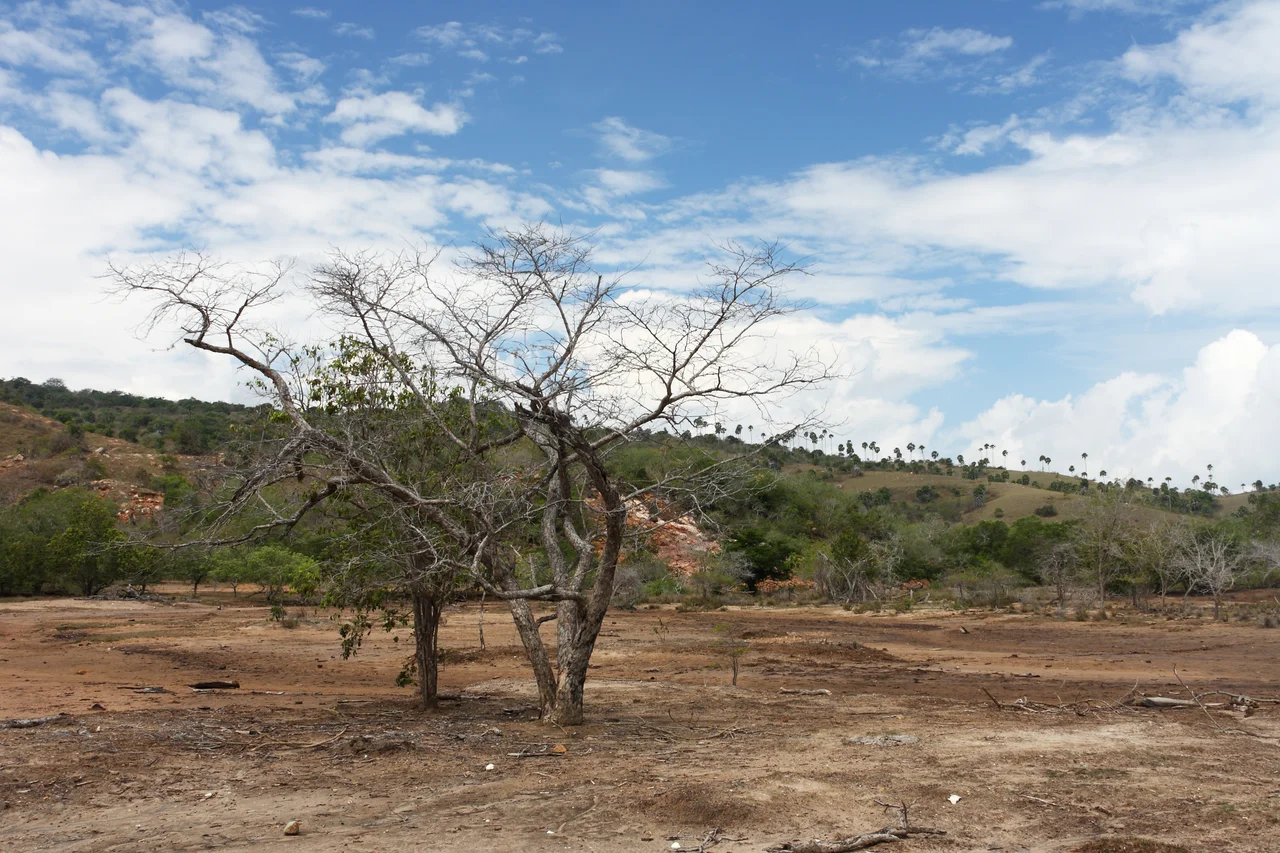
Rinca is among the driest places in Indonesia, receiving between 800 and 1,000 millimeters of rainfall annually -- roughly half what Flores gets. During the long dry season, the island's hills turn golden-brown, the savanna grass crackles underfoot, and the lontar palms stand like sentinels over a landscape that looks more African than Southeast Asian. Water buffalo wade into shrinking waterholes. Crab-eating macaques forage along the rocky shoreline. Wild pigs root through the undergrowth, always alert for the patient predators that hunt by ambush. This is Wallacea, the transition zone between Asian and Australian fauna identified by Alfred Russel Wallace in the 19th century, and Rinca sits squarely in its heart. The mammal diversity is low compared to the larger Indonesian islands, but what lives here has evolved in isolation, shaped by limited resources and the constant pressure of the world's largest lizard at the top of the food chain.
From the Air
Located at 8.70S, 119.69E in the Lesser Sunda Islands. Rinca is the second-largest island in Komodo National Park, visible as a rugged brown landmass between Komodo Island to the west and Flores to the east. The narrow strait between Rinca and Komodo is clearly visible from altitude -- look for tidal rips and color changes in the water. Nearest airport is Komodo Airport (LBJ/WATO) at Labuan Bajo on Flores, approximately 40 km east. The island's terrain is hilly savanna reaching up to 667 m elevation. Best viewed at 5,000-8,000 ft for island detail, or higher for the full Komodo National Park archipelago context. Dry season (April-November) gives clearest visibility; the island appears distinctly brown against the deep blue Flores Sea.
Nearby Stories
- Liang Bua: The Cave That Rewrote Human History 31 km away
- Sumba's Hidden Kingdom of Wings 86 km away
- The Day the Earth Lost Its Summer 132 km away
- The Island That Shook the World 136 km away
- The Month the World Didn't Know 148 km away
- The Eruption of Tambora: The Year Without a Summer 189 km away
- Ordinary Hunger: Life on Savu Island 249 km away
- The Silent Wave: Java's 1994 Tsunami Earthquake 715 km away