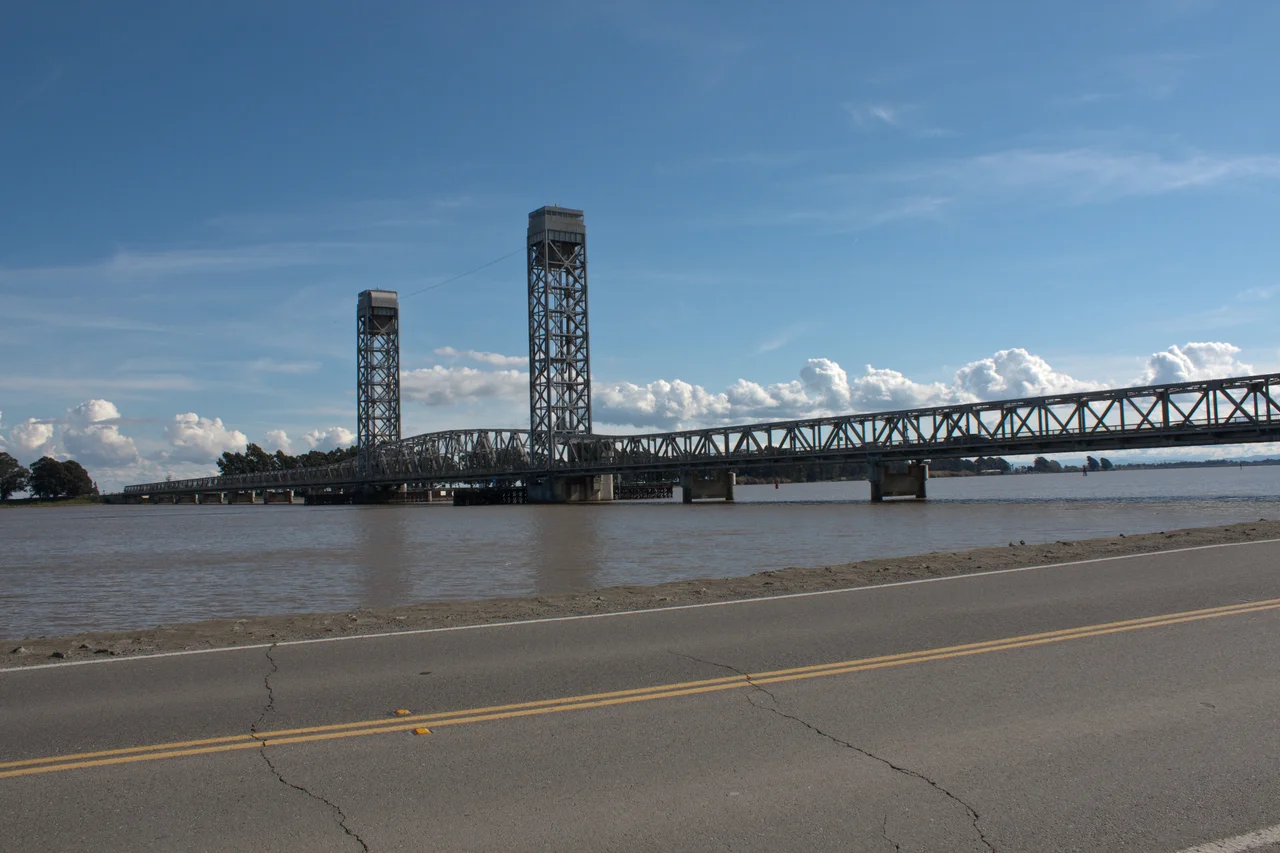

Rio Vista, California
In 1985, a young humpback whale swam 60 miles up the Sacramento River from the Pacific Ocean and surfaced near Rio Vista, California. Nobody could explain why. The whale, quickly nicknamed Humphrey, attracted thousands of onlookers to this small delta town before rescuers -- including an Army Reserve unit piloting landing craft -- managed to guide him back to sea. Then in 2007, it happened again: a mother humpback and her calf, dubbed Delta and Dawn, appeared in the river near town as if the detour were now a family tradition. Rio Vista has always been a place where improbable things show up. Whales. Natural gas fields. Wind farms. Silicon Valley investors buying every acre in sight. The town itself has moved once already -- relocated to higher ground after an 1862 flood drowned the original settlement -- and the habit of adapting to whatever arrives next has become the defining rhythm of life along this stretch of the Sacramento.
A Town That Moved Itself
Colonel Nathan H. Davis founded the original settlement in 1858, calling it Brazos del Rio -- 'Arms of the River' -- near the entrance of Cache Slough at the Sacramento River, on the Rancho Los Ulpinos Mexican land grant. The name was soon changed to Rio Vista, combining the Spanish words for 'river' and 'view.' A post office opened the same year. But the Sacramento Delta has never been gentle with human plans, and in 1862 a catastrophic flood inundated the settlement. Rather than rebuild in the same vulnerable spot, the town picked up and relocated several miles south to higher ground. Rio Vista was officially incorporated on December 30, 1893, its newspaper -- the River News-Herald and Isleton Journal -- already three years old by then, having been established in 1890. The present town center still sits on the ground the flood survivors chose, a reminder that in delta country, geography is negotiated, not inherited.
Fuel Beneath the Fields
Natural gas was discovered near Rio Vista in 1936, and the Rio Vista Gas Unit became the largest natural gas field in California. At one point, a gas well stood behind Rio Vista's City Hall in the middle of the boat launch parking lot -- a juxtaposition of municipal mundanity and subsurface wealth that captures something essential about the town. The field changed hands through a chain of energy companies: Amerada Hess, Sheridan Energy, Calpine Natural Gas (which collapsed alongside Enron), Rosetta Resources, Vintage Petroleum, and eventually California Resources Corporation, all operating from the same address since 1936. Gas extraction became a major employer for the remainder of the twentieth century. But the energy story did not end underground. On the Montezuma Hills close to town, over 750 wind turbines belonging to three renewable energy projects now spin against the delta sky, with plans for 200 more. Rio Vista sits at the intersection of California's energy past and its energy future.
The Army's River Post
From 1911 through 1992, Rio Vista was home to a United States Army Reserve Center that evolved with each era's conflicts. Initially established for river control activities by the U.S. Army Corps of Engineers, the facility shifted during the 1950s to harbor craft storage and maintenance under the Army Transportation Corps. The 1960s and 1970s brought its most urgent mission: preparing amphibious vehicles for Vietnam and training troops in their use. When Humphrey the whale needed an escort back to the Pacific in 1985, it was the 481st Transportation Company (Heavy Boat) that deployed its landing craft for the job -- perhaps the most unusual activation in the unit's history. The Army Reserve took over the facility in 1980, and the Base Realignment and Closure Commission shut it down in 1992. A Coast Guard station, established in 1963, remains active, maintaining a federal presence on a river that has always demanded watching.
Endive Capital and Speed King
Rio Vista's economy has produced some unlikely distinctions. The town is home to the largest American producer of Belgian endive -- a delicate, pale vegetable grown in darkness that seems at odds with the windswept delta landscape. Craig Breedlove, five-time world land speed record holder, chose Rio Vista as the site of his engineering facility, designing rocket-powered cars in a town of 10,000 people along the Sacramento River. The city is served by Rio Vista Municipal Airport and sits along the Rio Vista Highway, State Route 12, between Fairfield and Lodi. The highway crosses the Sacramento River via the Helen Madere Memorial Bridge, known locally as the Rio Vista Bridge. With a median age of 62.8 years and 45 percent of residents over 65 according to the 2020 census, Rio Vista has become a retirement destination, anchored by the Trilogy development built around the Rio Vista Golf Club northwest of the original town. The demographics have shifted, but the river view the town was named for remains constant.
The Billionaires Next Door
In 2018, a group of investors called Flannery Associates -- a subsidiary of the Silicon Valley-backed California Forever -- began quietly purchasing most of the agricultural land surrounding Rio Vista. The acquisitions drew national attention when the scale became clear: tens of thousands of acres acquired in Solano County, with lawsuits filed against landowners who refused to sell, alleging 'restraint of trade.' The New York Times reported on the group's ambitions to build an entirely new city from scratch on the purchased land. For Rio Vista, a town that has existed since 1858 and already moved once to survive, the prospect of a utopian tech city rising on its borders represents the latest in a long series of transformations imposed by outside forces -- floods, gas fields, military bases, wind farms, and now venture capital. The river still flows. The wind turbines still turn. Whatever the billionaires build or don't build, Rio Vista has outlasted stranger arrivals than Silicon Valley.
From the Air
Rio Vista sits at 38.16N, 121.70W in the Sacramento River Delta, visible from altitude as a compact town on the east bank of the Sacramento River in Solano County. The Helen Madere Memorial Bridge (Rio Vista Bridge) crossing the Sacramento River is a prominent landmark. Look for the extensive wind turbine arrays on the Montezuma Hills immediately south and east of town -- over 750 turbines are visible from considerable altitude. Rio Vista Municipal Airport (O88) is a small general aviation field serving the community. Nearby larger airports include Sacramento International (KSMF, 35nm northeast), Travis AFB (KSUU, 15nm west), and Stockton Metropolitan (KSCK, 30nm southeast). The Sacramento River Delta's maze of waterways, sloughs, and islands is distinctive from altitude, with Rio Vista positioned where the river makes a broad curve. The flat delta terrain and agricultural land contrast with the spinning turbines on the nearby hills.
Nearby Stories
- Where Vineyards Became a Canvas 3 km away
- Black Diamond Mines Regional Preserve 4.1 km away
- Chevron Richmond Refinery 4.9 km away
- Wings Mended: The California Raptor Center 6.1 km away
- Emery Worldwide Airlines Flight 17 7.9 km away
- When Wine Country Burned 13 km away
- Rancho Seco Recreational Park 21 km away
- From Aluminum to Ammunition to Aviation Fuel 43 km away