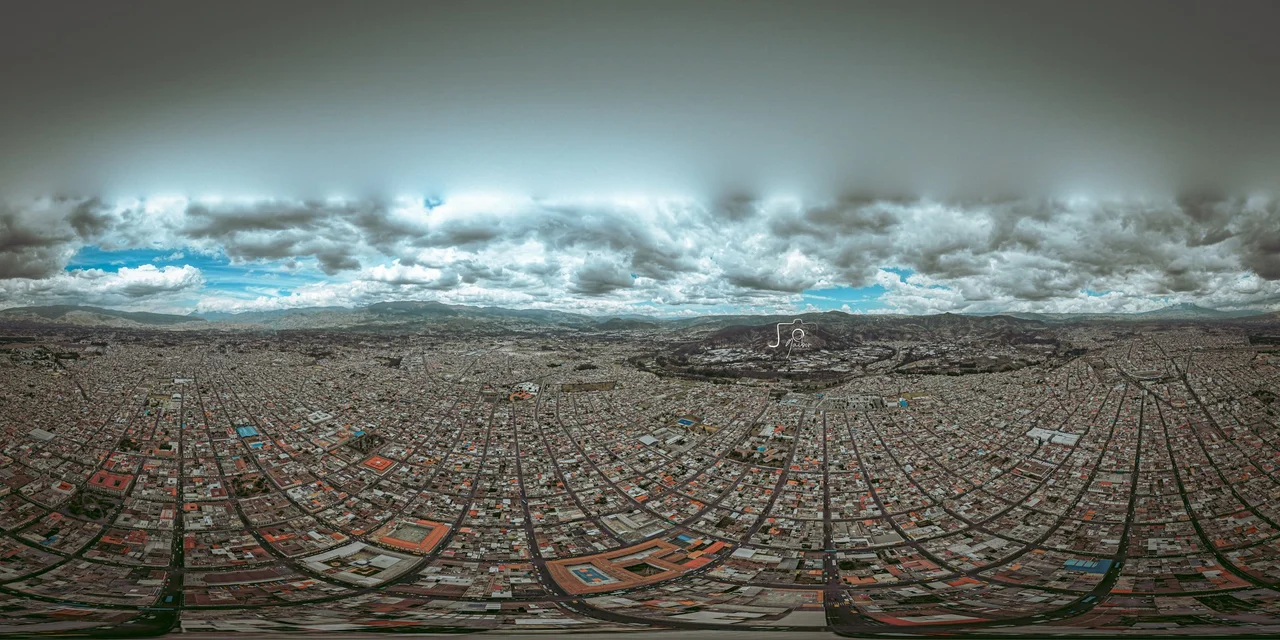

Riobamba
The locals call it Rio, and the nickname fits the city's easy rhythm. Riobamba sits in a high valley at 2,754 meters, surrounded by volcanoes on every horizon: Chimborazo to the northwest, Tungurahua to the north, El Altar to the east, Sangay smoldering to the southeast. On a clear morning the white peaks rim the sky like a crown, which is why locals have called their city the Sultan of the Andes since the colonial era. A population of around 150,000 keeps Riobamba on the smaller end of Ecuadorian cities, and it has the unhurried feel of a place where the mountains do most of the talking.
The Train That Was
For most of the 20th century, Riobamba was the launching point for the Nariz del Diablo, the Devil's Nose railway, a switchbacking descent down a near-vertical Andean cliff that became one of the great train rides in South America. Passengers used to ride on the roof, bracing against curves and whistling back at condors. That practice was banned in 2009 after two tourists died. The service itself has since contracted. The Devil's Nose route now runs from Alausi, a two-hour bus ride south, down to the village of Sibambe. Riobamba's grand old railway station still stands on Avenida Daniel Leon Borja, and Tren Ecuador occasionally runs excursion trains like the Tren del Hielo from Quito, but the daily bustle is gone. The platforms have gone quiet, the way so many small-town railway stations have gone quiet around the world.
Markets and Parks
Seven daily markets operate inside city limits, and three of them are within easy walking distance of the historic center: San Alfonso, San Francisco, and La Merced. These are not tourist affairs. They are where Riobambenos buy their potatoes, their chicken feet, their ponchos, their plastic buckets. Vendors pile fruit into precise pyramids. Butchers work open stalls with cleavers and practiced silence. On Saturdays a larger indigenous market overflows into Plaza Roja, drawing Puruha and Quichua farmers down from surrounding villages. The city is also threaded with parks. Parque 21 de Abril sits on a small hill near the train station and offers what locals swear is the best mountain view in town. Parque Maldonado anchors the historic center, bounded by the Cathedral on one side and the old government palace on another. Free WiFi reaches most of them under the RiobambaDigital network, a quiet civic gift.
Mountain Base Camp
Riobamba functions as the staging ground for most serious climbing in central Ecuador. Sangay National Park lies just to the east, holding three major volcanoes: Tungurahua, which erupted spectacularly between 1999 and 2016 and shut down Banos periodically; Sangay, one of the most active volcanoes in South America; and El Altar, an ancient collapsed caldera whose jagged rim is considered a technical climber's prize. Chimborazo rises to the northwest. Climbers use Riobamba as the place to acclimatize, buy last-minute gear, and hire guides. Mountain biking is popular too, with routes dropping from the paramo down toward the Amazon basin. For those who prefer trails to technical ascents, the Inca trail trek across Chimborazo Province takes two to three days through some of the most dramatic high-altitude terrain in Ecuador.
Hornado and Fried Chicken
Riobamba's kitchen runs on pork and potatoes, with hornado, a slow-roasted whole hog served with llapingachos and salted corn, as the undisputed city specialty. Several local restaurants specialize in it, served in portions ranging from $3.50 to $5. Locals will tell you which hornadero is having a good week and which one has slipped. Pollo Ejecutivo, a fried chicken joint across from Parque Guayaquil on Daniel Leon Borja, earns unironic praise for grease and crispness at under $3 a plate. D'Baggio, a pizzeria on Miguel A Leon, runs a wood oven in the front window so customers can watch the dough fly. Around Calle 10 de Agosto and Daniel Leon Borja, the main arteries of downtown, lunch runs $2 to $5 and dinner rarely tops $6. The Cafeteria Londres on Garcia Moreno has been doing cake since nobody remembers when.
April Nights
Each April, Riobamba celebrates its Independence Day with a week of concerts, parades, and public parties under the banner of the Fiestas del Abril. The city marked its first declaration of independence from Spain on 11 November 1820, and although crown forces soon crushed that attempt, the April celebration commemorates the later, permanent victory. La Avenida, the strip between El Parque Infantil and the train station, becomes a long open-air party. Bars like El Tentadero and Las Pipas, both across from the Plaza de Toros on 10 de Agosto, fill with university students and weekend visitors. By daylight, Riobamba returns to its pace, a city that doesn't particularly need to impress anyone, content with its mountains and its markets and the train whistle that used to echo down the valley.
From the Air
Located at 1.67 S, 78.65 W in central Ecuador's Sierra region. Elevation 2,754 m in the Chambo River Valley. Recommended viewing altitude 5,000 to 6,000 m to appreciate the ring of volcanoes around the city. Chimborazo (6,263 m) stands to the northwest, Tungurahua (5,023 m) to the north, El Altar (5,319 m) to the east, and Sangay (5,286 m) smokes to the southeast. Nearest major airport is Mariscal Sucre International (SEQM) in Quito, about 180 km north via the Pan-American Highway. The city's grid is visible against the green and brown patchwork of the Sierra highlands.
Nearby Stories
- Baños 17 km away
- Puyo 20 km away
- San Luis de Pambil 25 km away
- Alausi 41 km away
- Ventanas 48 km away
- Tena 53 km away
- Battle of Yaguachi 66 km away
- Borja, Peru 288 km away