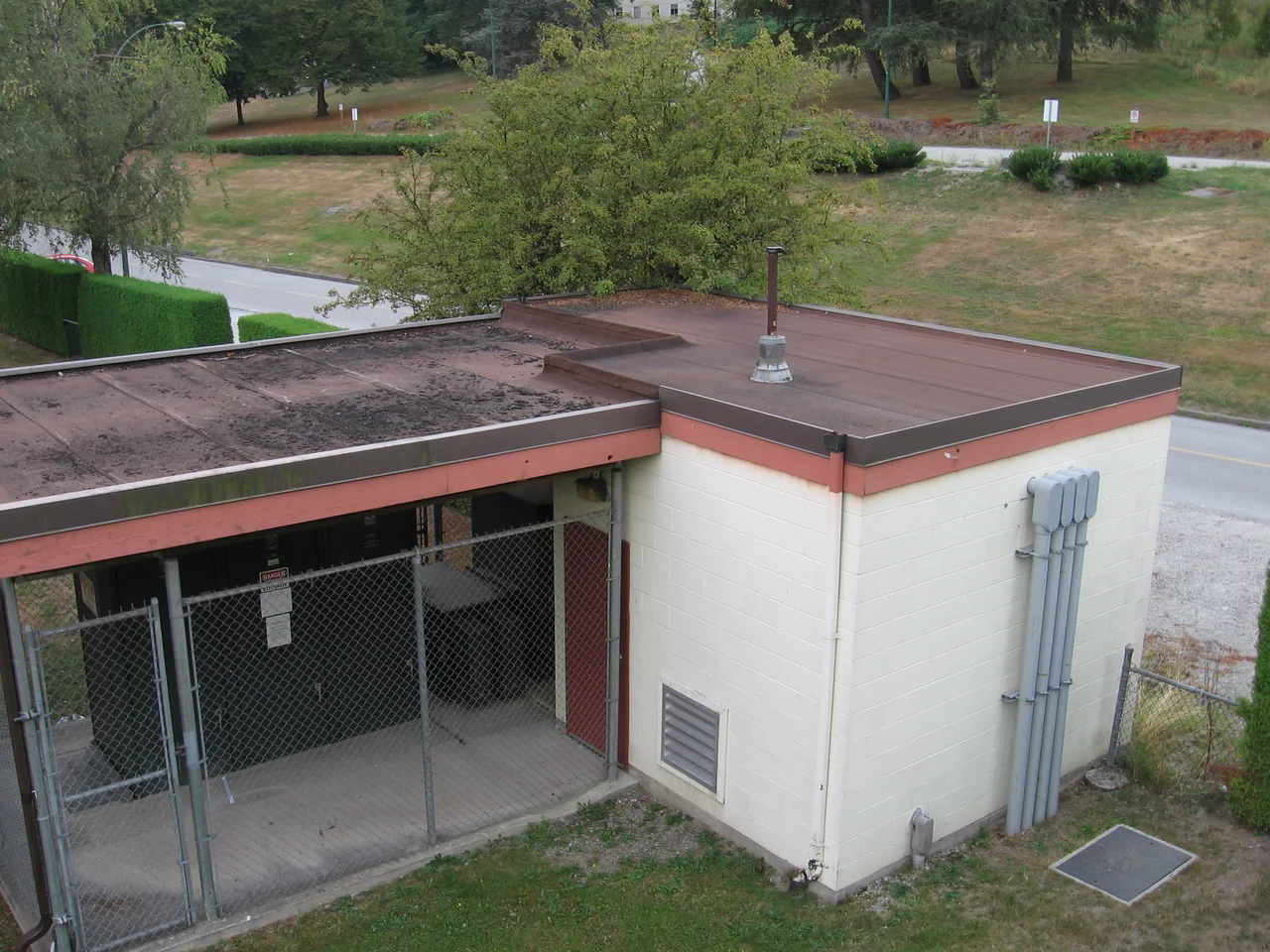

Riverview Hospital
It was built for 480 people. By the end of its first year it held 919. The permanent provincial mental hospital that opened on a Coquitlam hillside in 1913 was overcrowded before its plaster had properly cured, and it stayed that way for most of the century that followed — an arithmetic of need outrunning capacity that describes the institution's entire history in two numbers. What surrounds the buildings, though, is one of the finest collections of trees in western Canada, planted deliberately, by patients, on the theory that working among growing things could heal a mind. Both facts are true about the same place, and neither cancels the other.
Room Was Always the Problem
British Columbia's first facility for people with mental illness was the Royal Hospital in Victoria, converted to the purpose in 1876 and closed almost immediately for crowding; its patients moved to the Provincial Asylum for the Insane in 1878. That filled too. In 1904 the province bought a thousand acres of rural Coquitlam for a replacement and for the farmland beside it, and a temporary "Hospital for the Mind" went up on the site in 1909. The permanent hospital followed in 1913, administered by Henry Esson Young — a physician and provincial official whose name attached itself to the whole district, which became known as Essondale, and to the institution itself for decades. It opened treating around 300 seriously ill men. It was full within months, and then some.
The Botanist
In 1911, before the permanent hospital existed, British Columbia's first Provincial Botanist arrived on the grounds. John Davidson laid out an arboretum, a nursery, and a botanical garden across the hospital lands, and he did much of it with patients working alongside him — the era genuinely believed in the therapeutic value of this work, and in this case the belief produced something that outlasted everything around it. The botanical garden moved to the new University of British Columbia campus in 1916. The arboretum and nursery stayed, and the trees kept growing. When the hospital's future became uncertain, it was the trees that first organized people: the Riverview Horticultural Centre Society formed in 1992 to protect what remained of Davidson's plantings and to argue, still, for horticulture as care rather than decoration.
A Company Town
Adjacent Colony Farm was worked largely by patients, and by 1913 it was producing more than 700 tons of crops and 20,000 gallons of milk a year — an operation that fed the institution and was described as occupational therapy, though the people doing the work were not paid for it and could not leave. The site was remote enough that staff lived on it, and by 1927 a small community had grown at Essondale with shops, a school and a fire hall. Buildings accumulated: the Acute Psychopathic Unit in 1924, a 675-bed Female Chronic Unit in 1930 to absorb the overflow. In 1950 the wards were given the softer names they are still known by — Male Chronic became West Lawn, Female Chronic became East Lawn, the Acute Psychopathic Unit became Centre Lawn.
Emptying Out
The decline began in the 1960s and ran for half a century. Antipsychotic medication, psychiatric wards inside general hospitals, and a shift toward outpatient care all reduced the case for a single enormous institution, and the Mental Health Act of 1964 aimed to make mental health care as available as physical health care; by 1970 the province had seventeen mental health centres, twelve of them opened within the previous four years. A decision to downsize Riverview was made as early as 1967. West Lawn closed in 1983. In 1984, 141 acres of upper hillside were sold and built out as the Riverview Heights subdivision, 250 houses on ground that had been hospital land, with the remaining forest going to the City of Coquitlam. By 1990 the plan was a 358-bed facility, backed by a Mental Health Initiative promising $26 million over ten years for community services. Only the first payment arrived; by 1992 the second was eighteen months overdue. That gap — beds closed here, services never opened there — is the part of the story that has never been resolved.
Place of the Great Blue Heron
A 1992 review titled Listening finally established that patients must be told, and given the chance to object, before being certified incapable — rights granted less than twenty years before the hospital shut for good in July 2012. The site was added to the Canadian Register of Historic Places in 2009 and has spent much of the time since as a film location, its empty wards standing in for institutions in dozens of productions. The real successor arrived on 12 October 2021: the Red Fish Healing Centre for Mental Health and Addiction, a $101-million provincial facility with room for 105 inpatients, built for people facing severe mental health and addiction challenges together rather than separately. That same year, by agreement with the Province, the Kwikwetlem First Nation renamed the lands səmiq̓ʷəʔelə — Place of the Great Blue Heron — restoring the name of ground that was their core traditional territory long before anyone thought to build an asylum on it.
From the Air
The Riverview lands sit at 49.2465° N, 122.806° W, on a south-facing hillside in Coquitlam above the Coquitlam River's confluence with the Fraser, roughly 20 km east of downtown Vancouver. Fly it at 1,500 to 2,500 feet AGL. The site reads clearly from the air as a large, unusually green campus of scattered institutional buildings set in mature specimen trees — a distinctly older, heavier canopy than the suburban forest around it — with the dead-flat fields of Colony Farm Regional Park immediately south on the floodplain, and the Riverview Heights houses filling the upper slope. The Port Mann Bridge crosses the Fraser about 4 km southwest and Mary Hill rises just south of the farm. Pitt Meadows (CYPK) is about 5 nm northeast and is the practical base; Langley (CYNJ) is roughly 10 nm southeast, Boundary Bay (CZBB) about 13 nm southwest, Vancouver International (CYVR) about 16 nm west, Abbotsford (CYXX) about 22 nm east. This lies under Vancouver's terminal airspace — check the VFR terminal chart. Valley fog is common on calm autumn and winter mornings; summer afternoons are typically clear, with Golden Ears and the Coast Mountains filling the view north.
Nearby Stories
- Matsqui Institution 3.4 km away
- White Rock Pier 5.5 km away
- Stave Lake 7.4 km away
- Lower Mainland 10 km away
- Galiano Island 14 km away
- Salish Sea Human Foot Discoveries 30 km away
- Storm Bay 32 km away
- Okanagan 190 km away