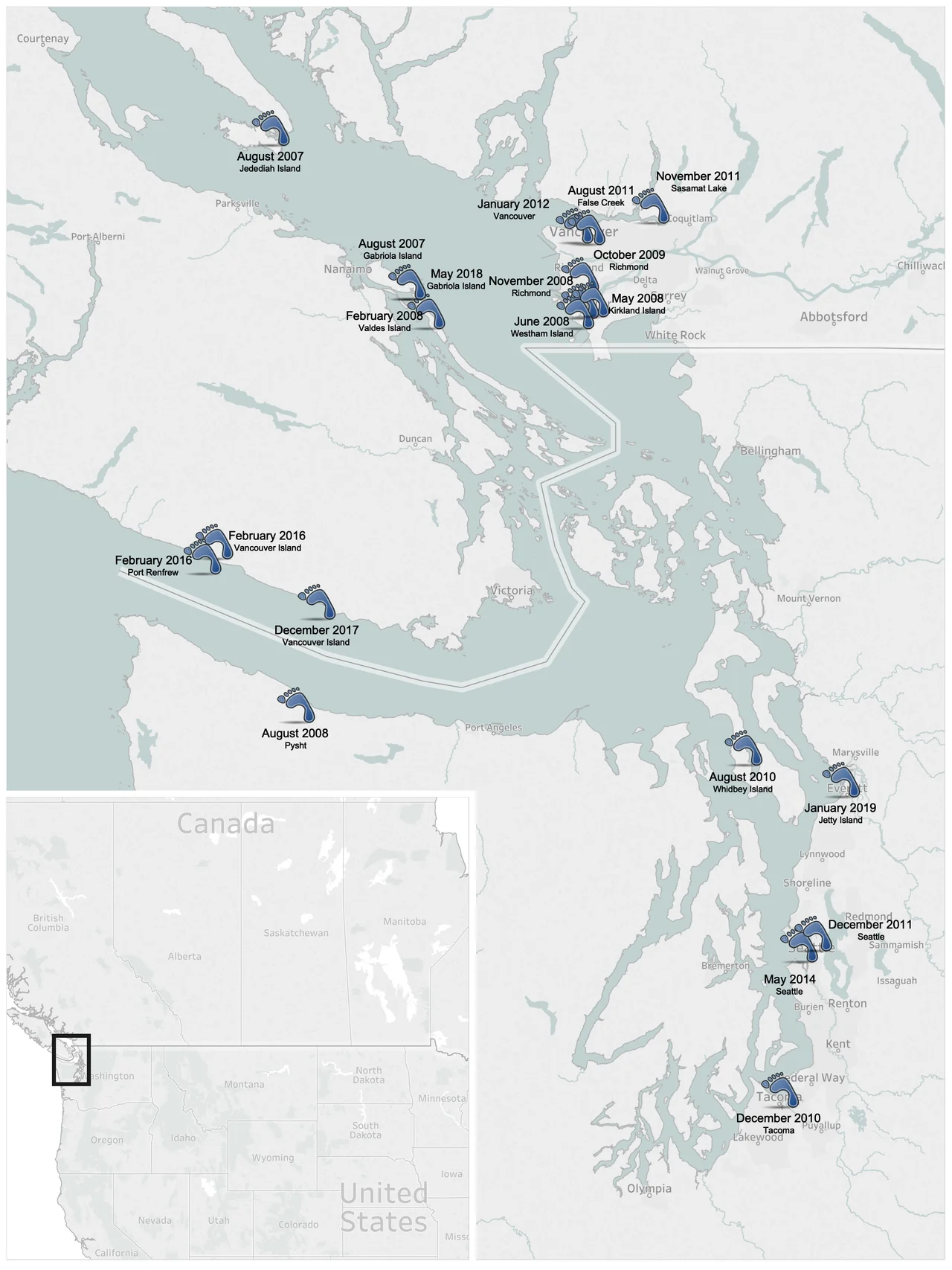

Salish Sea Human Foot Discoveries
Most of them have names now. Of the fifteen feet found on British Columbia's shores between 2007 and 2018, thirteen have been matched by DNA to specific people, and behind each match is a family that spent months or years not knowing. The last of those was a left foot found on a rocky West Vancouver beach in September 2018, identified as belonging to a man who had gone missing earlier that year. That is the part of this story that got lost while it was travelling around the world as a curiosity. At least twenty detached human feet, nearly all of them in running shoes, have come ashore on the coasts of the Salish Sea in British Columbia and Washington since August 2007. They are not evidence of a killer. They are what the ocean does with the people it takes.
Jedediah Island, and Then the World
The first turned up on 20 August 2007 on Jedediah Island, a small uninhabited island in the Strait of Georgia. Another followed. Then another. When a fifth foot appeared in June 2008, the story escaped the local papers and went global: the Melbourne Herald Sun, The Guardian in London, the Cape Times in South Africa. David Letterman put the question to two Canadians in his studio audience. One scientist who works in identifying human remains attributed the coverage to plain morbid fascination, which was accurate and did nothing to slow it down. Feet kept arriving, on island beaches in British Columbia and in Seattle and Tacoma, and every arrival restarted the speculation about serial killers, gangland disposal, and plane crashes.
What a Running Shoe Does
The explanation, once forensic scientists laid it out, was disappointingly ordinary and physically precise. A body in cold seawater decomposes slowly, and the ankle is a comparatively weak joint. Simon Fraser University entomologist Gail Anderson has noted that extremities, hands and feet and head, commonly detach as a body breaks down underwater, but they rarely float. A modern athletic shoe changes that. The foam midsole is buoyant enough to lift the foot off the bottom and carry it on the current, and the shoe also armours what is inside it against scavengers and abrasion, so the foot arrives intact enough to be recognized. The reason nobody finds hands is that hands do not come with flotation. The reason the discoveries cluster in the modern era has a great deal to do with what people now wear on their feet.
Foul Play Ruled Out
In December 2017 the British Columbia Coroners Service stated that foul play had been ruled out in every case investigated to that point. The identifications, where they were made, told a consistent and sombre story: people who had drowned, and people who had taken their own lives. In the American cases, a matched pair was identified as a woman who died by suicide, another foot as a fisherman who had gone missing, and another as a man whose family asked that his name not be released. That request is worth sitting with. For a family already carrying the worst thing that can happen, the last indignity would be watching a relative become an anecdote on a late-night talk show. Two feet found at Botanical Beach on Vancouver Island's west coast in February 2016 remain unidentified, and somewhere there are still people waiting on those.
Leg-In-Boot Square
None of this is new to the coast, only newly frequent. In 1887 a leg inside a boot washed up in Vancouver, and the place where it was found is called Leg-In-Boot Square to this day, which tells you something about Victorian-era attitudes to public commemoration. On 30 July 1914, the Vancouver Sun reported that people arriving from Kimsquit had described a human leg in a high boot found on a beach near the mouth of the river then called the Salmon, now the Dean, up near the head of Dean Channel. The remains were believed to be those of a man who had drowned in the river the previous summer. A stout leather boot, it turns out, does much the same job as a Nike.
Hoaxes and Afterlives
A foot found on Tyee Spit near Campbell River on 18 June 2008 was not a foot. Someone had put a skeletonized animal paw into a sock and a shoe, packed it with dried seaweed, and left it where it would be found; the RCMP opened an investigation. After the eleventh genuine discovery in Vancouver in August 2011, running shoes containing what police suspected was raw meat washed up on Oak Beach. The phenomenon has since been absorbed into fiction, turning up in an episode of Bones, an establishing scene in Rizzoli & Isles, a Preston and Child novel, a Netflix series, and more than one podcast. It has become a piece of Pacific Northwest folklore. Underneath the folklore are roughly twenty people who went into cold water and did not come out, and thirteen families in British Columbia who at least got to stop wondering.
From the Air
The first discovery site, Jedediah Island, lies at roughly 49.15N, 123.73W, in the Strait of Georgia between Texada Island to the west and Lasqueti Island to the southeast, about 25 kilometres east of the Vancouver Island coast near Qualicum Beach. From the air Jedediah is a small forested island with a distinctive deep notch at Home Bay on its east side; the long dark bulk of Texada dominates the view northwest. Subsequent discoveries range across the whole Salish Sea, from Botanical Beach on Vancouver Island's exposed west coast to the inner harbours of Seattle and Tacoma, which gives a sense of how far this water moves things. Look east across the strait to the Coast Mountains on the British Columbia mainland, and southeast down the Strait of Georgia toward Vancouver. Nearest airports are Qualicum Beach (CAT4) and Powell River (CYPW), with Comox (CYQQ) and Nanaimo (CYCD) nearby. Best viewed at 2,000 to 4,000 feet AGL. Strong northwest winds funnel down the strait on summer afternoons.
Nearby Stories
- Ganges, British Columbia 4.6 km away
- Burns Bog 5.4 km away
- Mesachie Lake 6.7 km away
- Strait of Georgia 8.5 km away
- Mount Arrowsmith Biosphere Region 12 km away
- Jedediah Island Marine Provincial Park 14 km away
- St. Augustine's Indian Residential School 16 km away
- Lower Mainland 31 km away