
Roanoke College
The school moved across Virginia in a single covered wagon. That detail tells you something about how small Virginia Collegiate Institute was when it pulled up stakes in Augusta County in 1847 and resettled in Salem, a stagecoach town on what would become Route 11. The two Lutheran pastors who ran it, David Bittle and Christopher Baughmann, were betting that Salem - then a junction of commerce and transportation in the Roanoke Valley - would give their boys' preparatory school a future. Six years later, on March 14, 1853, the Virginia General Assembly granted them a college charter. They renamed the school for the valley itself: Roanoke College.
Cadets Against the Union
Roanoke became one of the few Southern colleges to stay open throughout the American Civil War. The student body, organized into a corps of cadets, fought Confederate engagements near Salem in December 1863. They were outmatched almost immediately and forced to surrender, but the Union commander did something unexpected: he paroled them and sent them back to their studies. A generation later, in 1898, Roanoke produced the first Korean to graduate from any American college or university - Surh Beung Kiu. Another Roanoke-educated Korean, Kim Kyusik, would go on to lead the Korean independence movement; in 2022 the college dedicated a highway marker in his honor on High Street, naming a man who once walked those bricked sidewalks as a freshman.
Lamps and Palms
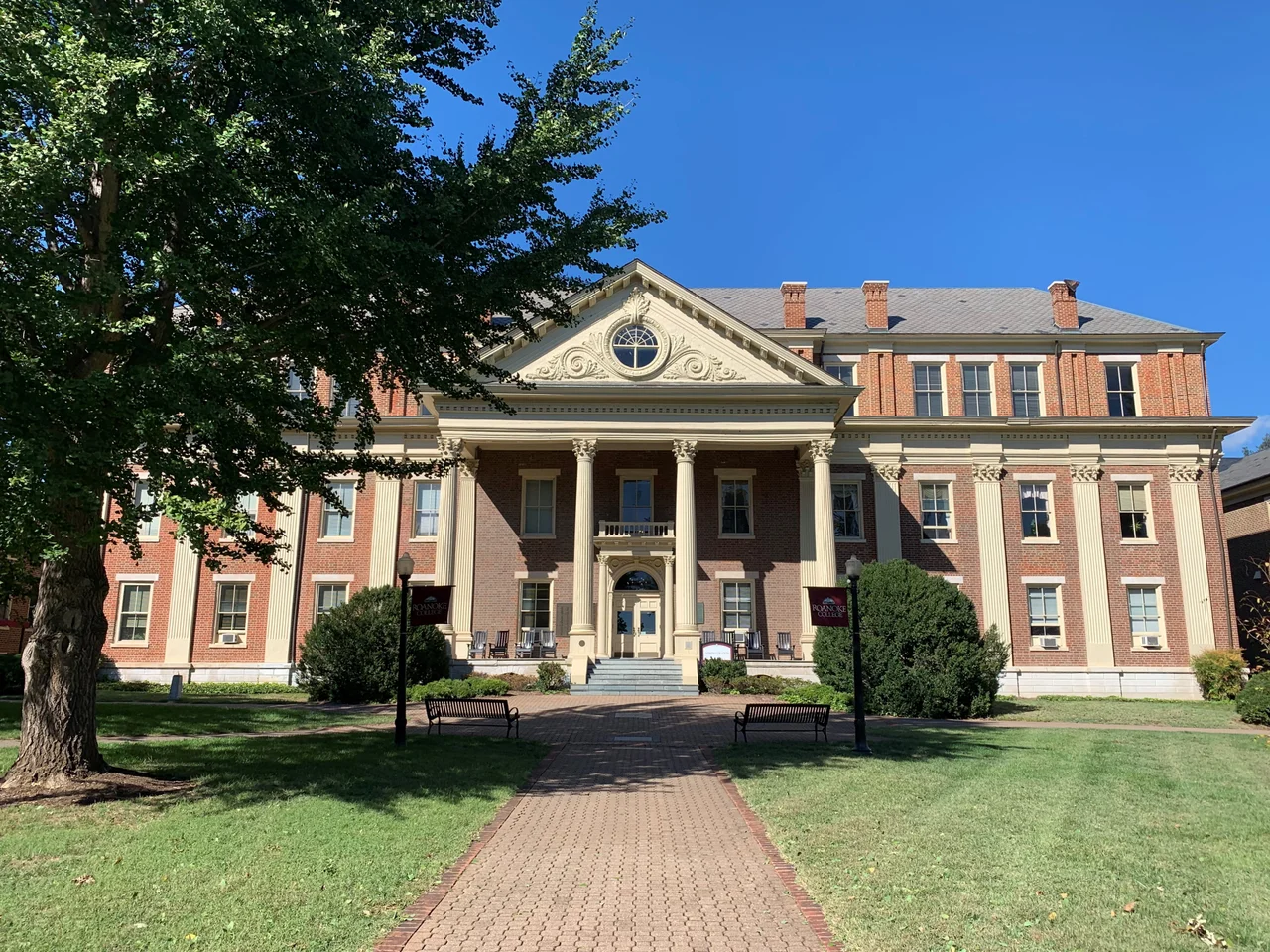
The college seal explains the place. A blue shield bearing a gold cross represents Roanoke's Lutheran roots - Roanoke is the second-oldest Lutheran-affiliated college in the United States, after Gettysburg. A white dogwood flower stands for Virginia, the state flower. A lamp above the shield signifies knowledge. And the motto, in Latin, reads Palmam Qui Meruit Ferat - Let he who earns the palm bear it - a phrase echoing back to the laurel-and-palm honors of ancient Greece. The campus where these symbols live is laid out around three quadrangles. Brick sidewalks lead between buildings constructed across two centuries. The Administration Building dates to 1848, built with bricks made on-site. Seven Roanoke buildings, including Miller Hall, Trout Hall, and Bittle Hall, are listed on the National Register of Historic Places. Near the library grows the largest Rock Elm in the United States. The only Alice Aycock sculpture in Virginia stands on the Back Quad.
The Maroons and the Railway
Athletics at Roanoke are wrapped in maroon and gray. The teams are the Maroons; the mascot is Rooney, a maroon-tailed hawk. Roanoke joined the Old Dominion Athletic Conference as a founding member in 1976 and has since won 101 conference titles. The college took the 1972 NCAA College Division men's basketball championship and the 1978 Division II men's lacrosse championship. In 2025, Mark Samuel won a D-III national wrestling title. The football program, which had not fielded a team since 1942, returned in 2024 - 82 years of silence broken. The college has also long been tangled with the Norfolk and Western Railway, headquartered in Roanoke until 1982. NWR named a Pullman car Roanoke College. John P. Fishwick, the railway's former president, lived in a colonial revival mansion on North Market Street; that house is now the college President's House.
Two Thousand Students, Forty States
Today Roanoke enrolls about 2,000 undergraduates drawn from roughly 40 states and 30 countries. The campus has expanded across College Avenue and onto Main Street, where the Old Salem Post Office, built in 1923, is now a college building. The Elizabeth Campus, two miles east, sits on the site of Elizabeth College, a Lutheran women's school that burned in late 1921 and never reopened. The largest project in years opened in 2016: the Morris M. Cregger Center, a 2,500-seat performance arena with a 200-meter indoor track, integrated with Kerr Stadium to form a unified complex on the north side of campus. Lutherans, the founding heritage, now total less than ten percent of the student body. The largest religious group is Roman Catholic. The covered wagon is long retired, but Roanoke College, the school that crossed a state in it, still occupies the central blocks of the town where it stopped.
From the Air
Roanoke College sits at 37.30 N, 80.06 W in central Salem, one block north of Main Street and approximately 6 miles west-southwest of downtown Roanoke. Cruise at 4,000 to 6,500 feet MSL. Look for the brick quadrangles set against the surrounding Blue Ridge foothills. Salem and Roanoke share airspace; the nearest airport is Roanoke-Blacksburg Regional (KROA), about 5 nautical miles east. I-81 runs just south of campus.
Nearby Stories
- Battle of Galudoghson 1.8 km away
- Franklin County, Virginia 14 km away
- Poplar Forest 17 km away
- Pulaski County, Virginia 18 km away
- Alleghany County, Virginia 18 km away
- Draper's Meadow Massacre 19 km away
- Hargrave Military Academy 29 km away
- 2020 Williamsburg Massacre 42 km away