
Rock Hill, South Carolina
On January 31, 1961, nine young men from Friendship Junior College walked into the McCrory's variety store in downtown Rock Hill, sat down at the whites-only lunch counter, and asked to be served. They were arrested. At the courthouse the next morning, they were offered the choice the sit-in movement had been quietly debating for a year: pay the fine and walk out, or refuse and go to jail. They refused. "Jail, no bail," the slogan went. The Friendship Nine spent thirty days breaking rocks on a York County chain gang. Their convictions were vacated in 2015. A circle of stools at the old McCrory's lunch counter, now Kounter Restaurant, is engraved with their names. Rock Hill is a city of about 75,000 in the South Carolina piedmont, twenty-five miles south of Charlotte. It is also that.
A Catawba River Town
Rock Hill takes its name from a flint outcrop the Charlotte and South Carolina Railroad surveyors hit in the 1850s while running their line south from Charlotte. The town incorporated in 1870 after three tries - members of the White family, who owned a large share of what would become the town, fought incorporation because they did not want to pay urban taxes for paving muddy streets they were perfectly happy walking in. They lost. The new town grew up around the railroad and around cotton: ginning, baling, shipping, and eventually milling. By the early 20th century, textile mills lined the rail corridor and a one-industry workforce kept the local economy stable but vulnerable. When the textile industry collapsed in the 1980s and 1990s as production moved overseas, Rock Hill had to reinvent itself.
The Friendship Nine
Sit-ins had been sweeping the South for a year by January 1961 - Greensboro had started the wave on February 1, 1960, and Nashville and Atlanta and Charleston had all followed. Most demonstrators paid their fines and walked free, which protest organizers worried sent the wrong message. Rock Hill became the testing ground for a different approach. Nine students from Friendship Junior College - Thomas Gaither, John Gaines, Clarence Graham, Willie McCleod, Robert McCullough, Willie Massey, James Wells, David Williamson Jr., and Mack Workman - sat down at McCrory's lunch counter together with a strategy worked out in advance with CORE organizer Tom Gaither. When the convictions came, they chose thirty days on the chain gang over the fine. The York County jail and roadwork crews now had to feed and house them, costing the segregation system money instead of underwriting it. The tactic spread across the South. The Friendship Nine carried it. In January 2015, fifty-four years to the week later, a York County judge vacated their convictions in the same Rock Hill courthouse where they had been sentenced. Several of the surviving men were present. The judge apologized.
Old Town and the Civitas
Walk through downtown Rock Hill today and the city's reinvention is on every block. At the gateway to Old Town stand four bronze statues called the Civitas, twenty-two feet tall, sculpted by Audrey Flack in 1991. Each figure holds a disc representing one aspect of the city's economy - industry, knowledge, inspiration, energy - and the ribbons in their hair turn into wings, nodding to the textile industry that built the place. Sixty-foot columns frame the intersection, salvaged from an Egyptian Revival Masonic temple in Charlotte and gifted to Rock Hill by the First Union Corporation. A Mural Mile of public art now winds through downtown, including one painted in 2021 by South Carolina-raised artist Shepard Fairey. The Freedom Walkway, an alley installation honoring civil rights heroes, is around the corner from where McCrory's used to be.
Football City and the Catawba
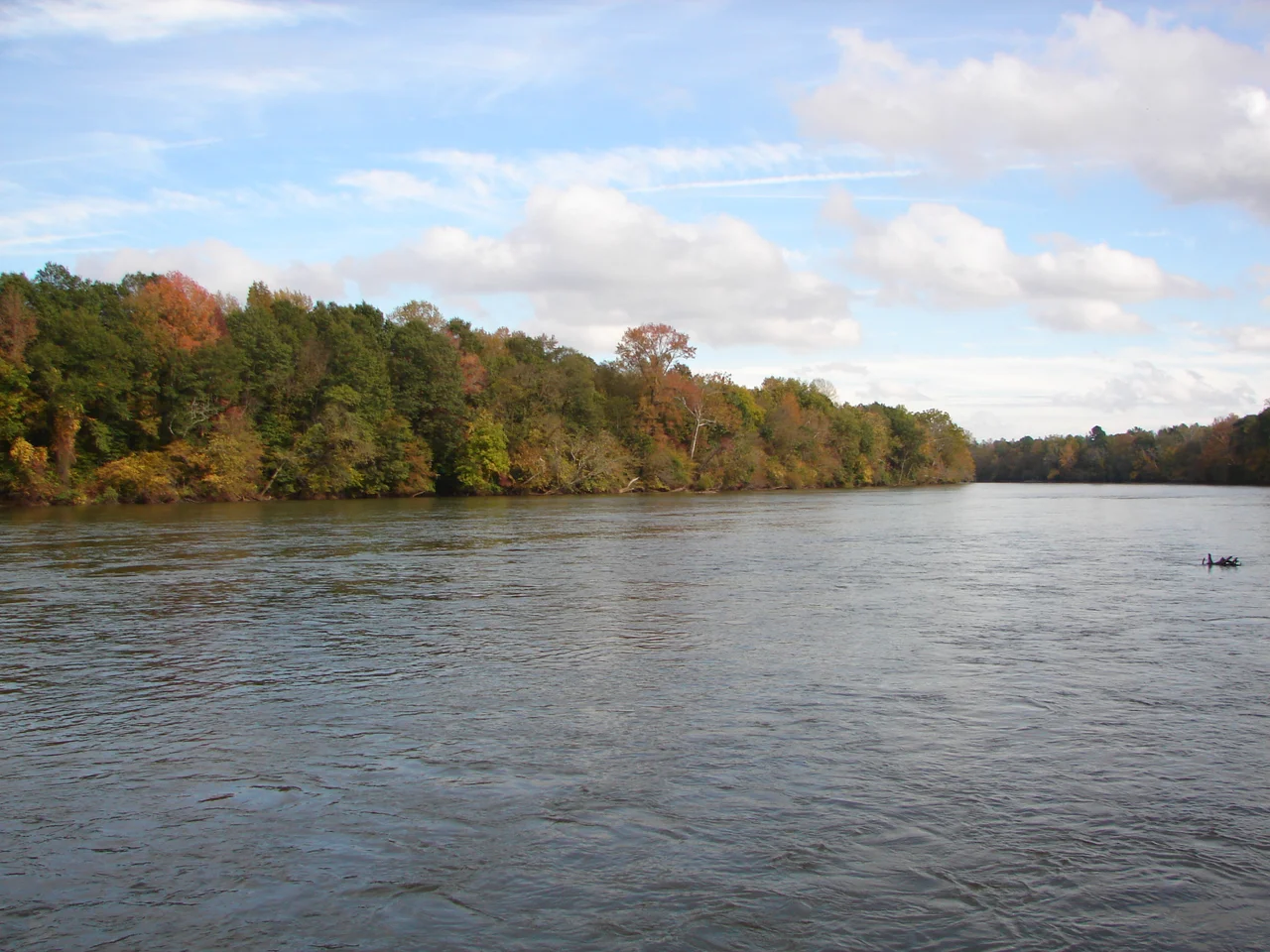
Rock Hill calls itself "Football City USA" because of how many NFL players it has produced per capita - Stephon Gilmore, Jadeveon Clowney, Mason Rudolph, Cordarrelle Patterson, and many more came out of South Pointe, Northwestern, and Rock Hill High schools. In 2019 the Carolina Panthers announced they would build their new training facility on 200 acres in the city, then abruptly killed the deal in 2022 in a public dispute about funding. Beyond football, the city hosts the United States Disc Golf Championship every year at Winthrop University and the UCI BMX World Championships were held there in 2017. Riverwalk - a thousand-acre mixed-use development along the Catawba - centers on the Giordana Velodrome and a BMX Supercross track. The Catawba itself, once the working waterway of the old mill town, is now the city's recreational spine, with parks at Ebenezer along Lake Wylie and Cherry Park and Manchester Meadows arranged along its bends.
From the Air
Rock Hill sits at 34.9381 N, 81.0261 W on the Catawba River in the South Carolina piedmont, about 20 nm south of downtown Charlotte. The city's airport, Rock Hill/York County (KUZA, also known as Bryant Field), is roughly 5 miles southwest of downtown and handles general aviation; commercial flights operate from Charlotte-Douglas (KCLT) to the north. Look for the I-77 corridor cutting through the eastern edge of town, the Catawba River and Lake Wylie east and northeast, and the Winthrop campus's distinctive layout in the central city. Recommended cruising altitude for visual flight: 3,500-5,500 feet AGL. The city is unmistakable in clear daylight - a moderate-density piedmont city with the river dominating the eastern view.
Nearby Stories
- Charlotte Douglas International Airport 11 km away
- Gardner-Webb University 14 km away
- Reed Gold Mine 15 km away
- Battle of Rocky Mount 18 km away
- Cherokee County, South Carolina 18 km away
- Battle of Musgrove Mill 27 km away
- Battle of Colson's Mill 48 km away
- Hartsville, South Carolina 49 km away