
Roker Park (park)
The drinking fountain in the corner of the park tells the whole story. Ashlar and sandstone and granite, erected in 1880 by the scholars, teachers and friends of the Sunday Schools in Sunderland to commemorate the centenary of Sunday Schools and the opening of the park itself on 23 June that year. The land had been donated. Sir Hedworth Williamson, 8th Baronet, and the Church Commissioners had agreed to give up a stretch of clifftop in the new resort of Roker so that ordinary people could walk along it. Sunday School children paid for the fountain that thanked him.
The Gift and the Layout
Roker in 1880 was being remade as a seaside resort. Terraced houses were rising along the cliffs. The railway had reached the area. What it lacked was an amenity to draw visitors and serve residents. Williamson and the Church Commissioners between them owned the land that became the park - an irregular plot bordered by Park Parade, Roker Park Terrace, Roker Park Road, and Side Cliff Road, shaped roughly like an upside-down reversed L. The northern part is the widest section and fronts onto Roker beach via a steep ravine. A wooden footbridge crosses the ravine. The drop down to the sand is steep enough that the bridge feels like a real crossing rather than a path embellishment.
The Boating Lake and the Trains
At the centre of the park lies a freeform boating lake. For more than a century it has hosted model boats - originally sail and clockwork, now radio-controlled cabin cruisers and tiny tugboats steered by retired engineers in folding chairs. In the northwest corner of the park, a model narrow-gauge railway built in the 1970s loops through landscaped beds. Children ride on small trains pulled by smaller locomotives, the steam mixing with the salt smell of the North Sea half a mile away. The combination - boating lake, model railway, Victorian bandstand, beach access - is the kind of park-as-civic-machine that British municipalities used to build deliberately to give working families places to spend a Sunday afternoon.
The Bandstand and the Cast Iron
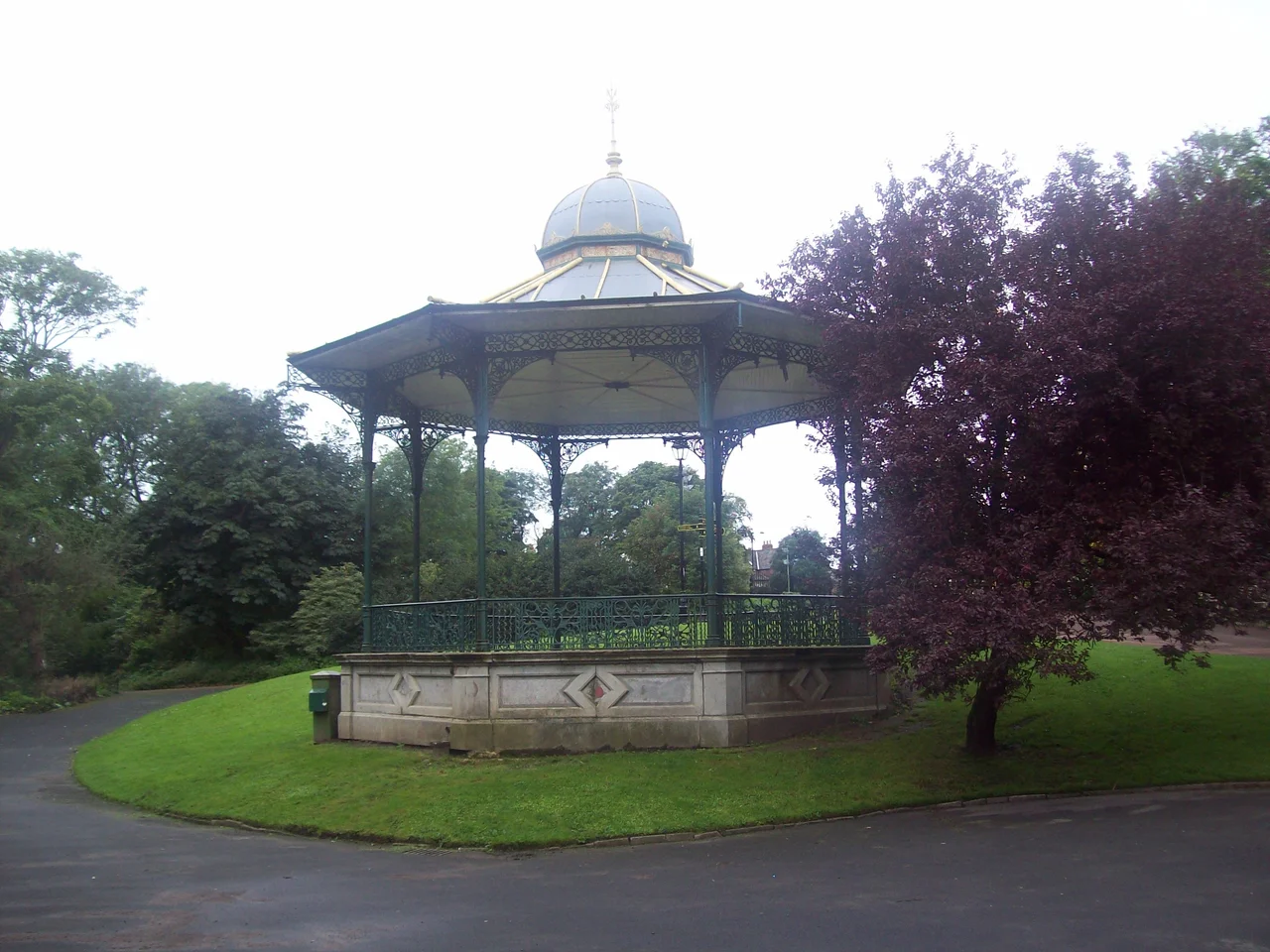
The bandstand is octagonal, cast-iron, wood-floored, with a metal-covered roof. It is listed Grade II - one of the few survivors of the Victorian park bandstand craze that filled British municipal parks with similar structures from the 1860s to the 1890s. Many were melted down for munitions in the Second World War. Roker's was either spared or restored. Brass bands still play there in the summer. The acoustics are not what concert halls call good; the wind off the North Sea sees to that. But on the right evening, with the sun setting behind the houses on Park Parade and a brass quartet working its way through a march, the bandstand is exactly what the Victorians designed it to be.
Illuminations and Spottee's Cave
For years the Sunderland Illuminations - the city's autumn light festival, modelled on Blackpool's - lit Roker Park and Seaburn from late September to early November. The event was branded the Festival of Light. Trees were strung with bulbs, the bandstand was floodlit, and the ravine became a tunnel of coloured lanterns. The illuminations have since moved to Mowbray Park in the city centre, but Roker still glows for summer events. Below the park on the beach is Spottee's Cave, a sea-cut hollow named after a beggar who supposedly lived there in the early nineteenth century. Local children dare each other to enter it at low tide. Most of them do.
From the Air
Located at 54.9254 degrees north, 1.3693 degrees west, the park sits on the cliffs about half a kilometre south of Roker Pier. From 1,500 to 2,500 feet AGL look for a roughly L-shaped green space bounded by terraced streets on three sides and dropping to the beach on the fourth via a wooded ravine. The cast-iron bandstand is visible as a small octagonal pavilion. Nearest major airport is Newcastle International (EGNT), 11 nautical miles north-northwest. Durham Tees Valley (EGNV) is 23 nautical miles south. The Roker Pier Lighthouse is 500 metres northeast.
Nearby Stories
- Seaton Carew 2.7 km away
- HMS Unity (N66) 6 km away
- George Stephenson's Birthplace 6.1 km away
- Raby Castle 9 km away
- Cragside 15 km away
- Whitby Abbey 21 km away
- German submarine U-2367 46 km away
- Alexander L. Kielland (Platform) 277 km away