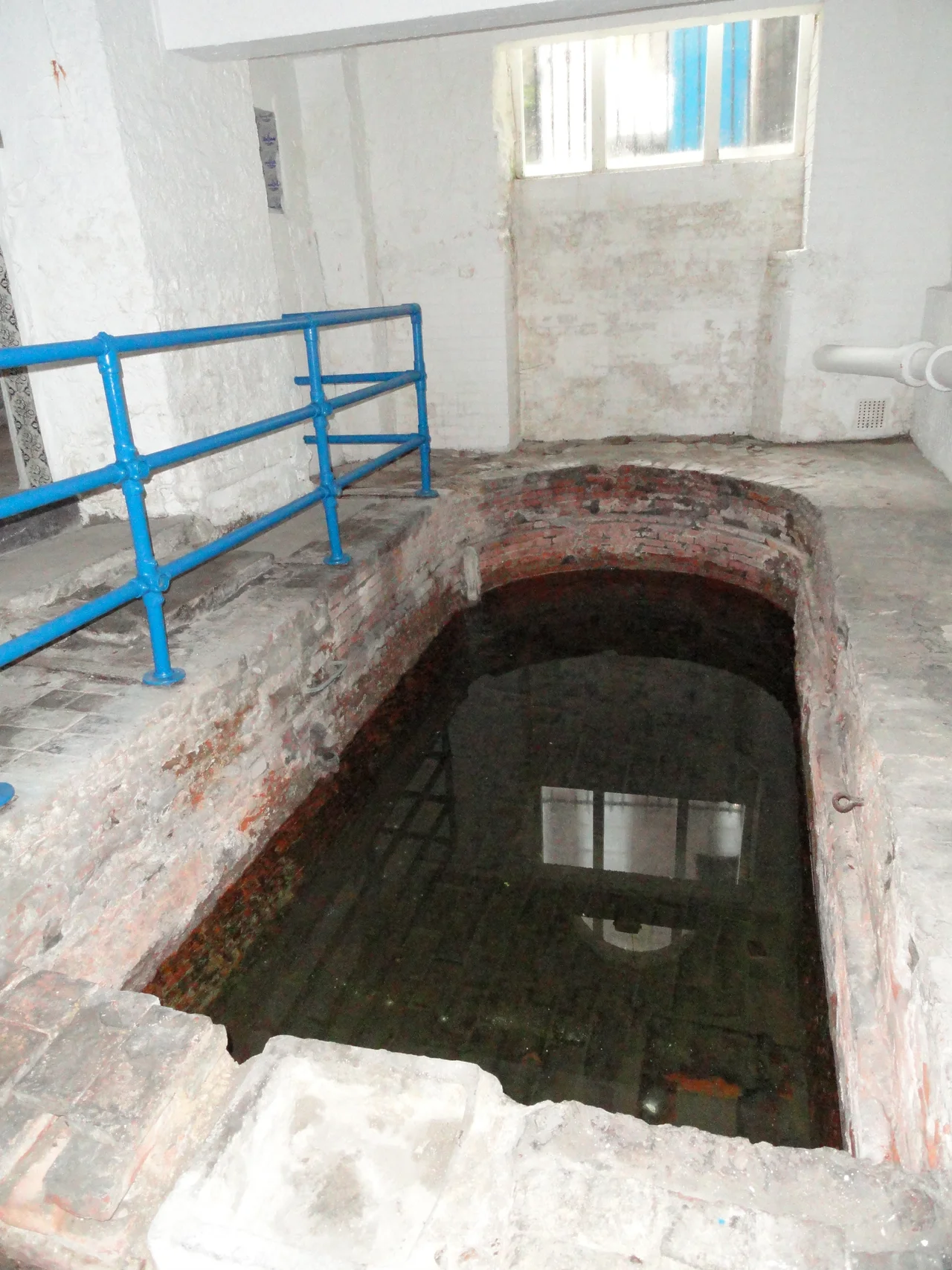

Roman Baths, Strand Lane
The plaque is still there, set into damaged wall plaster, identifying the brick basin as nearly two thousand years old, a relic of the days of Titus or Vespasian. It is, almost completely, a lie. The Strand Lane Baths are not Roman. They never were. The shallow Tudor bricks lining the pool were laid sometime between 1550 and 1650, the vaults overhead in the eighteenth century, and the Roman story itself only appeared in a London trade directory in 1838 under the proprietorship of a Mr Charles Scott, who needed a way to attract paying customers to a cold plunge bath that had begun to lose its appeal. Charles Dickens fell for it. He sent David Copperfield to bathe here in the novel's thirty-fifth chapter, and a hundred and eighty years of guidebooks, antiquarian writers, and credulous tourists fell in afterwards.
The Queen's Fountain
The real story begins in 1609, when James I commissioned an extravagant refurbishment of the old Somerset House for his queen, Anne of Denmark. Part of the redesign called for a fountain in the gardens, and a fountain needs water under pressure. A cistern house was built over Strand Lane, fed by pump from the Somerset House grounds, and that cistern house is what survives today, more or less, behind a window in a quiet corner off the bustling Strand. The full structure would have been considerably larger than the chamber visitors see now, tall enough to power the jets. What remains may be support for a water tank rather than the tank itself, which would explain the extraordinarily thick brick walls. When the fountain was demolished, the cistern was left to rot.
Mr Smith's Cold Plunge
In the mid-1770s, a Mr James Smith moved into No. 33 Surrey Street and saw potential in the derelict brick chamber out the back. By November 1776 he was advertising the cold bath at No. 33 for the reception of ladies and gentlemen, supplied with water from a spring that continually ran through it. Two years later he built a second bath next door, lined in marble and stone, with separate entrances for women on Surrey Street and men on Strand Lane. The clientele was, charitably, mixed. A newspaper reported in 1777 that a fare-dodger pursued by his angry cab driver tried to hide in the bath, fell in, and had to be rescued from drowning. In 1797 a gang of fraudsters used the place to escape police raiding their nearby house. In 1792 the MP and art collector William Weddell died here of a seizure on a hot spring day.
Becoming Roman
By the 1830s the baths had begun to lose patrons. Then, suddenly, in 1838 a trade directory listed them as the Old Roman Spring Baths. There was no archaeology, no scholarly claim, no excavation. Just a new proprietor, a new name, and the marketing genius of presenting cold water as ancient history. The story took. Charles Knight's 1842 London guidebook gave it weight. Dickens gave it readers. From there it spread through Victorian periodicals, tourist literature, and travel writing, gathering speculative ornament along the way: holy wells, underground streams from Hampstead, baths used by Roman matrons. The fact that the bricks were patently post-Tudor, that no documented Roman occupation reached this part of London, that the surrounding archaeology said otherwise, mattered less than the romance of bathing where the legions had bathed.
The Last True Believer
In 1922 the Rector of St Clement Danes, the Reverend William Pennington Bickford, bought the bath for five hundred pounds. Pennington Bickford was the last of the great believers. He stripped off the late-Victorian decorative scheme to find the real Roman fabric underneath. There was no real Roman fabric. There was Tudor brick. His allies, the journalist Edward Foord and the illustrator Fortunino Matania, kept publishing pamphlets and dramatic reconstructions showing Roman women lounging in marble splendour. Matania's drawing for The Sphere now sits in the Wellcome Library, a beautifully painted fantasy of something that never existed. When Pennington Bickford and his wife died in 1941, the bath passed through wartime bureaucratic limbo until the National Trust finally accepted it in 1947, on condition someone else paid for it. The timber magnate Montague Meyer did.
Peering Through the Glass
In 1951 the LCC published a new information leaflet acknowledging that the bath was almost certainly not Roman but worth preserving as a historical curiosity. Those conclusions are still on the noticeboard outside. The bath itself is harder to see than its mythology suggests. A call to the number on the board might get an appointment. It opens for Open House weekend each year, and is part of the weekly Somerset House Old Palaces Tour. Otherwise visitors press their faces against the foggy window on Strand Lane and squint into a dim chamber where the time-switch for the internal light is usually broken. What they see, when the light works, is one of the most enduring frauds in London tourism, a cistern that became a bath that became Roman because a Victorian shopkeeper needed a story.
From the Air
Coordinates 51.512°N, 0.116°W on the north bank of the Thames near Somerset House and the Strand. From altitude, the site sits between the river and the Strand, just east of the curve of Waterloo Bridge. The bath is not visible from the air, hidden beneath later buildings, but the location can be picked out by the riverside facade of Somerset House to the south and the spire of St Clement Danes to the east. Nearest airport: London City (EGLC) about 8 km east, London Heathrow (EGLL) 22 km west.
Nearby Stories
- Stevenage 5.7 km away
- Malling Abbey 5.7 km away
- 1952 Farnborough Airshow Crash 7.7 km away
- Ingatestone Hall 8.2 km away
- Hellfire Caves 9.1 km away
- The Carrington Event: The Solar Storm That Could Happen Again 9.8 km away
- Bletchley Park 16 km away
- Castle Hedingham 23 km away