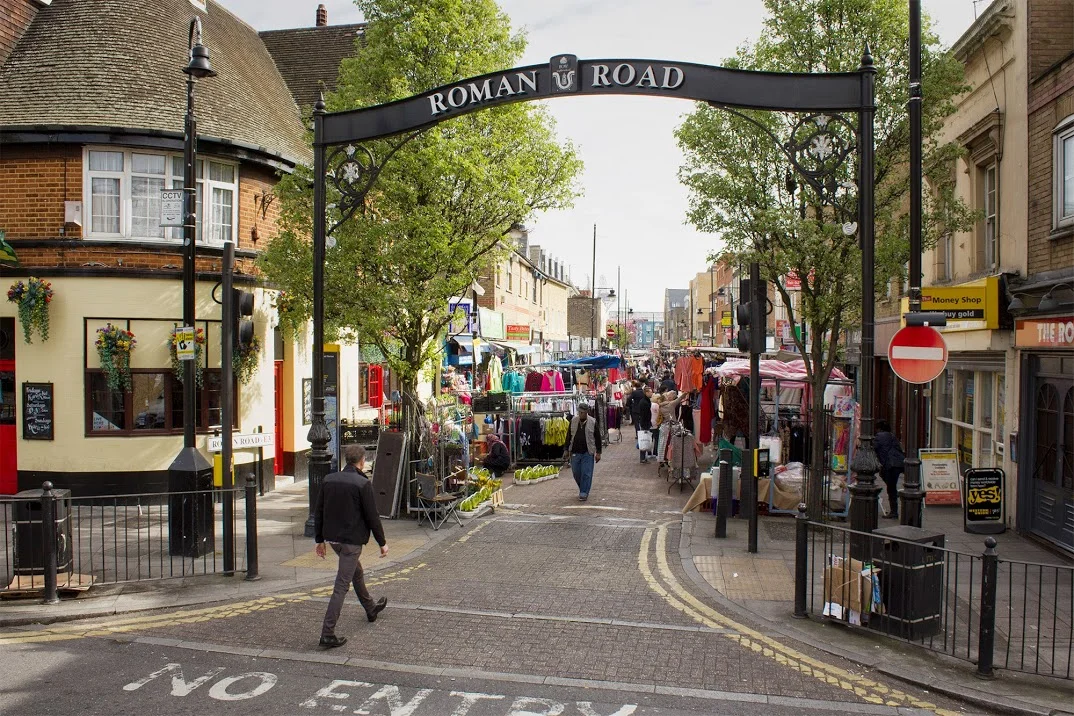

Roman Road, London
Sylvia Pankhurst lived at 400 Old Ford Road, and from there she ran an East London Federation of Suffragettes that did more than march. The Federation fed people. It found them work. It printed a newspaper called Women's Dreadnought out of 321 Roman Road, ran a co-operative toy factory at 45 Norman Grove, and held a market stall selling those toys alongside second-hand goods to fund the cause. When Mrs Savoy, a brushmaker and one of the East End women who marched on Downing Street in 1914, died, Pankhurst wrote that the streets of Old Ford were colder and greyer with her loss. Roman Road has been holding political meetings, feeding hungry families, and selling things at street stalls for at least 150 years, and possibly two thousand. Boudica is said to have come this way burning her path toward Londinium.
An Ancient Driftway
There is some debate about whether Roman soldiers actually marched along what is now Roman Road. The genuine Roman highway connecting London to Colchester runs roughly parallel, and the street here was for centuries shown on maps simply as a Driftway, a footpath through rural land. Then in 1845 an excavation on what is now Armagh Road turned up Roman remains, and further finds across the 19th and 20th centuries lent the name credibility. The Metropolitan Board of Works, established in 1855 mainly to engineer London's new sewers, also took on roads, and it was the Board that formally built Roman Road, formalising the old Driftway into a thoroughfare for an area that until then had been farmland with a windmill near what is now Ford Close.
The Battle of Bow
Roman Road became a centre for political radicalism with the speed of all rapidly urbanising places. In 1887 the social researcher Charles Booth toured the area with a policeman and reported that Beale Road was a hotbed of socialists, who had a club in Ford Street with many of the windows broken. George Lansbury, who lived around the corner in St Stephens Road, was their leader. Booth thought him a rare talker, not such a bad chap. The suffragettes held their regular meetings at Bow Baths, which doubled as a public bathhouse and a venue for political rallies, lectures, and variety shows. Pankhurst, Lansbury, and the dockers' leader Ben Tillett all spoke from its stage on subjects ranging from war and peace to the Welsh Miners Strike. In 1914 the press reported what they called The Battle of Bow, in which a police officer was charged with assaulting a labourer at a suffragette demonstration.
Bow Baths and the Library
The baths themselves were used 176,000 times in 1896 by a public that mostly relied on the tin bath, Victoria Park lake, or the canal for a wash. There were queues outside every Saturday in 1921, first or second class cold, warm, and spray baths, plus vapour baths, a wash house, and a swimming pool that hosted polo tournaments. The heat from the boilers travelled under the road in pipes to warm the new Passmore Edwards library, whose foundation stone was laid on 19 October 1900 after parishioners voted overwhelmingly to adopt the Free Libraries Act. The library opened in 1911 with 12,000 books in the lending library and seats for 56 readers in the reference room upstairs. Both buildings carried the names of philanthropists: Passmore Edwards the journalist, and one east-end benefactor named Macullum whose clock still ticks on the listed red-brick facade.
Grime in E3
By 2000 the bombs, the post-war slum clearance, and the brutalist housing estates designed by Lubetkin had remade the streetscape, but the market continued. So did a quieter kind of cultural production. A record shop at 391 Roman Road called Rhythm Division became the unofficial headquarters of a new music called grime. Dizzee Rascal, Wiley, Tinchy Stryder, Skepta, and Mercston all grew up around this street. They came to Rhythm Division to buy vinyl, hear what was new, and find an audience for what they were making. Wiley, dubbed the godfather of grime, told The Guardian in 2014 that Roman Road's street market culture, every Tuesday, Thursday, and Saturday, was the nurturer. It had everything to do with the Dizzees and Wileys coming through. Rhythm Division closed in 2010, but Wiley's song Bow E3 and Dizzee's 2020 album E3 AF kept the postcode in the music.
Going Down the Roman
The market runs Tuesdays, Thursdays, and Saturdays, and has done since at least 1843, when it was technically illegal but withstood several attempts to close it down. Going down the Roman has been an East End phrase for generations. Number 526 has sold pie and mash continuously since the 1920s, taken on in 1939 by George Kelly of the Kelly pie and mash dynasty. The conservation area designation came in 1989 and was extended in 2008 in recognition of the street's historic character. St Paul's Church on the north-eastern corner with St Stephen's Road dates to 1878 and now contains a four-storey steel-framed structure called the ark, inserted into the west end during a three-million-pound lottery-funded refurbishment, clad in tulipwood, that won a 2008 commendation for religious architecture. The road keeps changing. The market keeps selling. The pie and mash shop keeps the doors open.
From the Air
Coordinates 51.532°N, 0.032°W in the East End of London, running through Bow and Bethnal Green. From altitude the road appears as a straight east-west thoroughfare just south of Victoria Park, between the Regent's Canal and the Lee River. Look for the green rectangle of Victoria Park to the north and the curve of the River Thames around the Isle of Dogs to the south. Nearest airports: London City (EGLC) just 4 km south-east, London Heathrow (EGLL) about 30 km west.
Nearby Stories
- Stevenage 5.7 km away
- Malling Abbey 5.7 km away
- 1952 Farnborough Airshow Crash 7.7 km away
- Ingatestone Hall 8.2 km away
- Hellfire Caves 9.1 km away
- The Carrington Event: The Solar Storm That Could Happen Again 9.8 km away
- Bletchley Park 16 km away
- Castle Hedingham 23 km away