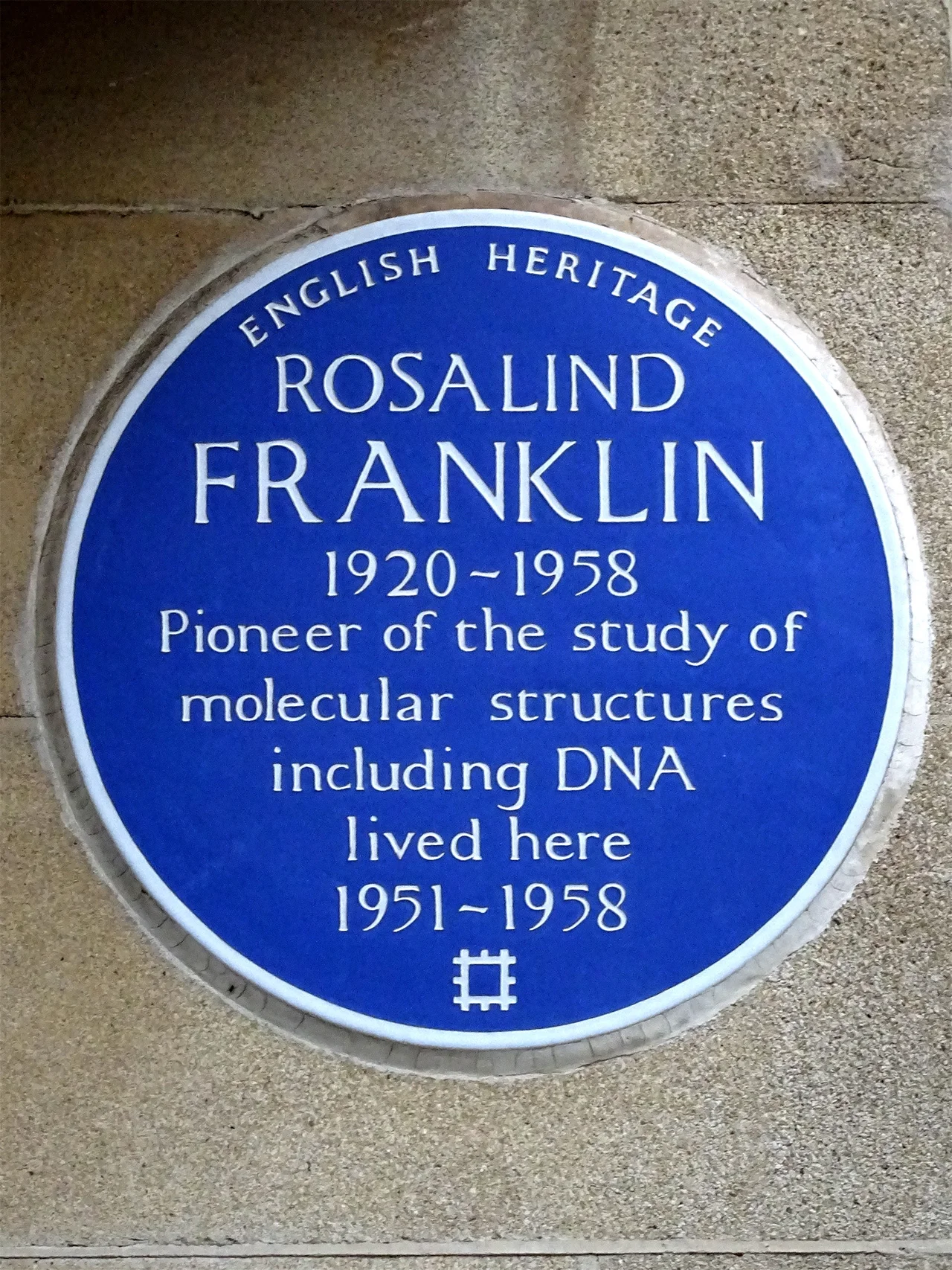

Rosalind Franklin
Rosalind Franklin's school music director was the composer Gustav Holst. He once called on her mother to ask whether the girl might be suffering from hearing problems or tonsillitis, because her singing was so poor. The girl was nine. By eleven she was matriculating with six distinctions at St Paul's Girls' School in Hammersmith, one of the very few girls' schools in London that taught physics and chemistry. By thirty-two she had taken the photograph that proved the structure of DNA — a near-perfect X-ray diffraction image of the molecule's B-form, made on a humidity-controlled camera she had refined herself. Within a decade three men would share a Nobel Prize for the discovery built on that image. By then Rosalind Franklin was four years dead, at thirty-seven, of ovarian cancer. The Nobel Committee does not award its prizes posthumously. The story of what she did, and what was done with her work, has been the subject of arguments ever since.
From Notting Hill to Cambridge
Franklin was born on 25 July 1920 at 50 Chepstow Villas, Notting Hill, into an affluent and politically engaged London Jewish family. Her father Ellis Franklin was a merchant banker who taught at the Working Men's College. Her great-uncle was Herbert Samuel, the first practising Jew to serve in the British Cabinet. In the 1930s the family sheltered two Jewish children from the Kindertransport in their home; one of them, a nine-year-old from Vienna, shared a bedroom with Franklin's sister Jenifer. Franklin's aunt Mamie described the young Rosalind to her husband: "alarmingly clever — she spends all her time doing arithmetic for pleasure, and invariably gets her sums right." She graduated from Newnham College, Cambridge, in 1941 with a degree in natural sciences. The university, then, gave women a "titular" BA rather than the full degree given to men. Cambridge began awarding full BAs to women only in 1947, and back-dated them to graduates who had been quietly denied them for decades.
Carbon, Then DNA
Her doctoral research had nothing to do with DNA. Working at the British Coal Utilisation Research Association during the war, Franklin studied the porosity of coal — using helium to determine its density and discovering, through patient measurement, the relationship between the fine constrictions in coal pores and the permeability of the porous space. Her conclusions classified coals more accurately and predicted their performance for fuel and for wartime gas masks. Cambridge awarded her a PhD in 1945. She then spent three years in Paris with the X-ray crystallographer Jacques Mering, learning the techniques that would transform her career. In 1950 she accepted a three-year Turner & Newall Fellowship at King's College London, expecting to apply X-ray diffraction to proteins in solution. Her director, John Randall, redirected her to DNA fibres before she had even started, and reassigned the graduate student Raymond Gosling to be her assistant. He did not tell Maurice Wilkins — already working on DNA in the same building — that Franklin would be taking over the project.
The Photograph
Franklin's critical innovation was a small humidity-controlled chamber for the X-ray camera, regulated by different saturated salt solutions. She discovered almost immediately that DNA existed in two distinct forms: a long thin fibre at relative humidity above 75 percent — which she called B — and a shorter fatter version when drier, which she called A. She divided the work with Wilkins: she would take the data-rich A form, he the B form. In May 1952 she and Gosling exposed a beam through a B-form fibre for over a hundred hours. The result, catalogued as Photograph 51, showed the unmistakable X-pattern of a helix at the heart of the molecule. Franklin set the photograph aside. She was applying the Patterson function to her A-form data, working with the methodical caution that her supervisor Bernal called the rigor of "experimental data" rather than the speculative model-building she distrusted. Cautious science is not always fast science. Photograph 51 sat in her files.
What Watson Saw
In January 1953 James Watson travelled from Cambridge to King's carrying a flawed preprint by Linus Pauling. Franklin was in her lab. Watson suggested she did not know how to interpret her own data. The argument escalated; Watson retreated, backing into Wilkins, who had been drawn by the commotion. Wilkins, in a gesture he later described as a friendly courtesy and others have called a betrayal, took Watson into his office and showed him Photograph 51 — without Franklin's permission or even her knowledge. Watson would later write that the moment he saw it, his mouth fell open and his pulse began to race. Six weeks later, on 7 March 1953, he and Francis Crick built the double-helix model at Cambridge. By March 17, Franklin — who had not been told what they were doing — had independently written a third draft paper describing a double-helical B-DNA. That paper was published in Nature in April 1953 alongside Watson and Crick's, and alongside a paper from Wilkins. The order of publication suggested confirmation of someone else's discovery; the truth was more complex.
Birkbeck and What Came After
Franklin moved to Birkbeck College in 1953 to work under J. D. Bernal, where she led pioneering structural studies of viruses, including tobacco mosaic virus and polio. Her papers on virus structure remain foundational. On the day before she was to unveil the structure of tobacco mosaic virus at the World's Fair in Brussels in 1958, she died of ovarian cancer. She was 37 years old. Her colleague Aaron Klug continued the virus work and won the Nobel Prize in Chemistry in 1982 for it, in a clear public acknowledgement of the lineage. The 1962 Nobel Prize in Physiology or Medicine was shared by Watson, Crick, and Wilkins for the discovery of the structure of DNA. The committee did not — could not, by its rules — name Franklin. Watson would later write that, had she lived, she would have won. The double helix has been depicted on stamps, in textbooks, and on building facades. The photograph that made it visible was taken by a woman who did not live to see what was done with it.
From the Air
Franklin's London is layered: born at 50 Chepstow Villas in Notting Hill (51.514°N, 0.207°W), educated at St Paul's Girls' School in Hammersmith, worked at King's College London on the Strand (51.512°N, 0.116°W), and at Birkbeck College in Bloomsbury (51.521°N, 0.130°W). The default location used here approximates the family home in Notting Hill / Bayswater. London Heathrow (EGLL) lies west on the standard approach; London City (EGLC) east. Northolt (EGWU) is the nearest general-aviation field. Hyde Park sits a short walk south of the birthplace.
Nearby Stories
- Stevenage 5.7 km away
- Malling Abbey 5.7 km away
- 1952 Farnborough Airshow Crash 7.7 km away
- Ingatestone Hall 8.2 km away
- Hellfire Caves 9.1 km away
- The Carrington Event: The Solar Storm That Could Happen Again 9.8 km away
- Bletchley Park 16 km away
- Castle Hedingham 23 km away