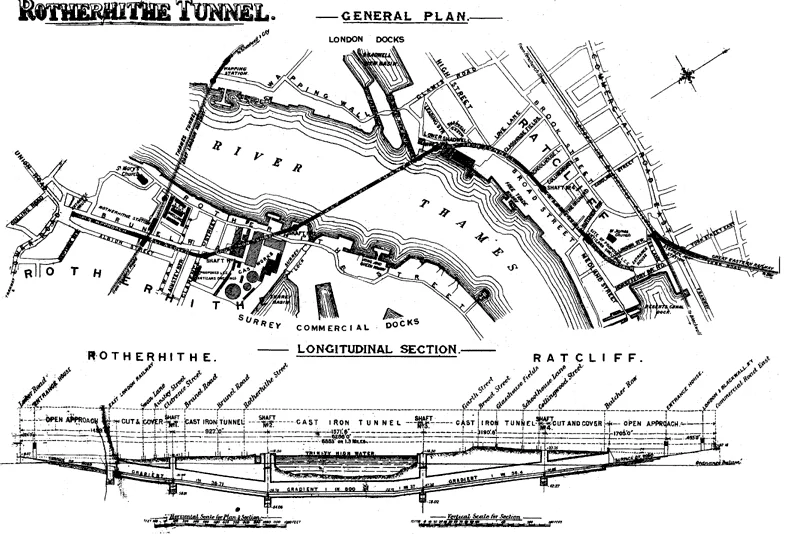

Rotherhithe Tunnel
The lanes are 2.4 metres wide. Modern road lanes are 3.6. Drive into the Rotherhithe Tunnel and the white-glazed brick walls close in on either side, the carriageway curves where it should run straight, and somewhere above you the Thames flows past at high tide. The bends are not for fun. They sit at the location of the four ventilation shafts, allowing the tunnel sections between them to run straight while avoiding the foundations of the old docks above. But London has another explanation that locals still repeat, even though Transport for London calls it a myth: that the bends were put there to prevent horses from seeing daylight at the end of the tunnel too early, which might make them bolt for the exit. When the tunnel opened in 1908, almost everything going through it was pulled by a horse.
Building It
The London County Council watched the Blackwall Tunnel open in 1897 to enormous success and decided it needed another toll-free crossing further west, midway between Tower Bridge and Blackwall, to serve the still-flourishing London Docks. Sir Maurice Fitzmaurice, the LCC's engineer, designed it closely on the Blackwall pattern but larger. At the time of its construction the Rotherhithe Tunnel was said to be the largest subaqueous tunnel in existence. Edward H. Tabor served as resident engineer; Price and Reeves were the contractors. The work ran from 1904 to 1908 at a cost of about one million pounds. Construction used two tunnelling shields working under compressed air, with the riverbed lined in puddle clay to keep the water out. Remarkably, no construction workers were killed, a rarity for a project of this scale at that period.
The People Who Lost Their Homes
The success of the engineering had a human cost. The long approach ramps and the cut-and-cover sections displaced nearly three thousand local residents from Rotherhithe and Limehouse. There was significant opposition. In 1903 the LCC built replacement tenements in Swan Lane, Clarence Street, and Albion Street in Rotherhithe, and at Brightlingsea Buildings on Ropemaker's Field in Limehouse. The new blocks had modern facilities, but the rents were significantly higher than what the displaced families had been paying. Many moved out again. Of all the things the Rotherhithe Tunnel accomplished, this is the least photographed and the least remembered: a working-class community broken up to make room for a road designed for a transport technology that would be obsolete within a generation.
Opening Day to Model T
The tunnel was formally opened in 1908 by George, Prince of Wales, later King George V, and Richard Robinson, Chairman of the LCC. Two pink granite portals, both Grade II heritage listed since 1983, mark the ends. The four shafts numbered one to four, south to north, were originally redbrick circular buildings with ornate ironwork grilles, capped with glass domes similar to the Greenwich Foot Tunnel. The domes came off in the 1930s to improve ventilation, leaving the iron spiral staircases inside open to seventy years of weather. They were closed to the public in the 1970s for low usage and security reasons, and fully refurbished only in 2007. Just months after opening, the launch of the Ford Model T started a rapid shift to motor traffic. By the late 1920s horse-drawn vehicles had almost vanished. They were formally banned from the tunnel in 1952.
Tiles, Fans, and Forty-Nine to Hospital
The original bore was lined throughout with white glazed tiles, the north half by Boote's and the south by Edwards, with a three-foot band of brown tiles marking the boundary where their work met. After repeated failures of the southern tiling, those were stripped out in 2011 and replaced with sprayed gunite, which detracts significantly from the look and feel. The ventilation has always been the problem. Two fans supplied fresh air via twenty-eight roadway grilles in the original design, but after several incidents, including one in 1930 in which forty-nine people were taken to hospital, more powerful fans and extract systems were added at shafts two and three. Traffic kept climbing: 2,600 vehicles a day at opening, 10,500 by 1955, over 34,000 by 1997. Pedestrians, who once crossed at 14,000 a day, are now down to about 20.
Banned, Filmed, and Sung
A 2003 survey rated the Rotherhithe Tunnel the tenth most dangerous tunnel in Europe. Transport for London now enforces a ban on any vehicle over two metres high or two metres wide, and any vehicle with a maximum authorised mass over two tonnes. In the first eight months of 2021 alone, TfL issued 75,387 violations and collected over five million pounds in fines. The speed limit is 20 mph, enforced by average speed cameras. Buses used to run through it. Route 82 served Stepney East and St Marychurch Street until 1968. Route 395 lasted until 2006, the only TfL bus route still using minibuses, three Mercedes-Benz Sprinters operated by First London, because nothing larger could fit. The tunnel has appeared in the opening credits of The Professionals, a police chase in the 1951 film Pool of London, and the video for The Specials' Ghost Town.
From the Air
Coordinates 51.506°N, 0.049°W beneath the Thames, connecting Limehouse north of the river to Rotherhithe south of it. From the air, look for the bend of the Thames around the Isle of Dogs; the tunnel runs north-south just upstream of that bend. The southern portal is near Rotherhithe London Overground station, and the northern portal is at The Highway near King Edward VII Memorial Park. Nearest airport: London City (EGLC) about 5 km east; London Heathrow (EGLL) 25 km west.
Nearby Stories
- Stevenage 5.7 km away
- Malling Abbey 5.7 km away
- 1952 Farnborough Airshow Crash 7.7 km away
- Ingatestone Hall 8.2 km away
- Hellfire Caves 9.1 km away
- The Carrington Event: The Solar Storm That Could Happen Again 9.8 km away
- Bletchley Park 16 km away
- Castle Hedingham 23 km away