.jpg)
Royal Academy of Arts
On 10 December 1768, King George III signed an instrument founding the Royal Academy of Arts with the mission to "establish a school or academy of design for the use of students in the arts" with an annual exhibition. The first document named 34 founder members. Among them: Thomas Gainsborough, Joshua Reynolds, and Angelica Kauffman. It was ambitious from the start.
The Founding
The idea had been circulating for over a decade before it succeeded. In 1755, the sculptor Henry Cheere had attempted to establish an autonomous academy through the Society for the Encouragement of Arts, Manufactures and Commerce. That attempt failed. When the Royal Academy was finally constituted thirteen years later, the charter Cheere had drafted was used almost verbatim. The architect Sir William Chambers used his connections with George III to secure royal patronage and funding. Joshua Reynolds was made the first president. The painter Francis Milner Newton became the first secretary, a role he held for two decades. The initial membership of 40 was carefully composed to represent painting, sculpture, and architecture — and included two women among the founders: Angelica Kauffman and Mary Moser. Female membership would not be normalised until the 20th century; Annie Swynnerton became the first woman Associate in 1922, 154 years after the founding.
From Pall Mall to Burlington House
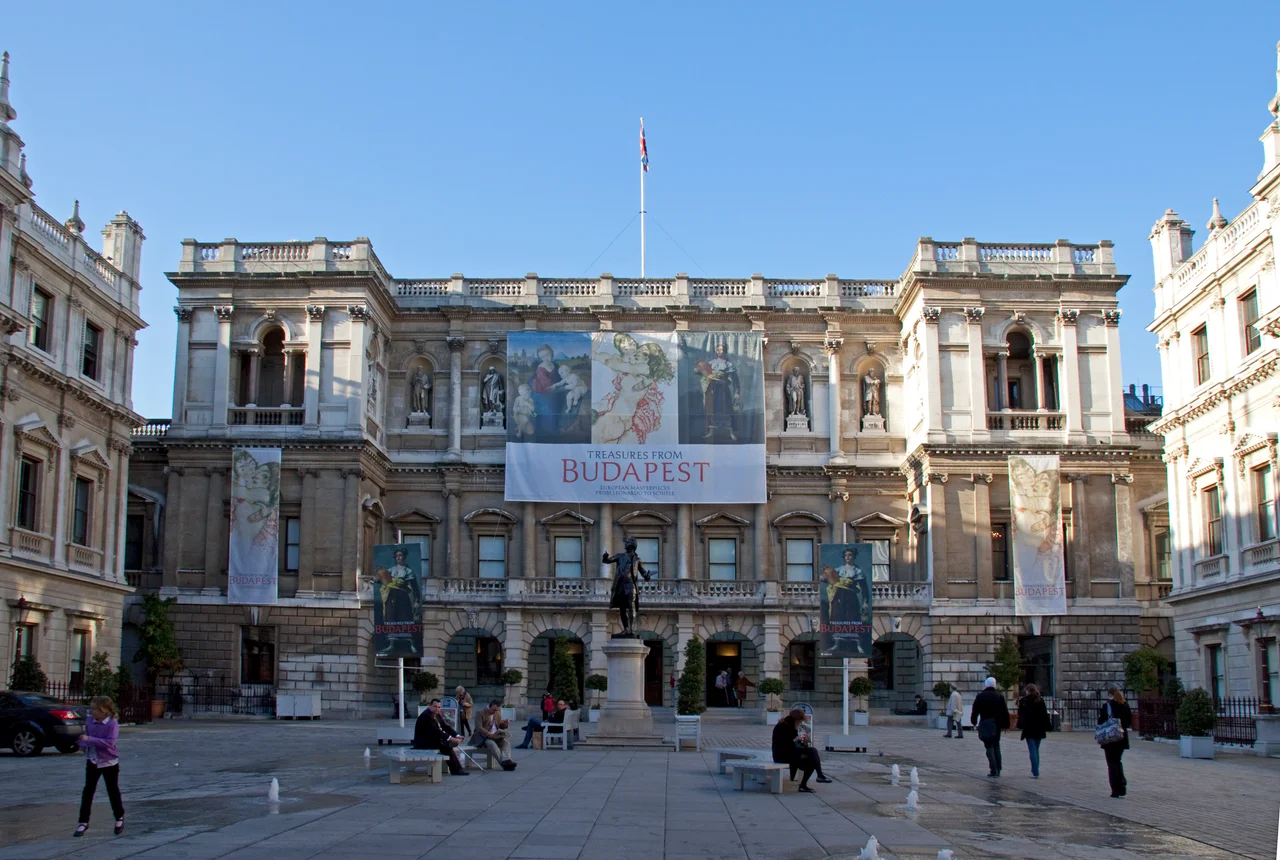
The Academy's early decades were spent in borrowed and inadequate quarters. It opened in cramped Pall Mall premises, moved to Somerset House in 1771, and was installed in purpose-built apartments in New Somerset House in 1780. In 1837, it moved again to Trafalgar Square, sharing the east wing of the newly completed National Gallery. The two institutions promptly ran out of room. In 1868, exactly one hundred years after its foundation, the Academy moved to Burlington House on Piccadilly, where it has remained. The courtyard of Burlington House, which it shares with the Geological Society, the Linnean Society, the Royal Astronomical Society, and others, is one of the most concentrated gatherings of learned institutions in the world. The Academy's first Summer Exhibition had taken place in 1769; it has been held every year without interruption since, making it the longest-running annual art exhibition anywhere.
What Hangs Here
The Royal Academy's most prized possession is Michelangelo's Taddei Tondo, carved in Florence between 1504 and 1506 and left to the Academy by Sir George Beaumont. It is the only marble by Michelangelo in the United Kingdom and depicts the Virgin Mary and child with the infant St John the Baptist. The collection also includes the diploma works donated by each elected member — Reynolds's self-portrait began the tradition, followed by gifts from Gainsborough and Benjamin West. The walls and ceilings of the entrance hall carry paintings by Benjamin West and Angelica Kauffman, moved from the previous premises at Somerset House. West's roundel The Graces Unveiling Nature occupies the centre, flanked by Kauffman's allegorical canvases. In the entrance portico, two war memorials record the students and staff who died in the World Wars.
Education and Controversy
The Royal Academy Schools form the oldest art school in Britain and are free of charge to those admitted — a principle maintained since the founding. Their alumni include J. M. W. Turner, John Constable, William Blake, Thomas Rowlandson, and John Soane. The first woman enrolled in 1860. The Summer Exhibition remains open to anyone who submits work, and the Royal Academicians — up to 80 practising artists elected by ballot — select and hang the results. That process has not always been without friction. In 1997, the Sensation exhibition of Young British Artists, including Marcus Harvey's portrait of the convicted murderer Myra Hindley, generated intense public controversy; the painting was vandalised during its display. The Academy receives no state or Crown funding and operates as a charity — its independence from official patronage as notable as its 256 years of continuous operation.
From the Air
Located at 51.5092°N, 0.1394°W at Burlington House on Piccadilly, City of Westminster. The building's Palladian facade is visible from altitude, set back from the street behind a courtyard. Green Park to the south and the distinctive roofline of Burlington House are useful orientation markers. Nearest airports: Heathrow (EGLL) approximately 13 miles west; London City (EGLC) approximately 11 miles east.
Nearby Stories
- Stevenage 5.7 km away
- Malling Abbey 5.7 km away
- 1952 Farnborough Airshow Crash 7.7 km away
- Ingatestone Hall 8.2 km away
- Hellfire Caves 9.1 km away
- The Carrington Event: The Solar Storm That Could Happen Again 9.8 km away
- Bletchley Park 16 km away
- Castle Hedingham 23 km away