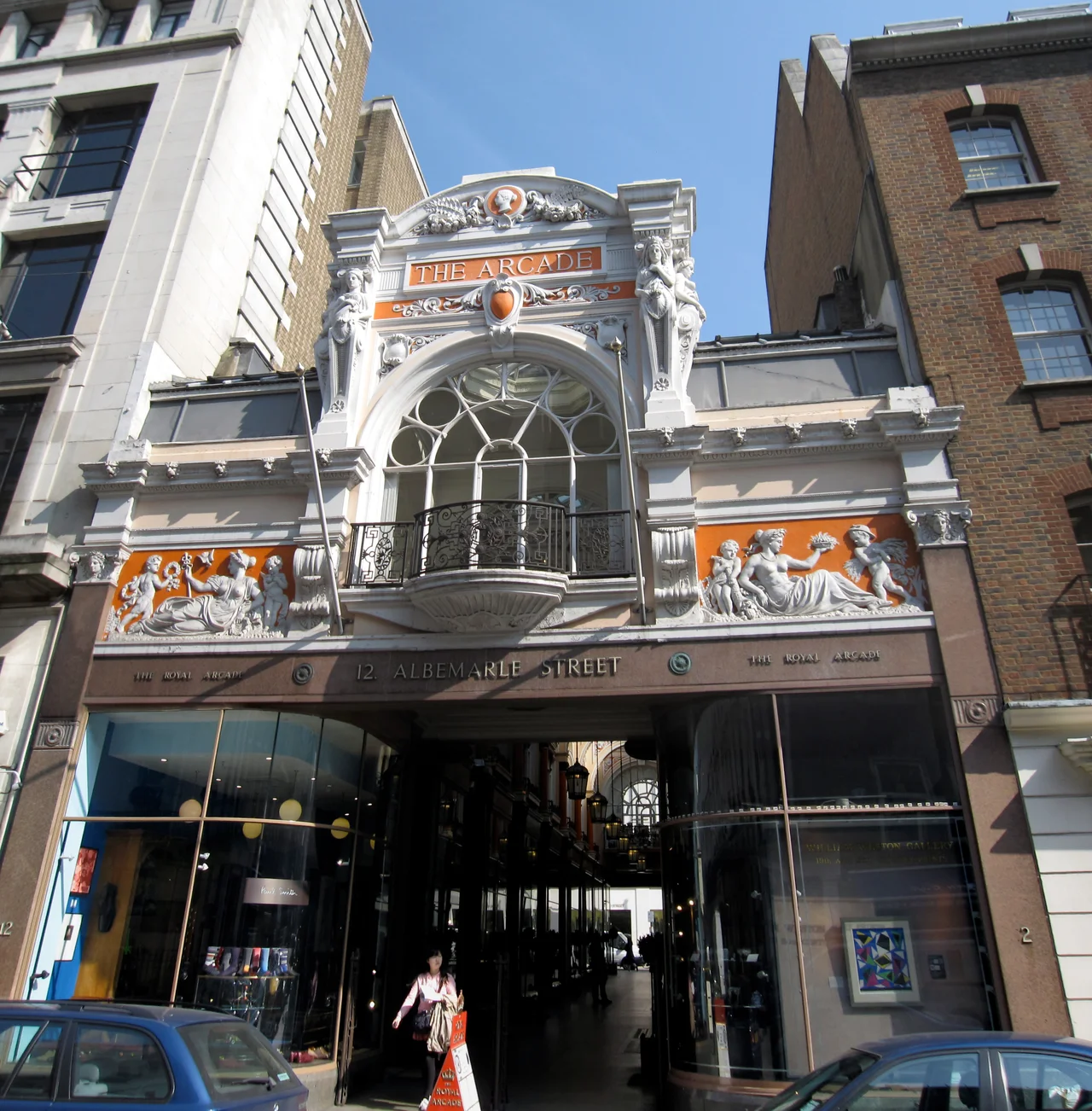

Royal Arcade, London
William Hodgson Brettell opened his shirtmakers in The Arcade in 1880 — he was 24 years old, occupying unit 12. A few years later, Queen Victoria became a customer. The appointment brought the royal prefix that has stayed ever since. It is the kind of detail that sounds like it should be a story about privilege, but is actually a story about a young tailor with a good address and a quality product, who happened to be in the right place at the right time.
A Proposal Rejected and Rebuilt
The idea for an arcade in this part of Mayfair was first proposed in 1864, and it was ambitious: a longer covered walkway that would have linked Old Bond Street all the way through to Regent Street. The proposal was rejected because the demolition required was too extensive and would have blocked access to existing properties. A revised, more modest design was submitted — the current layout, running from 12 Albemarle Street to 28 Old Bond Street — and that version was approved. Construction was completed in 1880, designed by architects Archer and Green. The result is what you see today: a relatively short arcade, perhaps 80 yards in length, but one that has preserved its Victorian character almost entirely intact.
What the Glass Roof Covers
The Royal Arcade's architectural character comes from its details rather than its scale. A saddled glass roof runs the length of the arcade, flooding the interior with diffuse light without the harshness of direct sun. Decorated stucco arches frame each section; Ionic columns support the structure; the curved glass shop fronts carry the aesthetic language of Victorian commercial architecture at its most refined. Archer and Green designed for permanence, and the building has rewarded that intention — little has changed since opening. Visitors who have seen photographs from the late 19th century and walk through today will find the proportions and ornament essentially unchanged. The arcade is Grade II listed, which formally recognises what visitors can see plainly: this is a rare surviving original.
The Shops and Their World
The Royal Arcade sits between Albemarle Street and Old Bond Street — two of Mayfair's defining thoroughfares — in a neighbourhood that has been associated with luxury trade since the 18th century. Bond Street has sold fine art, jewellery, and tailoring for centuries; Albemarle Street is where the Royal Institution has given public lectures since 1799. The arcade connects them. In 2025, the tenants include Charbonnel et Walker (the chocolate and confectionery maker), jewellers, an optician, a watch club, and George Cleverley, the bespoke shoemaker. The assortment is consistent with the arcade's tradition of specialist, quality-focused retail rather than mass-market commerce. The Burlington Arcade, a few streets to the west on Piccadilly, is the arcade most visitors know; the Royal Arcade is smaller, quieter, and for those who find it, somewhat more distinctive.
On Film and in the Street
The Royal Arcade has served as a film location more than once, its untouched Victorian interior useful to directors seeking period settings without extensive dressing. The Parent Trap (1998), Miss Pettigrew Lives for a Day (2008), and the Agatha Christie television episode The Theft of the Royal Ruby have all been filmed here, among others. The arcade's appearance in those productions is essentially the same as its appearance today and its appearance in the 1880s: the glass roof, the stucco arches, the curved shop fronts, the quiet sense of a street that time has left largely undisturbed. That consistency, in a city as subject to demolition and reinvention as London, is itself something worth noting.
From the Air
Located at 51.5091°N, 0.1415°W in Mayfair, City of Westminster, running between Albemarle Street and Old Bond Street. The arcade itself is invisible from altitude, concealed beneath surrounding rooflines, but it lies within the Mayfair grid between Piccadilly to the south and Oxford Street to the north. Green Park (EGLL Heathrow) is approximately 13 miles west; London City (EGLC) approximately 11 miles east.
Nearby Stories
- Stevenage 5.7 km away
- Malling Abbey 5.7 km away
- 1952 Farnborough Airshow Crash 7.7 km away
- Ingatestone Hall 8.2 km away
- Hellfire Caves 9.1 km away
- The Carrington Event: The Solar Storm That Could Happen Again 9.8 km away
- Bletchley Park 16 km away
- Castle Hedingham 23 km away