
Royal Armouries Museum
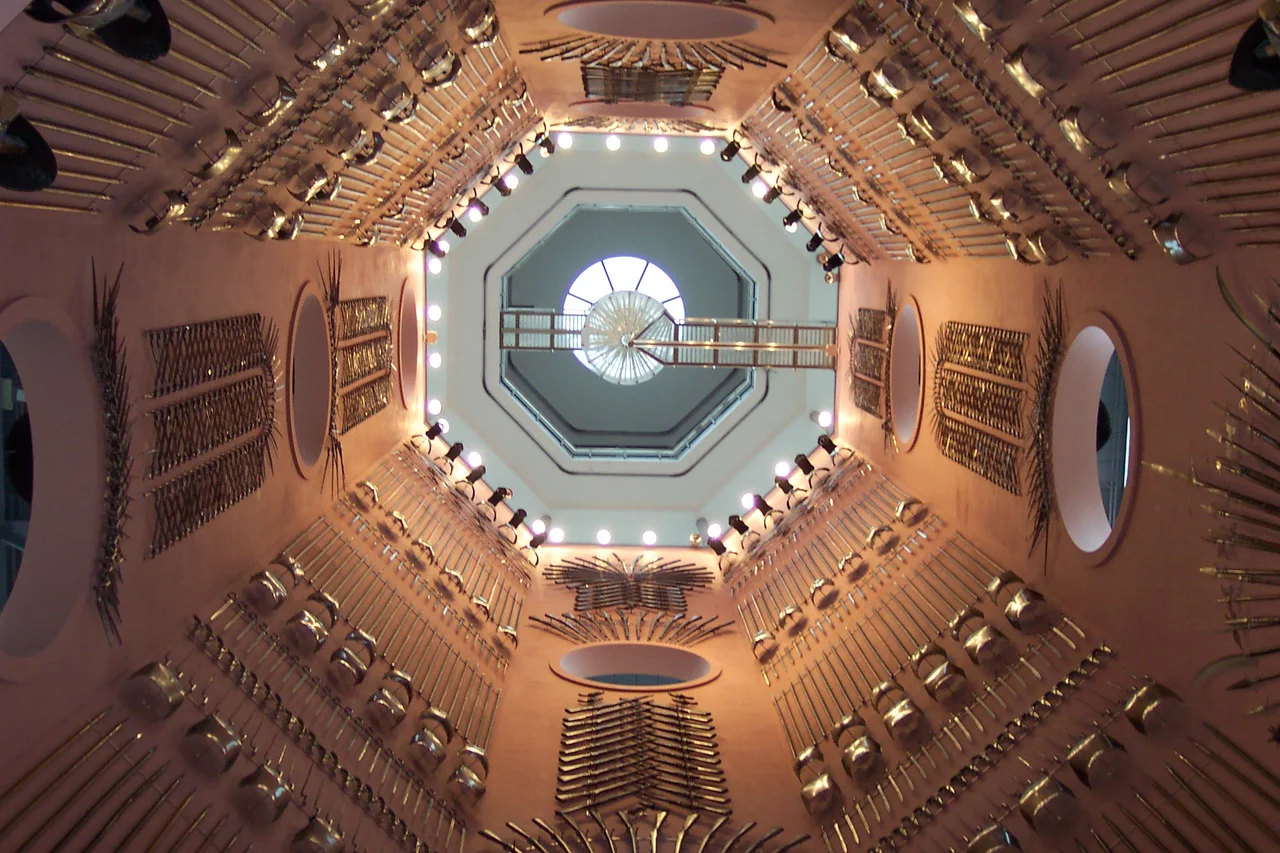
Walk into the Hall of Steel and look up. Twenty-five hundred objects - swords, daggers, helmets, breastplates, halberds, pole-arms - are arranged on the walls of a giant staircase as a single decorative composition. This is the seventeenth-century way of displaying weapons. The Tower of London used to do it like this, building trophy displays of arms collected from defeated armies. When the Royal Armouries needed a new home in the 1990s, the architects Derek Walker and Buro Happold designed the new building from the inside outward - ceiling heights were dictated by the longest staff weapons in the collection, displayed vertically, which is why the Hall of Steel rises 6.5 metres at its highest point. The museum opened in Leeds Dock in March 1996, opened by Queen Elizabeth II, built for £42.5 million. It moved the British national collection of arms and armour out of London for the first time in over six hundred years.
How a Museum Gets Built
The Royal Armouries Museum was one of the first projects completed under the UK private finance initiative. The Royal Armouries - a non-departmental public body - contracted with a private company, Royal Armouries International, which would build the museum and run it for 60 years in return for ticket revenue. The model was unusual; the financing was complex. A long-term bank loan from the Bank of Scotland combined with £28.5 million in public grant support from the UK Government, Leeds Development Corporation, and Leeds City Council. Private equity investors - 3i, Gardner Merchant, Electra, Yorkshire Electricity - rounded out the capital stack. Alfred McAlpine built the structure. The whole project was a test case for whether public museums could move out of the capital, and whether private capital could be marshalled to do it. Entry, as at all UK national museums, has remained free.
Five Galleries, Five Stories
The permanent displays hold 5,000 objects across five themed galleries. War traces the human business of armed conflict from ancient battlefields through the medieval period, the gunpowder centuries, and the industrial wars of the modern age. The Peace Gallery, embedded within the War Gallery, looks at disarmament, détente, and the possibility of a future without arms - developed in partnership with the Peace Museum in nearby Bradford. The Africa and Asia gallery covers South and South-east Asia, China, Japan, Central Asia, Islamic regions, and India. The Tournament gallery, running across two floors, recovers the lost world of jousting in armour. Self Defence covers the armed civilian, arms and armour as artistic expression, and Make:Believe, an exhibition on how arms appear in popular culture and how popular culture has shaped arms design - the loop running both directions.
The Tiltyard
Running 150 metres alongside the River Aire is the Tiltyard - a working jousting arena. The museum no longer keeps its own horses; the funding cuts of 2011 cost the riders, actors, and stable staff their jobs. But two major jousting tournaments still happen here each year. Easter is the peak of the calendar - a four-day international team competition from Good Friday to Easter Monday, with up to four teams of armoured knights competing against one another. The summer tournament closes the season with an individual joust competing for the Queen's Golden Jubilee Trophy. Competitors come from across the world. The spectacle is genuine: real armour, real lances, real horses, real impact. The land-ward bank holds the seating; the river-ward side keeps the dock and the open water as a backdrop.
The Horned Helmet
Among the most famous objects in the collection is a horned helmet given to Henry VIII by the Holy Roman Emperor Maximilian I around 1514. It is a parade piece, not a battle helmet - made of polished steel with curling ram's horns, brass-rimmed spectacles, and an unsettling grimacing face. It became the basis of the museum's original logo, designed by Minale Tattersfield. The horned helmet sits beside thousands of other pieces - sword hilts, hand-cannons, percussion-cap pistols, samurai armour, eighteenth-century duelling pistols, twentieth-century rifles, the personal weapons of historical figures. The Royal Armouries Keeper of Firearms and Artillery, Jonathan Ferguson, presents the GameSpot YouTube series Firearms Expert Reacts from these galleries, analysing the design and use of guns in video games - a series that has introduced the museum to audiences who would never otherwise have heard of it.
The Dock and the Novel
The museum sits at Leeds Dock, on the south bank of the Aire about three quarters of a mile south-east of Leeds station. The dock area was derelict warehouse and railway-arch land until the 1990s; the museum's arrival anchored the regeneration. Around it are now apartments, cafés, the headquarters of digital companies, and a working canal boatyard. The shuttle boat between Granary Wharf at the station and Clarence Dock at the museum still runs, a reminder that for centuries this was how cargo moved into Leeds. The novelist Charles Stross set The Nightmare Stacks - a book in his Laundry Files series - largely in Leeds, with the title an allusion to the museum's stacked weapons displays. The Kaiser Chiefs name-check the museum in their song 'Team Mate' on the debut album Employment. The building has folded itself into the cultural identity of the city in the thirty years since it opened.
From the Air
The Royal Armouries Museum sits at Leeds Dock at 53.792°N, 1.532°W, on the south bank of the River Aire approximately 0.75 nm south-east of Leeds railway station. The distinctive multi-storey building with its tall Hall of Steel atrium is visible from low altitude. Leeds Bradford Airport (EGNM) is 7 nm to the north-north-west. From altitude the dock complex is recognisable as a rectangular cut-off basin from the main river, with the museum at the eastern end. Best viewing altitude 1,500-3,000 ft AGL. The Tiltyard along the river is most visible from the south.
Nearby Stories
- Hovingham Hall 6 km away
- RAF Elvington 7.6 km away
- Battle of Hatfield Chase 9.1 km away
- Wentworth Castle 11 km away
- Murder of Suzanne Capper 12 km away
- Pendle Hill 13 km away
- RAF Topcliffe 15 km away
- Hawes Junction Rail Crash 26 km away