.jpg)
Royal Courts of Justice
George Edmund Street won the competition for the new Law Courts in 1868, beating eleven other architects for one of the most prestigious commissions in Victorian England. He spent the next fourteen years consumed by the project — designing every detail, overseeing construction through a bitter masons' strike, managing the import of German replacement workers who had to be housed inside the building itself for their own safety. When Queen Victoria opened the Royal Courts of Justice on 4 December 1882, Street was not there. He had died the year before, overcome, it was said, by the sheer weight of the work.
A Temple Built from Intestate Estates
The money for London's new central courthouse came from an unusual source: cash accumulated over decades from the estates of people who died without wills. These unclaimed funds, totaling £700,000, paid for the building itself. Oak fittings and courtroom furniture added £70,000 more. The total came in under £1 million — a remarkable economy for a building that architectural historian Nikolaus Pevsner later described as "an object lesson in free composition, with none of the symmetry of the classics, yet not undisciplined where symmetry is abandoned."
The site on the Strand had required its own Act of Parliament — two of them, in fact, pushed through by solicitor Edwin Wilkins Field, whose statue now stands inside the Great Hall he helped bring into being. Construction began in 1873 under the builder Messrs Bull & Sons of Southampton, and the masons' strike that nearly derailed it became one of the more dramatic episodes in Victorian labor history.
Gothic Revival's Last Great Secular Stand
The façade facing the Strand is a controlled riot of Victorian Gothic — pointed arches, lancet windows, towers, a rose window above the central entrance, and carved stonework in every direction. Another critic called it a "regular mongrel affair," which might have been unkind but wasn't entirely wrong: the building pulls from Gothic sources freely, without strict adherence to any single period or precedent. David Brownlee linked its aesthetic to the reformist political movements of the day, arguing that the High Victorian style expressed a kind of moral seriousness about public architecture.
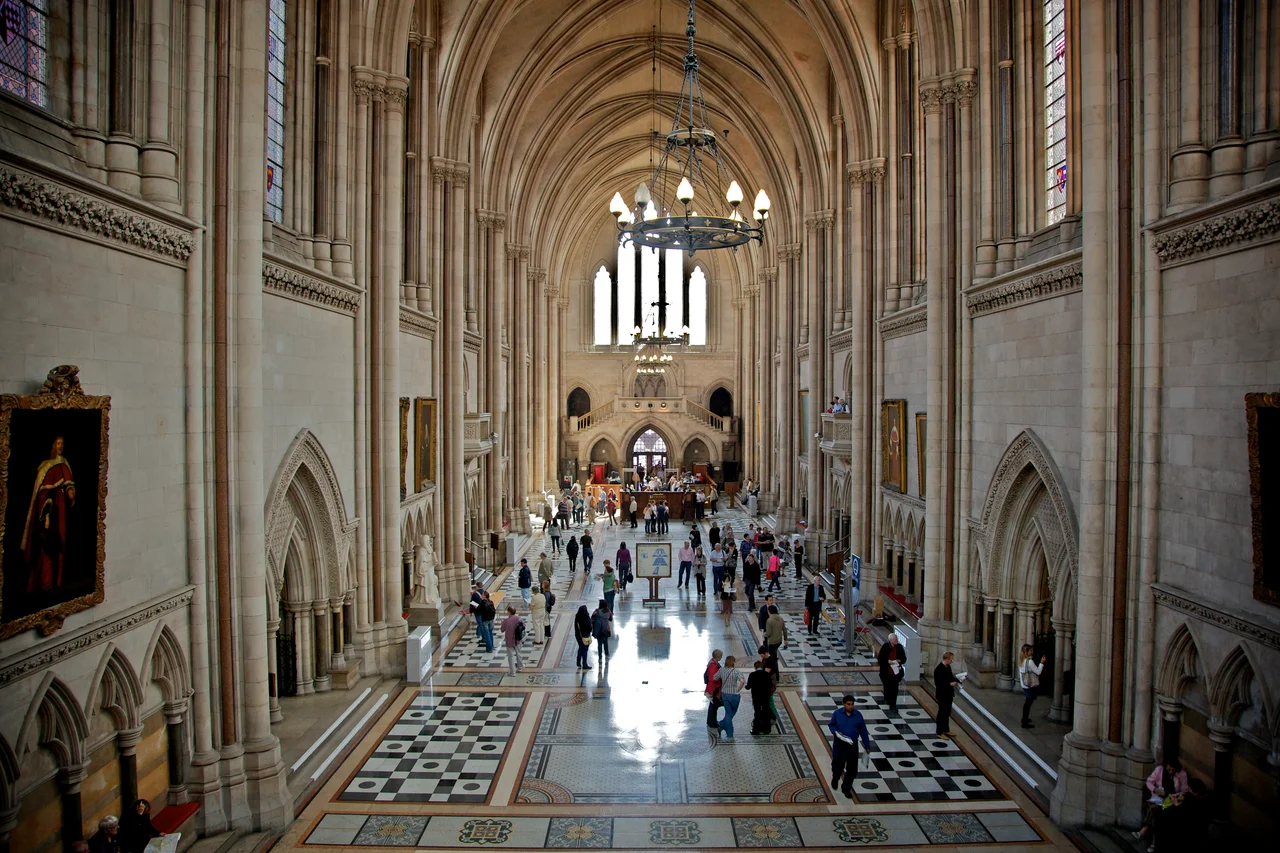
Internally, courts radiate from the Great Hall — a soaring nave-like space that runs north to south, its vaulted ceiling drawing the eye upward as visitors enter from the Strand. Around a courtyard to the east, the offices and rooms of courtroom staff fan out in the quieter, more workmanlike parts of the building. The whole complex is one of the largest court buildings in Europe, a Grade I listed building, and the home of both the High Court and Court of Appeal of England and Wales.
Where the Law Lives
To stand at Temple Bar, the ancient boundary between the City of Westminster and the City of London, and look west along the Strand is to confront the building on its own terms. The four Inns of Court surround it. St Clement Danes church stands nearby. King's College London and the London School of Economics are neighbors. The building sits at the center of London's legal world not by accident but by careful 19th-century planning — the consolidation of courts that had for centuries occupied Westminster Hall into a single purpose-built structure was a deliberate act of civic ambition.
The courts have heard cases that shaped English law for over 140 years. Outside its walls, the press gathers when verdicts come. Barristers in wigs cross the courtyard. And in September 2025, Banksy briefly appeared on its walls — a mural of a judge beating a protester with a gavel — only to be covered and removed the same day. Even anonymously, the building keeps attracting commentary on power and justice.
Street's Memorial
What makes the Royal Courts of Justice unusual among great Victorian buildings is the cost it extracted from its creator. George Edmund Street did not simply design this building — he was consumed by it. The level of personal involvement he brought to every detail, every courtroom fitting, every carved lintel, was extraordinary even by Victorian standards. He died in 1881, a year before the opening, having poured the last years of his life into a project that outlived him.
The building stands as his monument, more durably than any statue could. Inside the Great Hall, beneath the vaulted Gothic ceiling, daily legal business continues as it has for well over a century: appeals argued, injunctions granted, cases heard. The grey stone edifice on the Strand remains what it was built to be — a place where the highest civil law of England and Wales is made and unmade, housed in a building that cost its architect everything.
From the Air
Located at 51.5136°N, 0.1133°W on the Strand in central London. The building's Gothic spires and towers are distinguishable from low altitude. Nearest airports: London City (EGLC, ~7nm east), Heathrow (EGLL, ~14nm west). The Thames is visible 0.3 miles south. From the air, look for the cluster of Inns of Court buildings and Temple Church immediately to the south and west.
Nearby Stories
- Stevenage 5.7 km away
- Malling Abbey 5.7 km away
- 1952 Farnborough Airshow Crash 7.7 km away
- Ingatestone Hall 8.2 km away
- Hellfire Caves 9.1 km away
- The Carrington Event: The Solar Storm That Could Happen Again 9.8 km away
- Bletchley Park 16 km away
- Castle Hedingham 23 km away