
Royal Dublin Society
Twenty-five June 1731 - a Dublin drawing room, fourteen men, a single resolution: that Ireland should learn how to do things better. The new Dublin Society had no premises, no royal charter, and no obvious authority over anything. What it had was a programme that read like the agenda of an Enlightenment in miniature - husbandry, manufactures, useful arts, and within a week, sciences. Almost three centuries later, the Royal Dublin Society still meets behind the Georgian gates of its Ballsbridge campus, where Bruce Springsteen has played eleven times, where Leinster Rugby thunders on Saturday afternoons, and where the Dublin Horse Show still rolls onto the lawns each August.
The Practical Enlightenment
The early Society did not theorise; it published manuals. In its first eighteen months it reprinted Jethro Tull on tillage, papers on improving flax by changing the soil, instructions for draining boggy land. Then bee management, hop cultivation, wool production, demonstrations of new ploughs. It awarded cash premiums - prizes - to anyone who could improve Irish agricultural practice. Between 1766 and 1806, on the strength of those premiums, over fifty-five million trees were planted across Ireland. The Society leased a tract of land in Glasnevin in 1790 to teach the public botany, hired a Scottish head gardener, and opened the Botanic Gardens in 1800. They remained the Society's gardens until 1877, when they were handed to the state. The RDS practically invented Irish modern agricultural science, and only handed the work over once the state was ready to do it.
James Hoban Goes to Washington
The Society's drawing schools opened in 1750 with an annual £500 grant from the British government and one provocative rule: tuition was free. Cabinetmakers' apprentices and goldsmiths' sons drew alongside the children of merchants. Among the students who passed through in the 1780s was James Hoban, a young Kilkenny carpenter who had won a small premium for an architectural drawing. He emigrated to the United States soon after, settled in South Carolina, won the 1792 competition to design the new President's House in Washington, and built what the world now calls the White House. The drawing schools eventually became, in 1867, the Dublin Metropolitan School of Art, and later the National College of Art and Design. Walter Osborne and William Orpen and Sean Keating all took the RDS Taylor Art Award. So did Louis le Brocquy. The prize is still given every year, currently worth ten thousand euro.
Radium and the Dublin Method
In 1903 the RDS imported radium into Ireland for the first time. Two of its members, the geologist and physicist John Joly and the surgeon Walter Stevenson, used the new element to develop a needle-implant technique for cancer treatment - inserting hollow needles loaded with radon directly into tumours. It worked. Internationally the technique became known as the Dublin Method, and it remained in use for decades. In 1914 the Society established the Irish Radium Institute to supply radon to hospitals; that role transferred to the state in 1952. The Society also helped launch the Young Scientist and Technology Exhibition with the physicists Tom Burke and Tony Scott, and has hosted it in the RDS Main Hall since 1966. Generations of Irish teenagers have walked in with science-fair projects and walked out with national reputations.
The Horse Show
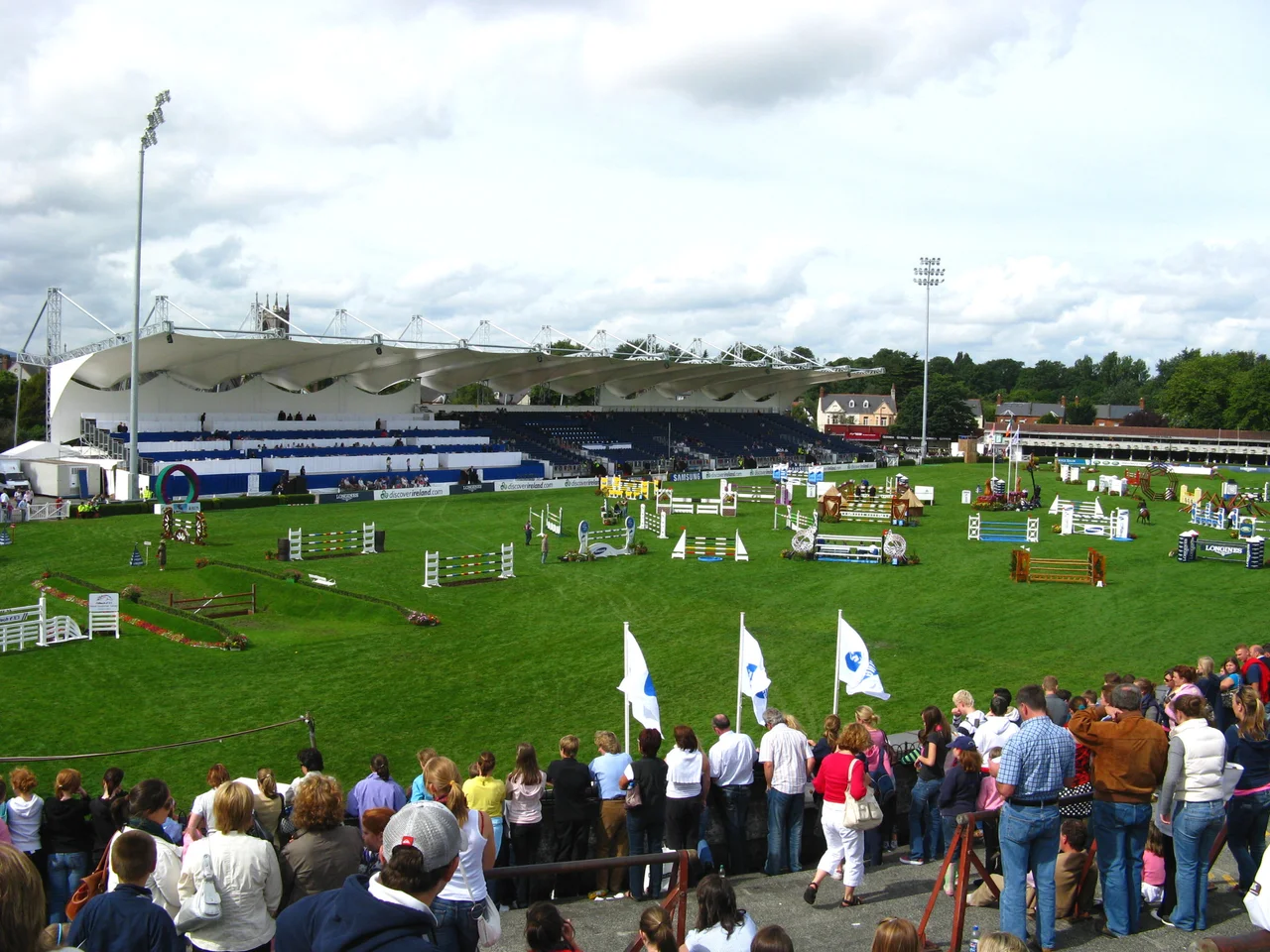
The first Dublin Horse Show was held in 1864. By the late nineteenth century it had become one of the great events of the European equestrian calendar - a five-day spectacle of show jumping, breed showing, and Anglo-Irish social ritual. In 1982 the RDS hosted the World Show Jumping Championships within that year's Dublin Horse Show. The show has been cancelled only twice in its 160-year history: in 1940, when the Second World War swallowed it, and in 2020 when COVID did. The 150th edition was held in August 2025, with Princess Anne in attendance - a former Olympic equestrian herself, presenting rosettes. The show jumpers stable in Simmonscourt Pavilion for the week. The smell of horse and hay and clipped grass hangs in air that on other weeks of the year smells of stadium beer, popcorn, and a Bruce Springsteen guitar amp.
Ballsbridge Now
The Society moved to Ballsbridge in 1879 - then a fifteen-acre site, since expanded to forty. The RDS Arena now seats 18,250 for Leinster Rugby matches, expanded in 2007 and 2008. The Simmonscourt Pavilion holds about seven thousand for concerts and hosted Eurovision in 1981 and 1988 - Bucks Fizz won in the first, Celine Dion in the second. The Main Hall still hosts the Young Scientist Exhibition every January, the way it has since 1966. The Society is currently spending €52 million on the arena. It survives by being many things at once: members' club, learned society, agricultural prize giver, exam hall, music venue, scientific institute, philanthropic foundation. Three thousand five hundred members keep the lights on, the same way Thomas Prior and his thirteen colleagues did in that Dublin drawing room in 1731, by refusing to do just one thing well.
From the Air
The RDS campus sits at 53.33°N, 6.23°W in Ballsbridge, Dublin 4, about 3 km southeast of the city centre. From altitude it is recognisable by the open green of the parade ring and the long roof of the Main Hall and Simmonscourt Pavilion, with the curved geometry of the RDS Arena visible alongside. Lansdowne Road stadium lies just to the north, and Dublin Bay opens out 1 km to the east. Dublin Airport (EIDW) lies 12 km north.
Nearby Stories
- Wicklow Mountains 12 km away
- Mornington 14 km away
- German submarine U-1051 16 km away
- Abbey of Kells 18 km away
- Irish Military Intelligence Service 20 km away
- HMS Manners (K568) 37 km away
- Templemore 42 km away
- Irish Sea Bridge 43 km away