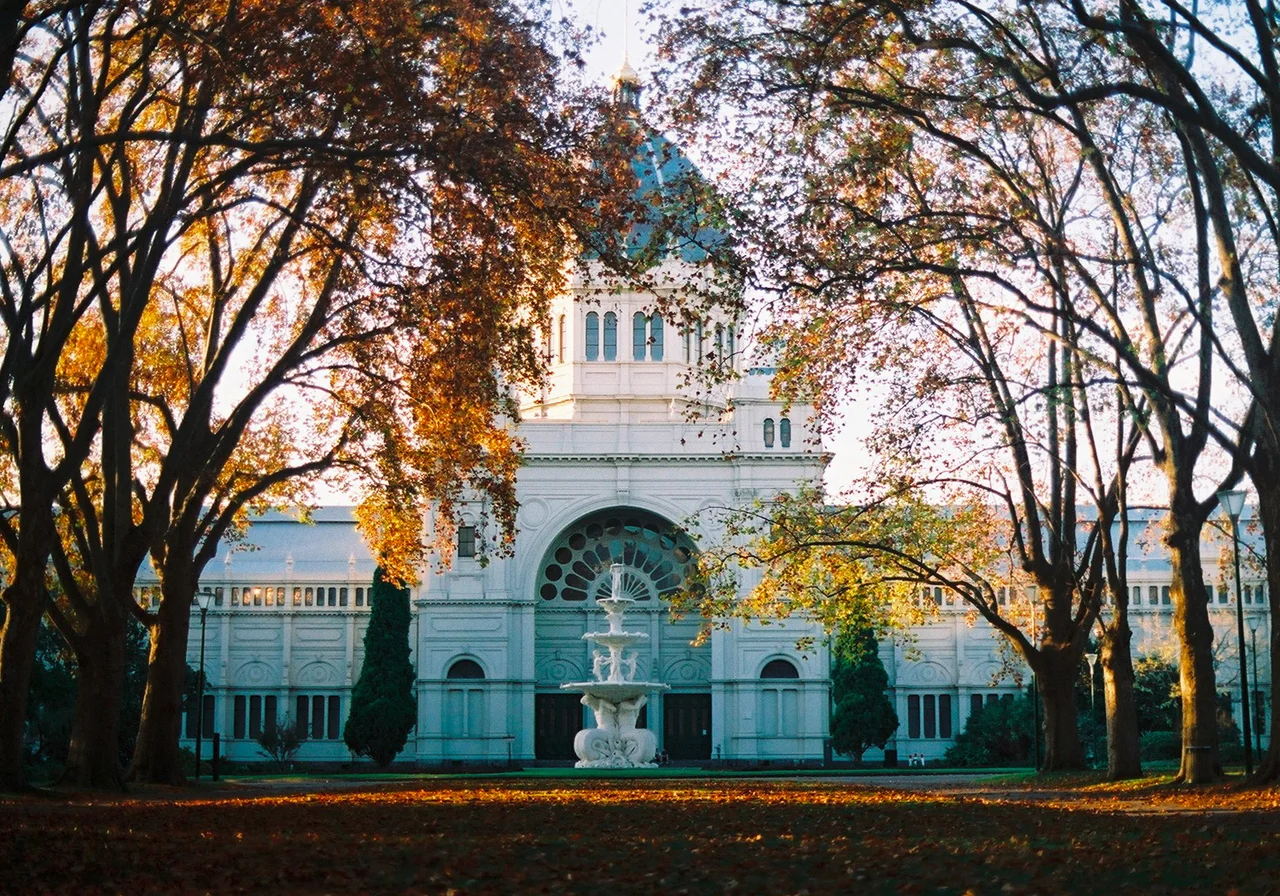

Royal Exhibition Building
Locals took to calling it the White Elephant. For decades in the middle of the twentieth century, this enormous domed hall in the Carlton Gardens sat half-empty and unloved, too costly to heat and too grand to use, and the Melbourne City Council came within a single narrow vote of swinging the wrecking ball in 1948. It seems almost impossible now. In 1880 the same building had been the proudest thing the colony of Victoria owned, raised in just eighteen months to host a world's fair, lit by some of the first electric lamps in the Southern Hemisphere, and crowned by a dome modeled on the cathedral of Florence. And on one morning in 1901, beneath that dome, a continent of separate colonies became a single country. The Royal Exhibition Building is one of the very last great halls of its age left standing anywhere on Earth.
Marvellous Melbourne's Cathedral of Commerce
The gold rushes of the 1850s had made Melbourne fabulously, almost obscenely rich, and the city wanted the world to know it. When Victoria won the right to stage an international exhibition, parliament voted 210,000 pounds, more than double the original budget, and threw open a design competition. The local architect Joseph Reed, already responsible for the Town Hall and the State Library, took first prize. His plan was a Latin cross of long, nave-like halls radiating from a central octagon, all Beaux-Arts scale and Renaissance borrowing. The contractor David Mitchell, who had built St Patrick's Cathedral, laid the foundation stone in February 1879 and finished by October 1880. At the centre rose the dome, sixty-eight metres tall, lifted straight from Brunelleschi's masterpiece in Florence and improbably transplanted to the far side of the planet.
The Day Australia Was Born
On the first of January 1901, six self-governing British colonies joined to become the Commonwealth of Australia. The new nation needed somewhere vast enough to swear in its first parliament, and only one Melbourne room would do. On 9 May 1901, the Duke of Cornwall and York, later King George V, opened the first Federal Parliament under the great dome before a crowd of thousands. The painter Tom Roberts spent more than a year recording the scene in a canvas so crowded with portraits it became known simply as the Big Picture. The federal members soon decamped to Parliament House across town, and the Victorian state parliament moved into the Exhibition Building, where it would sit for the next twenty-six years.
Decline, Fire, and a Single Saving Vote
Greatness did not protect it. Once the exhibitions ended, the rear annexes were dismissed as eyesores, and the government refused to spend on their upkeep. The wing that had housed an aquarium burned in 1953. The western annexe came down in the 1970s, and the grand ballroom was demolished amid public outcry in 1979. In the 1919 influenza pandemic the hall had served as an emergency hospital; in the 1956 Olympics it hosted the weightlifting, wrestling, basketball and fencing. But mostly it endured as a slightly shabby venue for car shows, dances, and school exams, the building generations of Melbourne students still remember from sitting their finals beneath its painted ceiling.
From White Elephant to World Heritage
The outcry over the ballroom's loss changed everything. New trustees came to see the hall's heritage as the point, not an obstacle, and through the 1990s the Great Hall was painstakingly restored. In 2004 the Royal Exhibition Building, with its surrounding Carlton Gardens, became the first building in Australia ever inscribed on the UNESCO World Heritage list. The committee recognised it as the most complete surviving site from the great age of international exhibitions, which ran from London's Crystal Palace in 1851 until the First World War. During the COVID-19 pandemic the hall came full circle, serving once again as a mass vaccination centre, doing for a new century the work it had done in 1919.
A View Few Have Earned
For more than a hundred years the Dome Promenade, the walkway encircling the cupola's base, was sealed off. In the 1880s it had been one of Melbourne's great attractions; with almost nothing else built tall, visitors paid for the panorama, and over a hundred thousand of them climbed up during the 1888 exhibition alone. After heritage restoration works were completed in 2022, the promenade reopened to the public for the first time in a century. The climb up the narrow internal stair delivers the same reward it offered the Victorians: the gardens spread below, the modern city skyline beyond, and the strange thrill of standing inside a dome that an architect copied from Florence and set down in the Antipodes.
From the Air
The Royal Exhibition Building stands at roughly 37.80 degrees south, 144.97 degrees east, in the Carlton Gardens on the northeastern edge of Melbourne's central business district. From the air its silhouette is unmistakable: a cruciform hall crowned by a tall blue-grey dome, set in formal Victorian gardens with fountains and tree-lined avenues, immediately adjacent to the low modern Melbourne Museum. The CBD towers rise just to the southwest. Melbourne Airport (ICAO YMML) lies about 20 km to the northwest; the smaller Essendon Fields Airport (YMEN) sits closer, roughly 10 km north-northwest. A recommended sightseeing altitude of 1,500 to 2,500 feet AGL gives a clear read of the dome and garden geometry; Melbourne's skies are often clear but can carry afternoon sea-breeze haze rolling in off Port Phillip Bay.
Nearby Stories
- Geelong 12 km away
- The Disappearance of Harold Holt: The Prime Minister Who Vanished Into the Sea 41 km away
- Eureka Rebellion 54 km away
- Yarra River 55 km away
- Sovereign Hill 65 km away
- Waterloo Plains massacre 73 km away
- Glenrowan, Victoria 142 km away
- Bass Strait 210 km away