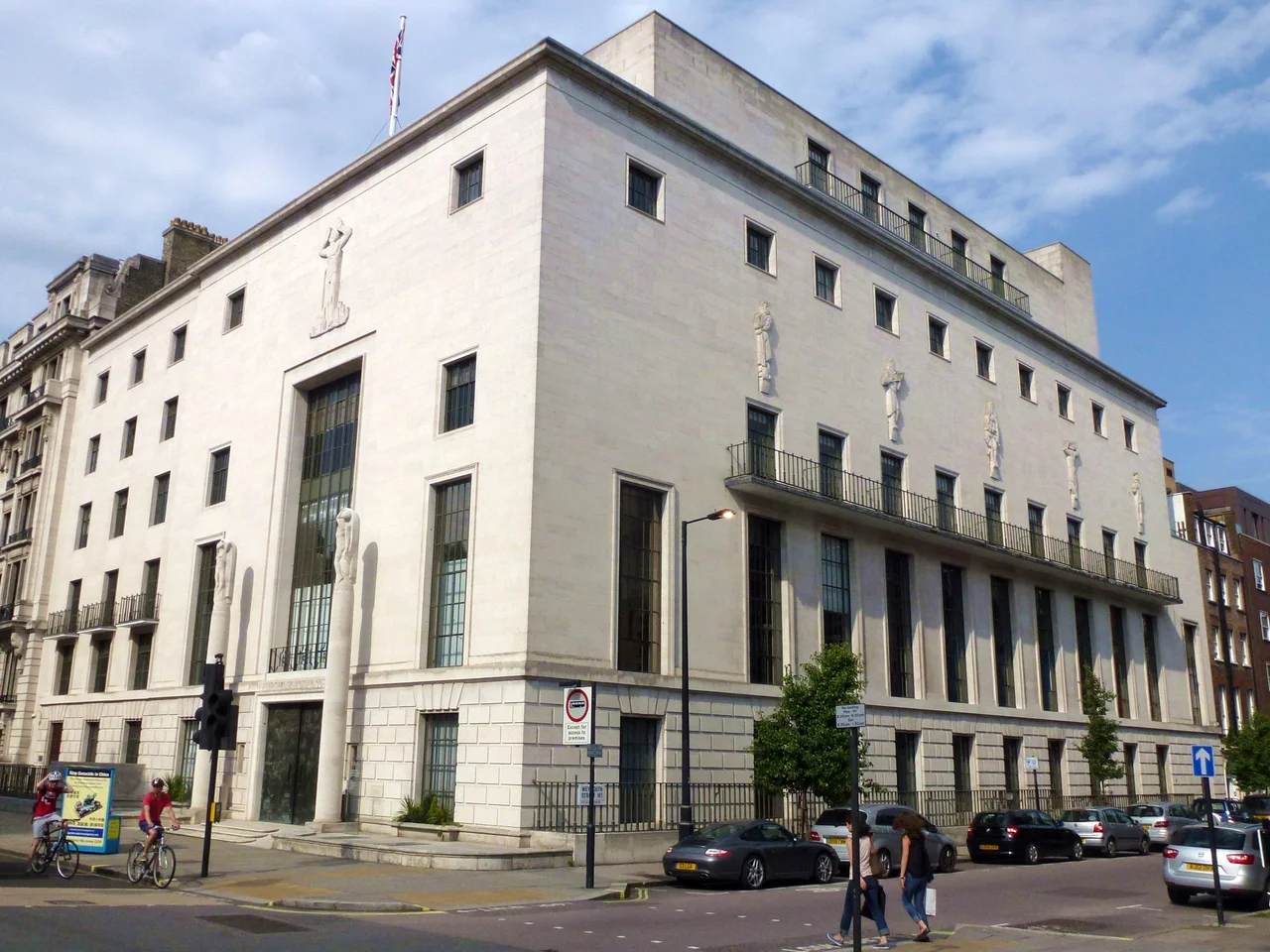

Royal Institute of British Architects
When the Institute of British Architects gathered for the first time in London in 1834, its secretary articulated a vision: to uphold the character of architects as "men of taste, men of science, men of honour." The gendered language was not incidental. It would be 64 years before the organization admitted its first woman member — Ethel Charles, in 1898. Another 33 years passed before the first woman fellow was elected. And not until 2009, 174 years after the institute's founding, did Ruth Reed become its first female president. The RIBA's history is partly a story of architecture's ambitions, and partly a story of how long those ambitions were shared with only half of humanity.
A Library That Sheltered the Modernists
The British Architectural Library, established alongside the institute in 1834, is now one of the three largest architectural libraries in the world and the largest in Europe. Its four million items span drawings, photographs, archives, books and models — including the world's largest collection of drawings by Andrea Palladio and a first edition of his Quattro Libri from 1570. The earliest book in the collection dates from 1478.
During World War II, when much of Europe's cultural heritage was under threat, the library stayed open and performed an unexpected act of preservation: it sheltered the archives of Modernist architect Adolf Loos, keeping them safe through the conflict. The reading room, designed by architect George Grey Wornum and his wife Miriam for the 1934 headquarters building, retains its original Art Deco interior — open bookshelves, double-height central space, original furniture. It is free to the public.
The Building on Portland Place
In 1934, a century after the institute's founding, RIBA moved to its permanent home at 66 Portland Place — a Grade II* listed building designed by Wornum and opened by King George V and Queen Mary. The building features sculptures by Edward Bainbridge Copnall and James Woodford on its façade. Inside, alongside the library, are exhibition galleries, a lecture theatre, a bookshop, and event spaces.
The building closed on 1 June 2025 for what has grown into an £85 million refurbishment — a figure that climbed considerably from the initial £20 million estimate announced in 2022. Staff relocated temporarily to the British Medical Association's offices in Tavistock Square while the work proceeds. The renovated building is envisioned as a new "House of Architecture" when it reopens.
Awards, Competitions, and the Stirling Prize
The RIBA has administered some of the world's oldest architectural awards. Its President's Medals have been given annually since 1836, making them possibly the oldest architectural awards in continuous existence anywhere. The Royal Gold Medal, first awarded in 1848, honors a distinguished body of work over a career. The Stirling Prize, established more recently, recognizes the best new building of the year in the UK.
The institute also organizes architectural design competitions — a historically significant role, since it was through a competition that George Edmund Street won the commission for the Royal Courts of Justice in 1868. The RIBA's competition framework has shaped some of Britain's most significant public buildings. Its Plan of Work, first developed in 1963, remains the standard stage-by-stage process model for UK construction projects.
An Institution Arguing with Itself
With 44,000 members and a London headquarters that has sometimes been perceived as the whole of the organization, RIBA has faced recurring criticism as London-centric, insufficiently transparent, and slow to reckon with its own diversity failures. In 2022, young architects organized to demand change, supporting the ultimately successful candidacy of Muyiwa Oki for the presidency. Oki became president in September 2023.
The institute's motto, in Latin, translates as "for the use of the people, for the glory of the city." It was designed by Thomas Leverton Donaldson in the 1830s and takes its imagery from the Lion Gate at Mycenae — an ancient image of power framing an entrance. Whether the institute has lived up to either half of that motto remains, as it always has been, a matter of active debate among its members.
From the Air
Located at 51.5214°N, 0.1450°W on Portland Place in the City of Westminster. Portland Place is a broad, straight avenue visible from low altitude. Nearest airports: London City (EGLC, ~8nm east), Heathrow (EGLL, ~13nm west). Regent's Park is immediately to the north; Oxford Circus is roughly 0.5 miles south.
Nearby Stories
- Stevenage 5.7 km away
- Malling Abbey 5.7 km away
- 1952 Farnborough Airshow Crash 7.7 km away
- Ingatestone Hall 8.2 km away
- Hellfire Caves 9.1 km away
- The Carrington Event: The Solar Storm That Could Happen Again 9.8 km away
- Bletchley Park 16 km away
- Castle Hedingham 23 km away