
The Sultans' Rest
Somewhere between the living and the legendary, the Brunei River makes a gentle curve past Kampong Ayer's wooden stilts, and the noise of the water village fades. The road from Bandar Seri Begawan to the Istana Nurul Iman passes this way, threading between the capital and the world's largest residential palace. Most travelers notice neither, their eyes fixed ahead. But set back from the road in Batu Satu, shaded by tropical canopy and cooled by river breezes, the Royal Mausoleum waits with a patience appropriate to a place that has been receiving Brunei's monarchs since the eighteenth century.
A Dynasty Written in Stone
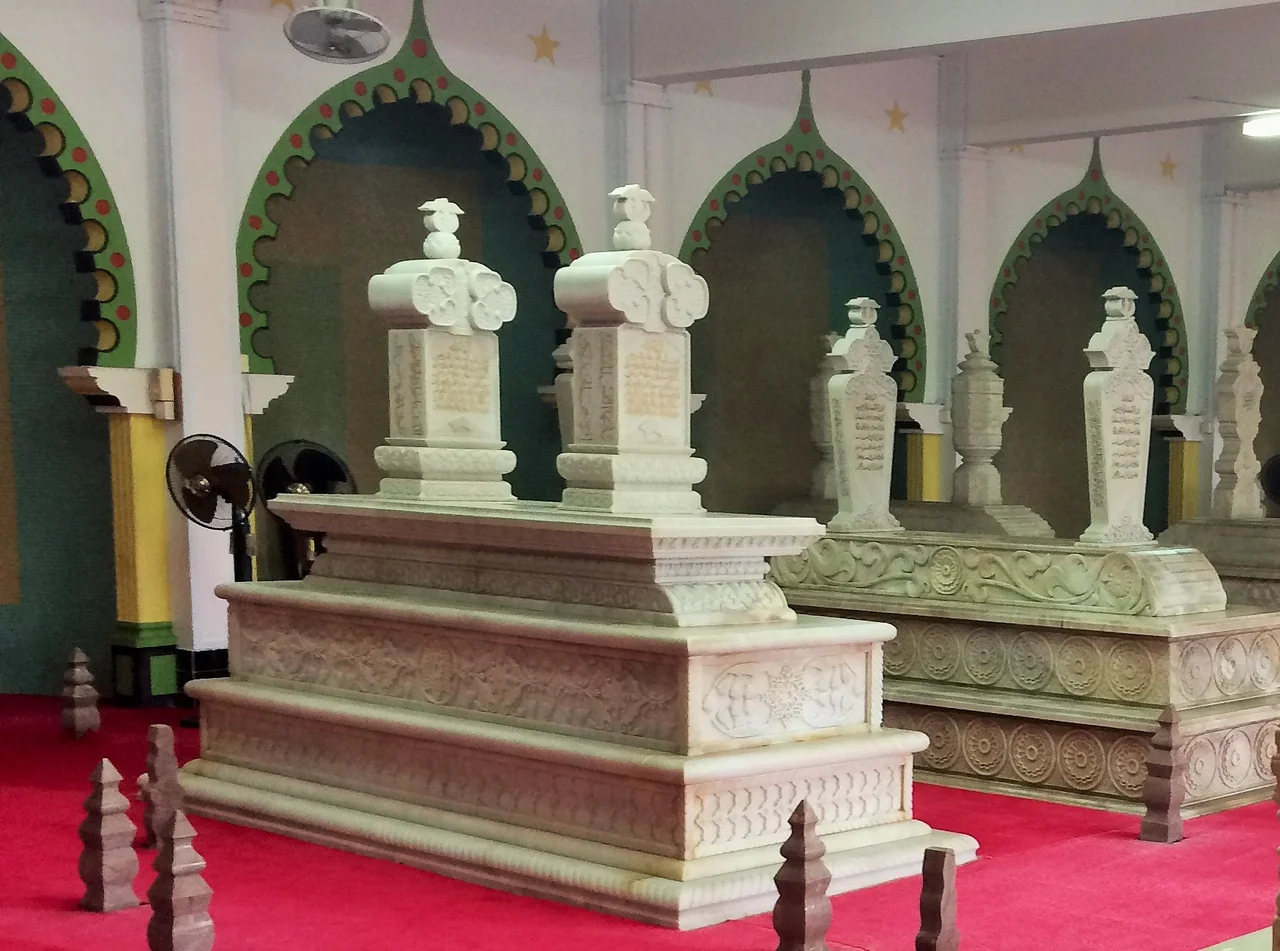
Sultan Omar Ali Saifuddin I was the first monarch interred here, following his death in 1795. In the two centuries since, the mausoleum has gathered generation after generation of the House of Bolkiah into its grounds. Inside the main dome lie four sultans side by side: Hashim Jalilul Alam Aqamaddin, the 25th Sultan, who navigated the dangerous currents of British colonial influence in the late nineteenth century; his son Muhammad Jamalul Alam II, the 26th; Ahmad Tajuddin, the 27th, who led Brunei through the Japanese occupation of World War II; and Omar Ali Saifuddien III, the 28th, who modernized the nation with oil wealth and abdicated in favor of his son, the current Sultan Hassanal Bolkiah. The graves are designated as ancient monuments under the Antiquities and Treasure Trove Order of 2007, but their significance runs deeper than any legal gazette can capture. This is where the unbroken thread of Brunei's monarchy becomes tangible.
Beyond the Dome
The mausoleum extends well beyond its central structure. Outside, in the open burial ground, the roster reads like a who's who of Bruneian statecraft and culture. Consorts of sultans rest here alongside viziers, legislative speakers, and police commissioners. Besar Sagap, who composed the melody of Brunei's national anthem 'Allah Peliharakan Sultan' in 1947 while working as a civil servant in the Public Works Department, lies in the outdoor grounds. So does Pengiran Muda Abdul Kahar, a member of the Tujuh Serangkai, the group of seven young nationalists who pushed for Brunei's constitutional development in the 1950s. In 2020, the mausoleum received Prince Abdul Azim, the son of the current sultan, who died at the age of 38. A nation mourned publicly, and the funeral procession wound through the capital to this same riverside ground where his ancestors had been laid before him.
A Quiet Authority
Foreign tourists rarely find their way here. The mausoleum sits off the well-trodden path that runs between the Omar Ali Saifuddien Mosque and the Royal Regalia Museum in the capital's center. There are no ticket booths, no souvenir shops, no guided audio tours. Instead, the grounds offer something increasingly rare in Bandar Seri Begawan: stillness. Domestic visitors come to pay respects, park easily in the ample lot, and perhaps stop at the small refreshment shop near the entrance. The setting is peaceful rather than grand, the architecture restrained rather than ostentatious. Yet the mausoleum's quiet authority is unmistakable. The Brunei government holds regular tahlil ceremonies here, with state officials gathering to recite prayers for the departed sultans. In a constitutional monarchy where the sultan holds both executive and spiritual authority, this is not mere tradition. It is a living assertion of continuity.
River, Palace, and the Long Memory
From the air, the mausoleum's relationship to Brunei's geography becomes legible in ways that ground-level views obscure. It sits on the same stretch of the Brunei River that passes Kampong Ayer, the water village that served as the capital of the Brunei Empire for centuries. A few kilometers further along the road stands the Istana Nurul Iman, the current sultan's residence and the world's largest palace by floor area. The mausoleum occupies the space between these two poles of Bruneian identity: the ancient, water-borne civilization that once controlled trade across Borneo, and the modern, oil-rich monarchy that emerged from British protection in 1984. The tombs here span exactly that transition. From Omar Ali Saifuddin I in 1795 through the colonial era, the Japanese occupation, independence, and into the twenty-first century, the Royal Mausoleum records in burial plots what other nations record in textbooks.
From the Air
Located at 4.886°N, 114.934°E along the Brunei River in Batu Satu, between Kampong Ayer and the Istana Nurul Iman. Best viewed from 2,000-3,000 feet following the river corridor southwest from central Bandar Seri Begawan. Brunei International Airport (WBSB) is approximately 8 km to the northeast. The green canopy and riverside setting make the mausoleum difficult to spot from altitude, but the river itself is an excellent navigation reference.
Nearby Stories
- From Residency to Memory 28 km away
- Twenty Years on the Seattle Run 30 km away
- The Abode of Peace on Borrowed Coastline 31 km away
- USS Salute: The Minesweeper That Found the Last Mine 33 km away
- The Ants of Borneo 50 km away
- Sabah State Railway 55 km away
- Starcevich Monument 74 km away
- Luconia Shoals 209 km away