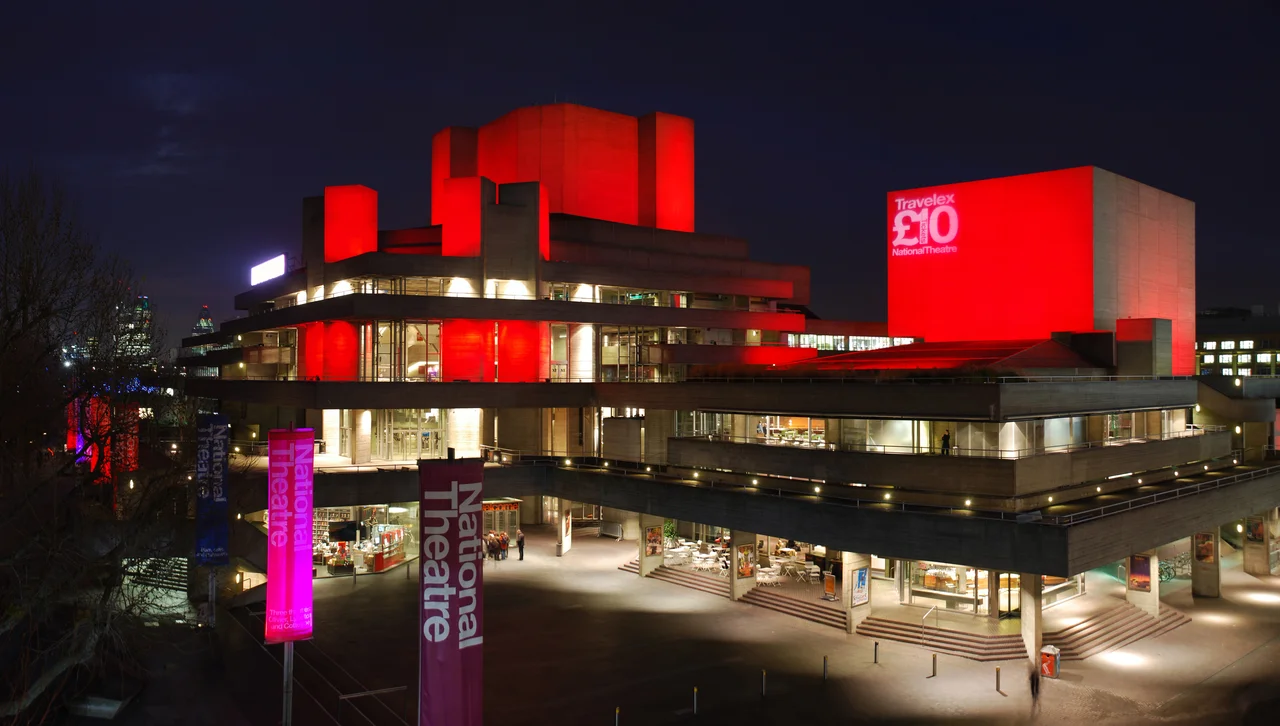

Royal National Theatre
Prince Charles once said it looked like a clever way of building a nuclear power station in the middle of London without anyone objecting. The architect Denys Lasdun, who designed it, called concrete itself a poetic material. Visitors stand on the river walkway, look at the stacked terraces and angled towers rising from the South Bank, and pick a side. Few buildings in Britain provoke such immediate, durable, and divided opinion as the Royal National Theatre, and few have so single-mindedly delivered what they were built for. Inside those much-debated concrete walls are three of the most important stages in the English-speaking world: the Olivier, the Lyttelton, and the Dorfman. Laurence Olivier founded the company in 1963. The building opened on this site in 1976 after decades of false starts.
A Theatre Without a Home
The idea of a National Theatre had haunted British cultural life since the Victorian era. Plans were drawn, sites proposed, foundation stones laid and forgotten. World wars and shifting governments kept postponing the project. When Laurence Olivier finally founded the National Theatre company in 1963, he had no permanent home. The new company performed at the Old Vic in Waterloo Road, just inland from the South Bank, building a repertoire and an ensemble while everyone waited for a building. Olivier himself led the troupe and ran it with an actor's instinct for what worked on stage. By the time Lasdun's South Bank theatre opened thirteen years later, Olivier had retired from running the company but the largest of its three auditoria carried his name.
Lasdun's Concrete Landscape
Denys Lasdun was not given the brief to design a single building. He was given the brief to design a piece of city. The result is more like a landscape than a theatre: stacked horizontal terraces, angled fly towers, exterior staircases and walkways, all in board-marked concrete that bears the grain of the wooden shuttering it was cast against. The intention was that audiences would mingle across multiple foyers and outdoor terraces both before and after performances, treating the building as a public extension of the riverside walk. The strategy worked. Even people who hate the architecture often admit they enjoy being inside it, drinking on the terraces, eating in the foyers, watching the Thames move past. The building is a Grade II* listed example of Brutalist architecture, and one of the masterworks of post-war British design.
Three Stages, Three Personalities
The Olivier Theatre, named for the founding director, is the largest. Its open stage was inspired by the ancient amphitheatre at Epidaurus, and underneath it sits a complex piece of stage machinery called the Drum Revolve, a deep cylindrical lift that can lower entire sets out of view and bring others up. The Lyttelton Theatre is the proscenium-arch house, named after Oliver Lyttelton, 1st Viscount Chandos, the National Theatre Board's first chairman. The smallest space, originally called the Cottesloe, was renamed the Dorfman Theatre in 2013 after a ten-million-pound donation from the philanthropist Lloyd Dorfman, who funded the most recent refurbishment. The Dorfman is a flexible studio space where the theatre stages experimental and new work. It opened in its current form with a Fatboy Slim-scored musical, signalling that the National was not interested in being only the National Museum of Acting.
National Theatre Live
In 2009 the National Theatre began broadcasting live performances by satellite to cinemas. National Theatre Live was an experiment that worked. Productions are filmed during real performances in front of audiences in London and beamed to thousands of cinemas in the UK and abroad, plus subsequent recorded screenings. Suddenly a touring company in concept only could perform for school children in Yorkshire, audiences in Manhattan, and Australian retirees on the same night. Productions of Frankenstein, One Man Two Guvnors, War Horse, and dozens of others reached millions of people who would never have set foot on the South Bank. The model has been copied by opera houses and theatres around the world. Brexit briefly threatened the company's European touring with new visa and customs rules, but the live broadcasts kept moving.
The Patrons and the Future
Queen Elizabeth II was the theatre's royal patron from 1974 until 2019. Meghan, Duchess of Sussex took the role briefly from January 2019 to February 2021. Queen Camilla has held it since March 2022. The artistic directorship has rotated through some of the most influential figures in British theatre: Peter Hall succeeded Olivier, then Richard Eyre, Trevor Nunn, Nicholas Hytner, Rufus Norris, and from 2025 Indhu Rubasingham, the first woman of colour to lead the National. The riverside building still divides opinion. The work inside it continues to define what serious English-language theatre looks like. Cross the Thames any evening and the concrete terraces are full of people drinking, talking, waiting for the bells that tell them the play is about to begin.
From the Air
Coordinates 51.507°N, 0.114°W on the South Bank of the Thames, just east of Waterloo Bridge. From altitude the building is recognizable as a series of stepped horizontal concrete terraces with angular fly towers, sitting directly on the river. To the west is the Royal Festival Hall and the London Eye; to the east, the Oxo Tower and Blackfriars Bridge. Nearest airport: London City (EGLC) about 9 km east, London Heathrow (EGLL) 23 km west.
Nearby Stories
- Stevenage 5.7 km away
- Malling Abbey 5.7 km away
- 1952 Farnborough Airshow Crash 7.7 km away
- Ingatestone Hall 8.2 km away
- Hellfire Caves 9.1 km away
- The Carrington Event: The Solar Storm That Could Happen Again 9.8 km away
- Bletchley Park 16 km away
- Castle Hedingham 23 km away