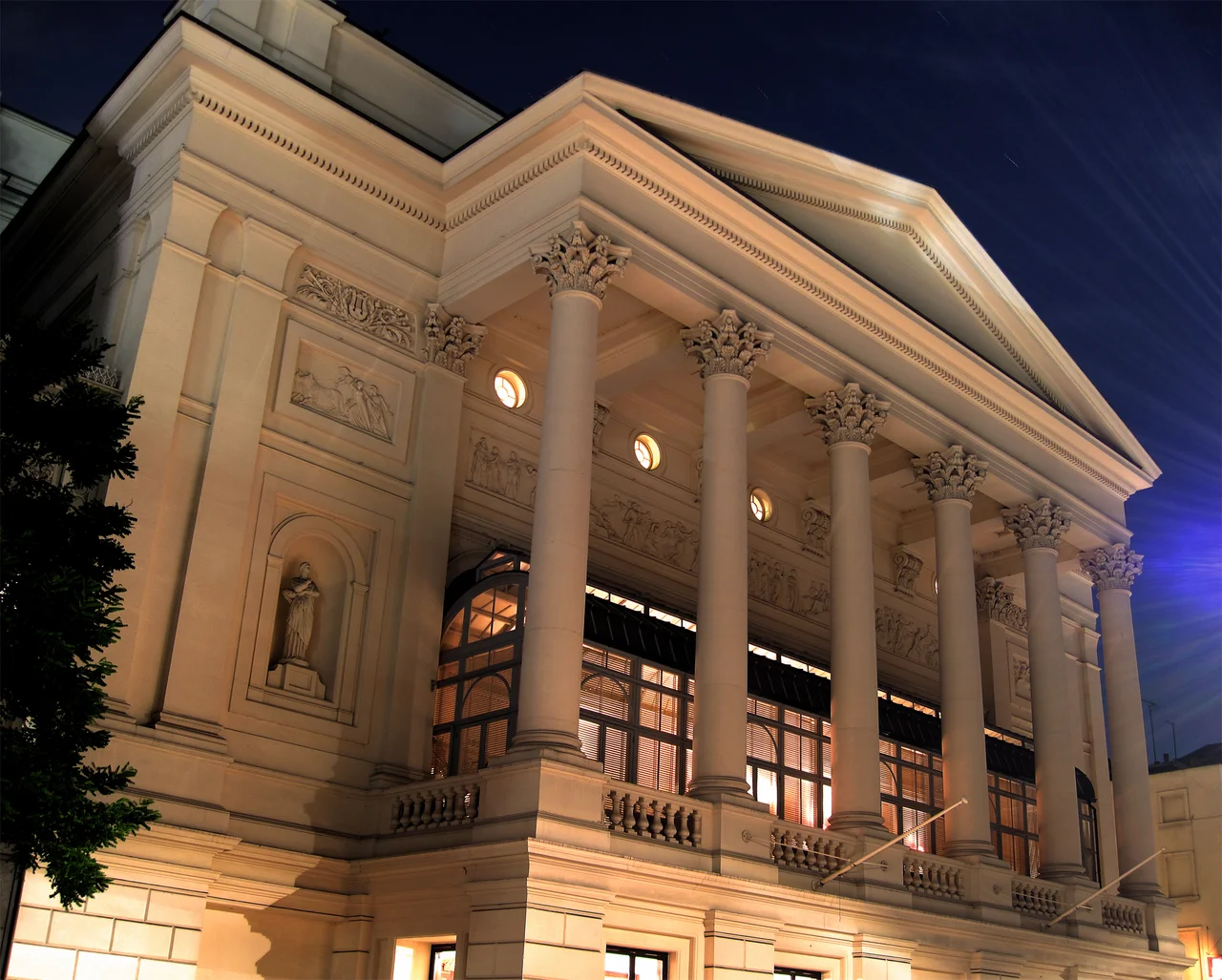

Royal Opera House
On 25 March 1833, Edmund Kean was playing Othello on the Covent Garden stage when he collapsed. Two months later, he was dead. Kean was already the most famous Shakespearean actor of his generation, a man who could empty London streets when he played Richard III. The role he died playing required him to murder Desdemona and then murder himself with a knife, and he never made it to the murder. The Royal Opera House is full of such stories because three different theatres have stood on this Covent Garden site since 1732, and two of them burned down. Handel premiered operas here. The first ballet in London was danced here. Queen Victoria sat with Napoleon III in a private box. A David Hockney portrait that hung on the wall for decades was sold to save the company during the pandemic. The current auditorium dates from 1858, the rest of the building from a 1990s reconstruction.
Handel and the Beggar's Opera
John Rich, actor-manager at Lincoln's Inn Fields Theatre, commissioned The Beggar's Opera from John Gay in 1728. The show was such a success that it gave him capital enough to build a new theatre on what had once been an ancient convent garden, near the piazza Inigo Jones had laid out in the 1630s. Edward Shepherd designed the building. It opened on 7 December 1732 with Rich himself carried in procession by his actors to inaugurate it with Congreve's The Way of the World. Two years later the stage hosted London's first ballet, a piece called Pygmalion. In 1735, George Frideric Handel began his first season of opera here. He gave regular seasons until his death in 1759, and many of his operas and oratorios premiered or first reached London at Covent Garden. When the theatre burned down on 20 September 1808, his bequeathed organ was among the lost.
Old Price Riots
The second theatre, designed by Robert Smirke, opened on 18 September 1809 with Macbeth. John Philip Kemble, the actor-manager, raised seat prices to recoup rebuilding costs and an increased ground rent from the Duke of Bedford. The audience refused to accept it. For over two months, performances were systematically disrupted by patrons beating sticks, hissing, booing, and dancing in the aisles. The Old Price Riots became one of the most sustained public protests in London theatre history, and the management finally surrendered to the audience's demands. This second theatre lit its stage by candles and oil lamps until 1817, when bare gaslight was installed. Then in 1837 William Macready introduced limelight here for the first time, using a block of quicklime heated by oxygen and hydrogen flame to throw spotlights on his performers.
From Italian Opera to Royal Opera
Joseph Grimaldi made his name on this stage as the great pantomime clown, introducing the pantomime dame and starting the tradition of audience singing. By 1821 the physical toll had ruined him; he could barely walk. By 1828 he was penniless. Drury Lane held a benefit concert for him after Covent Garden refused. After the 1856 fire, the third theatre by Edward Middleton Barry opened on 15 May 1858 with Meyerbeer's Les Huguenots. The company performed everything in Italian, even operas originally written in French or German, until 1892, when Gustav Mahler debuted Wagner's Ring cycle here and the word Italian was quietly dropped from the house's name. The Royal Opera House had arrived, with French and German repertoire and a new identity.
Lifting the Floral Hall
Between 1997 and 1999, the company reconstructed almost the entire site at a cost of two hundred and thirteen million pounds, under the chairmanship of Sir Angus Stirling, with Jeremy Dixon and Edward Jones leading the architecture. The horseshoe auditorium itself was kept, but more than half the complex was new. The most ambitious surgery happened next door. The cast-iron and glass Floral Hall, designed by Edward Middleton Barry in 1860 to house a flower market, had fallen into disuse and been used as a scenery store. The redevelopment lifted the entire cast-iron structure into the air to insert new public areas beneath. Its southern portico, no longer needed because the building now connected on that side, was dismantled and rebuilt at Borough Market, where it stands separately Grade II listed. Renamed the Paul Hamlyn Hall after a ten-million-pound donation from his estate, it is now the opera house's main public atrium.
Selling Hockney
In October 2020 the Royal Opera House announced it had lost sixty percent of its income to COVID-19 restrictions. To survive, the company put up for auction a 1971 David Hockney portrait of Sir David Webster, the general administrator who had rebuilt the company after the Second World War. The painting had hung in the opera house for decades. Christie's sold it for twelve point eight million pounds. Significant redundancies followed, public donations were solicited, and a Culture Recovery Fund loan was applied for. The institution survived. In 2024 the public branding shifted to Royal Ballet and Opera, reflecting the combined companies that share the building, although the building itself still carries the title Royal Opera House. The auditorium remains Grade I listed. The Linbury Studio Theatre below ground hosts experimental dance and music. Surtitles flash above the proscenium in any language the production requires.
From the Air
Coordinates 51.513°N, 0.123°W in Covent Garden, central London. From altitude the opera house is hard to pick out at street level, but the Covent Garden piazza forms an open rectangle just north-east of the building, with the curving roof of the iron-and-glass market hall visible. The Thames runs to the south. Look for the open green of Lincoln's Inn Fields to the north and the Strand running east-west just south of the site. Nearest airport: London City (EGLC) about 9 km east, London Heathrow (EGLL) 22 km west.
Nearby Stories
- Stevenage 5.7 km away
- Malling Abbey 5.7 km away
- 1952 Farnborough Airshow Crash 7.7 km away
- Ingatestone Hall 8.2 km away
- Hellfire Caves 9.1 km away
- The Carrington Event: The Solar Storm That Could Happen Again 9.8 km away
- Bletchley Park 16 km away
- Castle Hedingham 23 km away