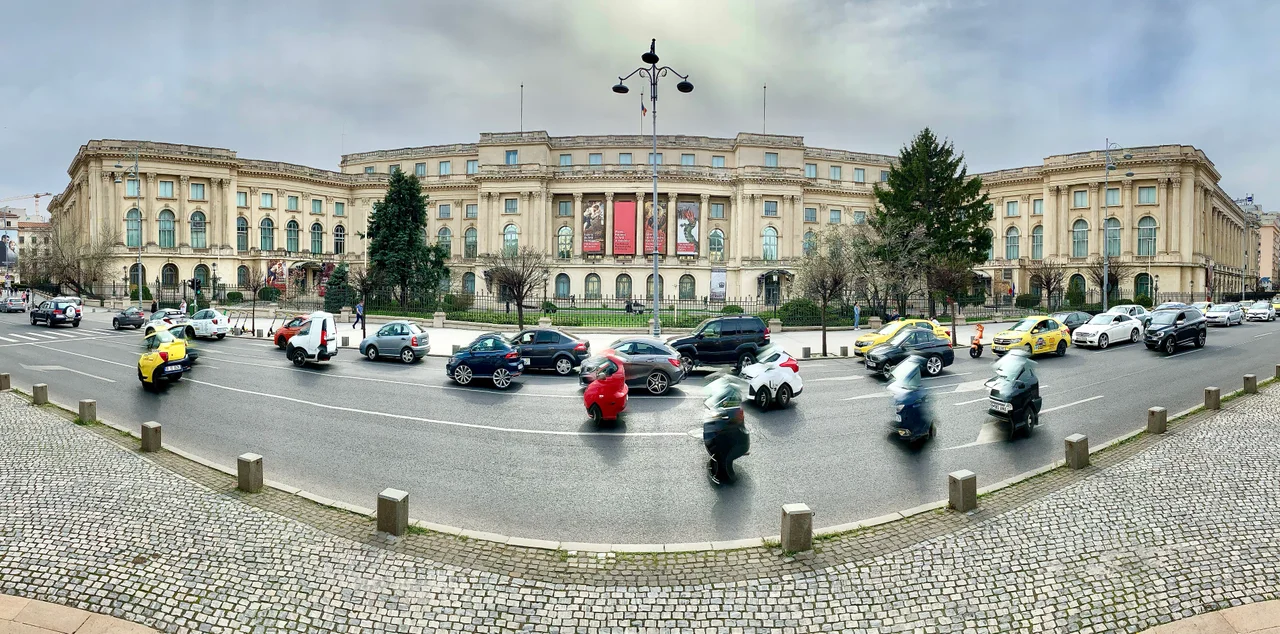
,_now_the_National_Museum_of_Art_of_Romania.jpg)
Royal Palace of Bucharest
King Michael I of Romania was twenty-six years old on 30 December 1947 when communist Prime Minister Petru Groza summoned him to the Palace of the Republic, as the building was about to be renamed, and presented him with an abdication document. Soviet troops surrounded Bucharest. The communist government had quietly arrested the palace guard. Michael signed. Within hours, the monarchy was abolished by parliamentary decree. The Royal Palace of Bucharest, where Romanian kings had lived and reigned since 1866, became state property. Three years later, the new regime turned it into the National Museum of Art of Romania, which is still its purpose today.
From Boyar to Hospodar
The story of the building begins between 1812 and 1815, when Dinicu Golescu, a Wallachian aristocrat with the rank of stolnic, built himself a Neoclassical mansion of twenty-five rooms on Calea Victoriei. It was unusually large for the Bucharest of that era. In 1837, the Golescu Mansion became the official residence of Alexandru II Ghica, Hospodar of Wallachia, putting the building on a track from private aristocrat's house to seat of state. From 1859 to 1866, Alexandru Ioan Cuza, the Domnitor who had unified the principalities of Wallachia and Moldavia into a single Romanian state, lived here. The building was already a palace by function before it was officially called one.
Carol I Arrives
In February 1866, a coalition of Liberals and Conservatives forced Cuza to abdicate. The new Romanian state needed a foreign prince, and the assembled politicians invited Karl of Hohenzollern-Sigmaringen, a German aristocrat with French and Russian royal connections, to take the throne. He arrived in Bucharest on 10 May 1866, taking the regnal name Carol I, and the aristocrats handed him the Golescu Mansion as state residence. Carol ruled for forty-eight years, transforming Romania from an Ottoman vassal principality into an independent kingdom. The palace expanded around him through successive renovations and expansions, becoming larger, more ornate, more imperial in scale.
The Bombardment
On 24 August 1944, the day after King Michael I led a coup that pulled Romania out of the Axis alliance, the German Luftwaffe retaliated with a heavy bombardment of central Bucharest. The Casa Noua, the new wing of the Royal Palace, was completely destroyed. The main palace was seriously damaged. Reconstruction during the postwar years preserved what could be saved, but the building that emerged was significantly altered from its prewar form. Ironically, the German bombs had set the stage for the communist takeover that would soon use the palace against the family that had rebuilt it.
The Long Exile
After abdicating in 1947, King Michael and his family went into exile in Switzerland and the United Kingdom. The new communist regime renamed the building the Palace of the Republic, removed royal symbols, and in 1950 installed the National Museum of Art there. The Throne Hall, the Royal Dining Room, the monumental Voivodes' Staircase, all were preserved as museum spaces but stripped of monarchic context. Michael was not allowed back into Romania until April 1992, more than two years after the December 1989 revolution that ended communist rule. He returned to a republic that politely declined to restore the monarchy but allowed him and his family to use Elisabeta Palace as their Bucharest residence.
Final Tribute
In December 2017, the funeral of King Michael I was held outside the Royal Palace where he had once lived as a king. Romanians who had grown up under communism and who had never lived under a monarchy turned out in numbers to mourn the last king of Romania. The catafalque rested in front of the Throne Hall, which had been carefully restored after 1989. The equestrian statue of Carol I, by the Croatian sculptor Ivan Mestrovic, stood at the center of the square outside, recently renamed Revolution Square in honor of the December 1989 uprising. The palace is now a museum, the monarchy is now a memory, and the building still stands at the heart of a city that has spent two centuries arguing about what kind of country to be.
From the Air
Located at 44.4393 N, 26.0959 E on Calea Victoriei in central Bucharest, on the eastern edge of Revolution Square. The building is a major landmark, recognizable by its scale and Neoclassical/eclectic architecture. Henri Coanda International Airport (LROP) lies 16 km north. Bucharest Baneasa (LRBS) is 8 km north. The Carpathian Mountains rise to the north.
Nearby Stories
- National Transport Museum, Bulgaria 34 km away
- Slanic Mine 68 km away
- Sinaia 79 km away
- Great Basilica, Pliska 87 km away
- Sinaia Monastery 108 km away
- Holy Forty Martyrs Church, Veliko Tarnovo 115 km away
- Shumen Fortress 126 km away
- Danube Delta 227 km away