
From Churchill's Shadow to the Sultan's Gold
An eight-foot bronze statue of Winston Churchill once stood in the heart of Bandar Seri Begawan, flashing his famous V sign from atop a granite pedestal inscribed with his own words: 'These are not dark days. They are great days.' The statue was a gift of genuine admiration. Sultan Omar Ali Saifuddien III, who had met Churchill only once during a visit to London, considered the British wartime leader a model of statesmanship and commissioned an entire building in his honor. When the Churchill Memorial Building opened in 1971, it was the only museum in the world dedicated solely to the man. Churchill's daughter, Mary Soames, attended the ceremony. Two decades later, the statue went into storage, the building was gutted and reimagined, and Churchill's memorial became a monument to something else entirely.
A Sultan's Tribute Transformed
The original building, constructed in 1965 as a crescent-shaped monument, served multiple purposes beyond honoring Churchill. It housed the Hassanal Bolkiah Aquarium, Brunei's historical and cultural center, the Department of Fisheries offices, and a lecture hall. The architecture was straightforwardly modernist, a two-story concrete structure that the New York Times in 1972 noted as part of a sultanate 'top-heavy with wealth.' By the early 1990s, Brunei had been independent for nearly a decade, and the impulse to honor a British prime minister had cooled. Renovations began in early 1992, taking eight months to complete. The transformation was timed for the Silver Jubilee of Sultan Hassanal Bolkiah, who had ruled as the 29th monarch for twenty-five years. When the Royal Regalia Building opened on 30 September 1992, Churchill's name was gone. In December 2017, the building was renamed once more to the Royal Regalia Museum, marking the Sultan's Golden Jubilee.
The Architecture of Authority
The 1992 renovation kept the original crescent footprint but wrapped it in a new architectural language that blends constructivist geometry with Melayu Islam Beraja, the national philosophy that fuses Malay culture, Islamic faith, and monarchical governance. The original 1960s walls, staircases, verandahs, and banisters were preserved and integrated into the expanded structure, creating a building that contains its own history in layers. The most striking addition is the dome, capped with golden flower mosaics called bunga putar that mirror patterns found in the Sultan's ceremonial dress. Rising from the dome, a 13.5-meter white spire takes the shape of a traditional umbrella, inspired by the Pemanjangan found in the Istana Nurul Iman. In Bruneian royal symbolism, the umbrella represents protection and vigilance. Below it, a semi-circular atrium connects old and new, and Black Assoluto granite flooring gives the interior galleries a weight that the original concrete never possessed.
Gold, Jewels, and a Golden Hand
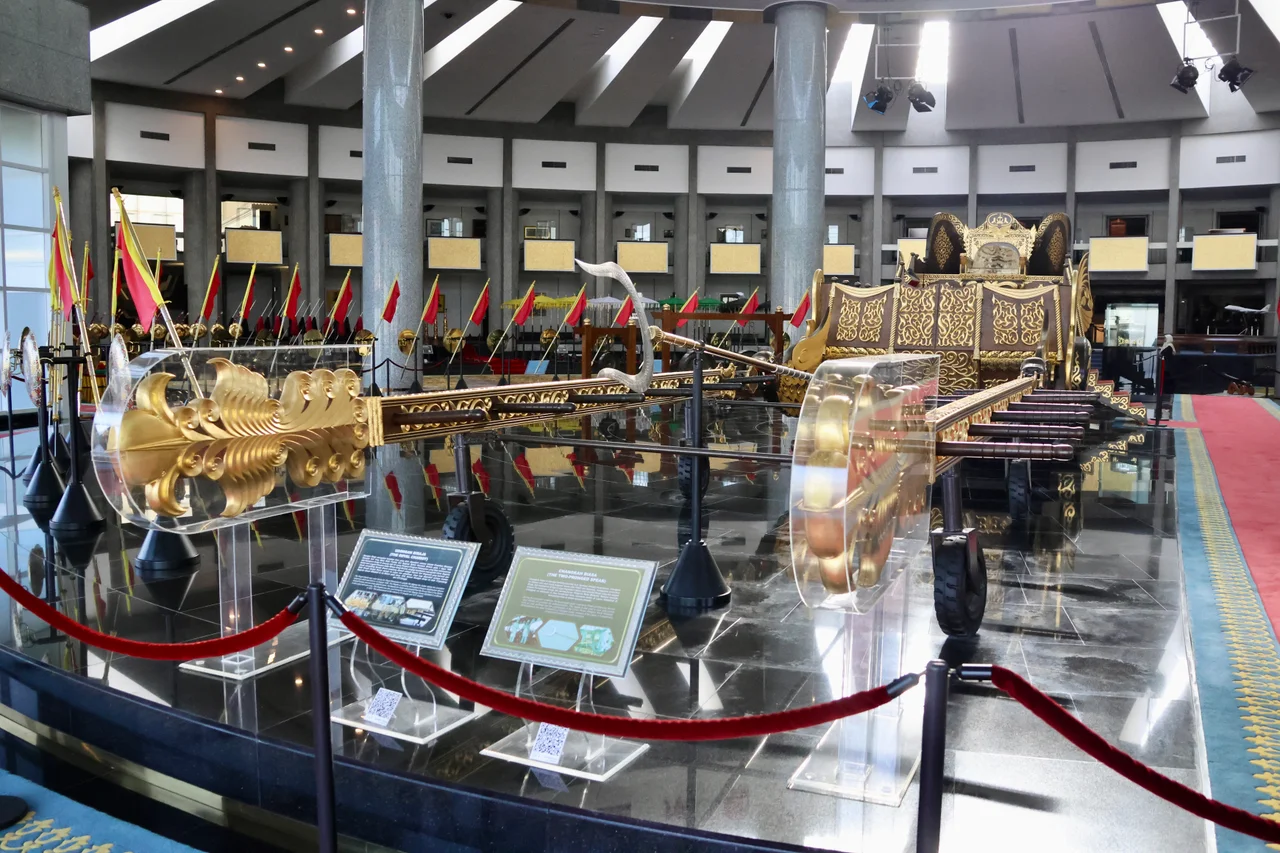
The exhibits within make the building's purpose unmistakable. The Royal Regalia Gallery displays the ceremonial objects used at Sultan Hassanal Bolkiah's 1968 coronation: gold and silver weaponry, jewel-encrusted crowns, and the elaborate costumes worn during the ceremony. The most unusual artifact is a golden hand and forearm, used by the Sultan as a chin rest during the coronation -- a practical solution to the physical endurance required by hours of ceremony, elevated to art by the goldsmith's craft. The Constitutional Gallery houses documents and treaties that trace Brunei's political evolution from a British protectorate to an independent state. Visitors remove their shoes before entering, a gesture of respect that transforms the act of viewing from tourism into something closer to a visit to someone's home. The Golden Jubilee Exhibition Gallery, added to mark fifty years of the Sultan's reign, uses contemporary LED lighting and large-format photography to document national milestones, projecting audio and video from Independence Day celebrations and the coronation itself.
What Churchill Left Behind
The bronze statue of Churchill has never been publicly displayed since its removal. Its fate is a small mystery in a small country -- stored somewhere, presumably, in a government warehouse in Bandar Seri Begawan. The transformation of his memorial into a celebration of Bruneian sovereignty is not a story of disrespect. Omar Ali Saifuddien III genuinely admired Churchill, and the memorial was built with sincerity. But nations change, and the symbols they choose to display in their capital cities change with them. Brunei gained independence from Britain in 1984, and the conversion of Churchill's building into a showcase of royal Malay identity eight years later was as much about a young nation finding its own voice as it was about a building needing a new purpose. Today the museum sits at the center of Bandar Seri Begawan, a short walk from the Omar Ali Saifuddien Mosque, and draws both domestic and international visitors. The crescent-shaped walls that once honored a British prime minister now hold the gold that honors a Bruneian sultan.
From the Air
Located at 4.893°N, 114.942°E in the heart of Bandar Seri Begawan, adjacent to Taman Haji Sir Muda Omar Ali Saifuddien park. Visible from 2,000-3,000 feet as part of the cluster of landmark buildings in the capital center, near the distinctive golden dome of the Omar Ali Saifuddien Mosque. Brunei International Airport (WBSB) is approximately 9 km northeast. The museum's dome is a useful orientation point when navigating the compact capital from the air.
Nearby Stories
- From Residency to Memory 28 km away
- Twenty Years on the Seattle Run 30 km away
- The Abode of Peace on Borrowed Coastline 31 km away
- USS Salute: The Minesweeper That Found the Last Mine 33 km away
- The Ants of Borneo 50 km away
- Sabah State Railway 55 km away
- Starcevich Monument 74 km away
- Luconia Shoals 209 km away